

Giao dịch
Khám phá đa dạng thị trường với mức giá cạnh tranh, thanh khoản sâu và các công cụ giao dịch tiên tiến.
Tìm hiểu thêm 
Nền tảng
Giao dịch mượt mà với nền tảng mạnh mẽ của TMGM, được xây dựng để đảm bảo tốc độ, độ chính xác và trải nghiệm giao dịch vượt trội.
Tìm hiểu thêm Nền tảng Giao dịch
Công cụ Giao dịch
Học viện
Học các kiến thức cơ bản về giao dịch với các tài nguyên thân thiện cho người mới bắt đầu, bao gồm hướng dẫn, hội thảo trực tuyến và nhận định thị trường.
Tìm hiểu thêm Học viện TMGM
Tin tức & Phân tích
Nhận cập nhật thị trường theo thời gian thực và phân tích chuyên gia để luôn dẫn đầu các cơ hội giao dịch
Tìm hiểu thêm Tin tức & Phân tích
Giới thiệu
Tìm hiểu điều gì làm nên sự khác biệt của TMGM — sự hiện diện toàn cầu, sức mạnh quy định và cam kết đổi mới trong giao dịch.
Tìm hiểu thêm Tại sao chọn TMGM
Silver Price Forecast: XAG/USD trades flat around $61.50, US data awaited
- Silver price wobbles near $61.45 ahead of the US PCE Inflation and the ADP Employment Change data.
- The US PCE Inflation is expected to have remained stick at 3.3% on an annualized basis in August.
- Economists expect US private sector to have hired 70K fresh workers in September.
Silver price (XAG/USD) trades in a tight range at around $61.45 during the European trading session on Wednesday. The white metal consolidates as investors await the United States (US) Personal Consumption Expenditure (PCE) Price Index data for August, which will be published at 12:30 GMT.

Investors will pay close attention to the US PCE inflation data as Federal Reserve (Fed) officials have explicitly stated that higher price pressures are a key concern for them. Fed policymakers have also stated that inflationary pressures are driven by both energy supply shocks and Artificial Intelligence (AI)-driven strong demand.
The core PCE inflation, which is closely tracked by Fed officials, is expected to have remained steady at 3.3% Year-on-Year (YoY), with monthly figures growing at a faster pace of 0.3% against the previous reading of 0.2%.
The inflation data is expected to have a significant influence on Fed’s interest rate expectations. Meanwhile, financial markets are confident that the Fed will extend its monetary-tightening cycle further in the remainder of the year.
Fed October hike seen as increasingly likely by TD Securities
According to TD Securities, “an October hike is looking more likely,” with the bank arguing that the Fed will be “unlikely to regain its confidence in inflation progress before the October meeting.” With “most participants expecting further tightening,” TD’s economists contend that “it does not make sense to wait until December to hike again,” reinforcing their view that the policy bias remains firmly skewed toward additional near-term tightening.
Higher interest rates by the Fed bode well for interest-bearing assets, such as Treasury Yields, but poorly for non-yielding assets, like Silver.
Just before the US PCE inflation data release, investors will focus on the ADP Employment Change data for September. The data is expected to show that the private sector created 70K fresh jobs, higher than 38K in August.
This week, the major catalyst for Fed’s interest rate expectations would be the Nonfarm Payrolls (NFP) data for September, which will be released on Friday.
Silver Technical Analysis
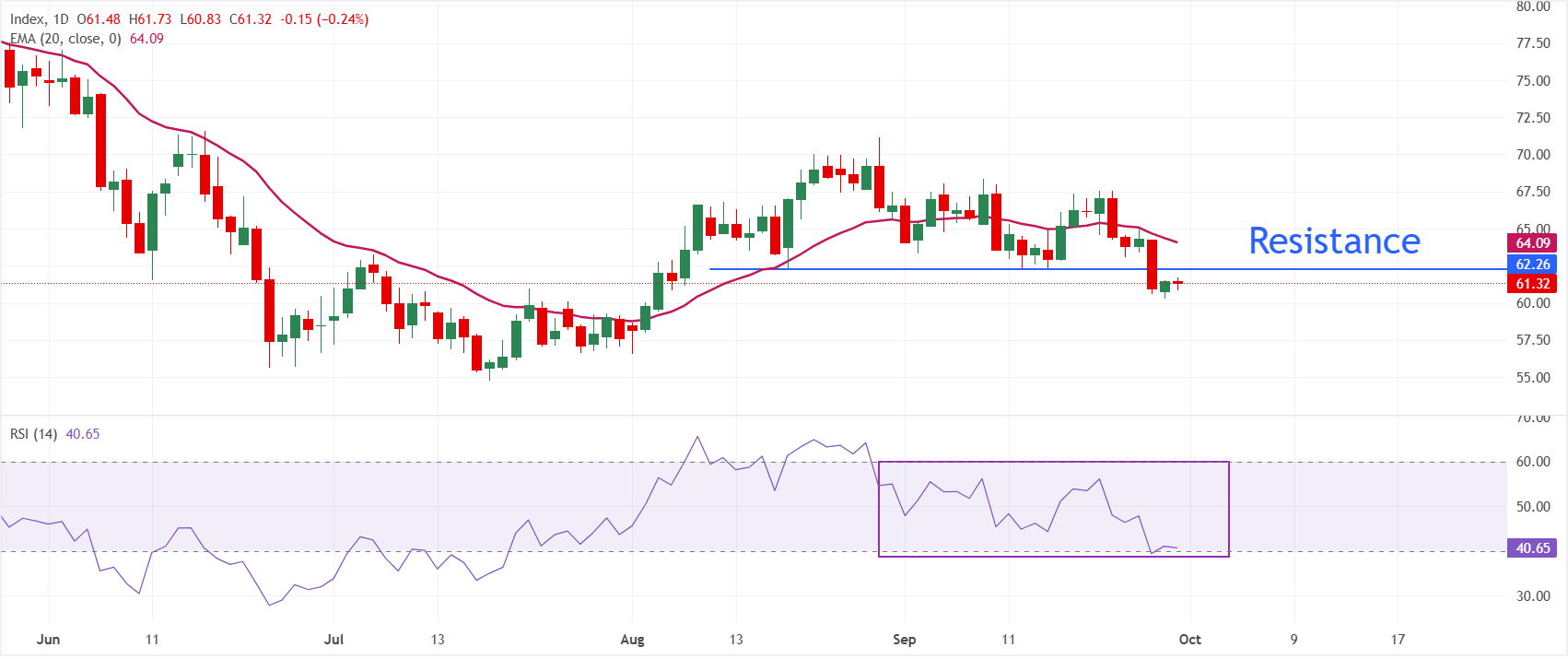
In the daily chart, XAG/USD trades at $61.32, maintaining a bearish near-term tone as it holds below the 20-period exponential moving average (EMA) at $64.09. The price trading under this key trend reference hints that recent strength has faded, while the Relative Strength Index (14) at 40.66 remains in neutral-to-weak territory, suggesting sellers still have the upper hand but without outright oversold conditions.
On the topside, immediate resistance is located at $62.26, followed by the 20-day EMA near $64.09, where any recovery is likely to face supply and where a sustained break would be needed to ease the current downside bias. On the downside, the psychological level of $60 is the key support level.
(The technical analysis of this story was written with the help of an AI tool. Know more.)
Silver FAQs
Silver is a precious metal highly traded among investors. It has been historically used as a store of value and a medium of exchange. Although less popular than Gold, traders may turn to Silver to diversify their investment portfolio, for its intrinsic value or as a potential hedge during high-inflation periods. Investors can buy physical Silver, in coins or in bars, or trade it through vehicles such as Exchange Traded Funds, which track its price on international markets.
Silver prices can move due to a wide range of factors. Geopolitical instability or fears of a deep recession can make Silver price escalate due to its safe-haven status, although to a lesser extent than Gold's. As a yieldless asset, Silver tends to rise with lower interest rates. Its moves also depend on how the US Dollar (USD) behaves as the asset is priced in dollars (XAG/USD). A strong Dollar tends to keep the price of Silver at bay, whereas a weaker Dollar is likely to propel prices up. Other factors such as investment demand, mining supply – Silver is much more abundant than Gold – and recycling rates can also affect prices.
Silver is widely used in industry, particularly in sectors such as electronics or solar energy, as it has one of the highest electric conductivity of all metals – more than Copper and Gold. A surge in demand can increase prices, while a decline tends to lower them. Dynamics in the US, Chinese and Indian economies can also contribute to price swings: for the US and particularly China, their big industrial sectors use Silver in various processes; in India, consumers’ demand for the precious metal for jewellery also plays a key role in setting prices.
Silver prices tend to follow Gold's moves. When Gold prices rise, Silver typically follows suit, as their status as safe-haven assets is similar. The Gold/Silver ratio, which shows the number of ounces of Silver needed to equal the value of one ounce of Gold, may help to determine the relative valuation between both metals. Some investors may consider a high ratio as an indicator that Silver is undervalued, or Gold is overvalued. On the contrary, a low ratio might suggest that Gold is undervalued relative to Silver.
BÀI VIẾT PHỔ BIẾN
1Euro: EUR/USD Bearish risks toward 1.10 – ING2Swiss Franc edges up from yearly lows despite tepid Economic Expectations data3Bitcoin Price Forecast: BTC consolidates below $85,000 amid rising US Treasury yields, derivatives deleveraging4WTI Price Forecast: Sticks to recovery gains below $89.00; lacks bullish conviction5Dow Jones futures advance as Fed rate hike expectations cool6US Dollar: Fragile strength hinges on Fed – Commerzbank7US Dollar Index Price Forecast: Possibility of breakout above 101.80 hinges on US data8USD/JPY: Yen carry risks build into Q4 – Rabobank9ADP Employment Report expected to confirm a tight labour market in September
GIÁ TRỰC TIẾP


Bắt đầu ngay!
Đăng ký và truy cập Thị trường Toàn cầu trong vòng chưa đầy 3 phút

Kết nối với chúng tôi









Liên hệ
Điện thoại: +61 2 8036 8388
Fax: +61 2 8036 8388
Email: support@tmgm.com
Website: https://www.tmg-max.com



Thông tin được cung cấp trên trang web này chỉ mang tính chất chung và không cấu thành lời khuyên tài chính cá nhân. Trước khi hành động dựa trên bất kỳ thông tin nào trên trang web này, bạn nên cân nhắc mức độ phù hợp của thông tin đó với mục tiêu, tình hình tài chính và nhu cầu của mình. Đầu tư vào CFD và Hợp đồng Ký quỹ FX tiềm ẩn rủi ro đáng kể và không phù hợp với tất cả nhà đầu tư. Bạn có thể mất nhiều hơn khoản tiền nạp ban đầu của mình. Bạn không sở hữu hoặc có bất kỳ quyền lợi nào đối với tài sản cơ sở. Chúng tôi khuyến nghị bạn tìm kiếm tư vấn độc lập và đảm bảo rằng bạn hiểu đầy đủ các rủi ro liên quan trước khi giao dịch. Điều quan trọng là bạn phải đọc và cân nhắc tài liệu công bố thông tin trước khi mua bất kỳ sản phẩm nào được liệt kê trên trang web. Thông tin và quảng cáo được cung cấp trên trang web này không nhằm mục đích sử dụng bởi bất kỳ cá nhân nào tại bất kỳ quốc gia hoặc khu vực pháp lý nào mà việc sử dụng đó sẽ trái với luật pháp và quy định địa phương. Các Sản phẩm và Dịch vụ được cung cấp trên trang web này không dành cho cư dân Hoa Kỳ, Malaysia và Thái Lan.
TMGM được ủy quyền và quản lý tại nhiều khu vực pháp lý khác nhau.
Trademax Australia Limited, giao dịch dưới tên TMGM, được quản lý bởi Ủy ban Chứng khoán và Đầu tư Úc (ASIC), AFSL số 436416 và có trụ sở tại Tầng 28, One International Tower, 100 Barangaroo Avenue, 2000 Sydney, NSW Australia.
Email: support@tmgm.com.au
Trademax Global Limited, giao dịch dưới tên TMGM, được ủy quyền và quản lý bởi Ủy ban Dịch vụ Tài chính Vanuatu (VFSC), số đăng ký 40356 và được đăng ký tại 1276, Kumul Highway, Port Vila, Vanuatu, Cộng hòa Vanuatu.
Email: support@tmgm.com
Trademax Global Markets (SE) Limited, hoạt động dưới tên TMGM, được ủy quyền và điều chỉnh bởi Cơ quan Dịch vụ Tài chính (FSA) của Seychelles, với số giấy phép SD224. Công ty đăng ký tại Văn phòng số 13, Providence Estate ABIS Centre, Mahe, Seychelles.
Email: support@tmgm.com
Trademax Global Markets (International) Pty Ltd, giao dịch dưới tên TMGM, được ủy quyền và quản lý bởi Ủy ban Dịch vụ Tài chính, Mauritius (FSC) với giấy phép số GB22201012, và được đăng ký tại 33, Edith Cavell Street C/o IQ EQ Fund Services (Mauritius) Ltd Port Louis, 11324 Mauritius.
Email: support@tmgm.com
Bản quyền © TMGM. Tất cả quyền được bảo lưu