
News & AnalysisCareer

A fresh seven-month low of 0.6862 was recorded by AUD/USD during Friday’s European session, as the Australian Dollar (AUD) came under heavy selling pressure against the US Dollar (USD).
Behind the pair’s sharp decline is the US Dollar’s outperformance: a worldwide sell-off in Artificial Intelligence (AI) infrastructure shares has boosted demand for safe-haven assets.

Today’s percentage moves in the US Dollar (USD) against the major currencies listed are set out below. Its largest gain was against the New Zealand Dollar.
| USD | EUR | GBP | JPY | CAD | AUD | NZD | CHF | |
|---|---|---|---|---|---|---|---|---|
| USD | 0.36% | 0.38% | 0.30% | 0.36% | 0.85% | 0.91% | 0.15% | |
| EUR | -0.36% | 0.02% | -0.07% | 0.00% | 0.50% | 0.56% | -0.21% | |
| GBP | -0.38% | -0.02% | -0.06% | -0.02% | 0.48% | 0.54% | -0.23% | |
| JPY | -0.30% | 0.07% | 0.06% | 0.07% | 0.56% | 0.61% | -0.15% | |
| CAD | -0.36% | -0.00% | 0.02% | -0.07% | 0.49% | 0.54% | -0.22% | |
| AUD | -0.85% | -0.50% | -0.48% | -0.56% | -0.49% | 0.05% | -0.70% | |
| NZD | -0.91% | -0.56% | -0.54% | -0.61% | -0.54% | -0.05% | -0.74% | |
| CHF | -0.15% | 0.21% | 0.23% | 0.15% | 0.22% | 0.70% | 0.74% |
Percentage movements between the major currencies are displayed in the heat map. Select the base currency in the left-hand column and the quote currency in the top row. Selecting the US Dollar on the left and following its row across to the Japanese Yen, for instance, gives the percentage change for USD (base)/JPY (quote) in the corresponding cell.
At the time of writing, a gain of 0.42% takes the US Dollar Index (DXY) to around 102.00. The index measures the Greenback against six major currencies.
Despite tighter US financial conditions, the dollar has shown resilience, according to MUFG analysts. They describe how the “spillover impact from the AI-related equity market sell-off into the foreign exchange market has remained surprisingly modest so far.” Nevertheless, they say the episode “has resulted in the dollar index reversing all of its initial losses since the US mid-term election results were announced,” highlighting that resilience.
Following Wednesday’s US midterm election outcome, which gave Democrats a majority in both the House and the Senate, the USD Index dropped to a new monthly low around 101.00.
In MUFG’s assessment, “US dollar strength this year has been supported by higher energy prices and record foreign demand for riskier US assets.” The bank nevertheless cautions that “if both these drivers continue to reverse, it would increase the likelihood of the US dollar weakening,” especially should appetite for US assets deteriorate further. It also warns that “if financial conditions continue to tighten it could make it less likely that the Federal Reserve (Fed) will hike again in December as planned thereby adding to downside risks for the US Dollar.”
Due at 13:30 GMT, October’s US Nonfarm Payrolls (NFP) figures are the next release investors are watching for further guidance on the Fed’s monetary policy outlook.
Forecasts for the US NFP report point to 65K new jobs, up from September’s 29K, alongside an unchanged Unemployment Rate of 4.2%.
For the Australian Dollar, attention centres on further indications of whether the Reserve Bank of Australia (RBA) will raise interest rates again this year. Five quarter-percentage-point increases so far in 2026 have taken the Official Cash Rate (OCR) to 4.85%.
Although the RBA raised rates this week, its accompanying communication suggested reluctance to tighten further. RBA Governor Michele Bullock said, “Voters favoring pause perceived greater downside risks,” and added, “Those favoring a hold wanted to wait longer for data.” She also said, “Not definitely hiking rates again, preserving options.”
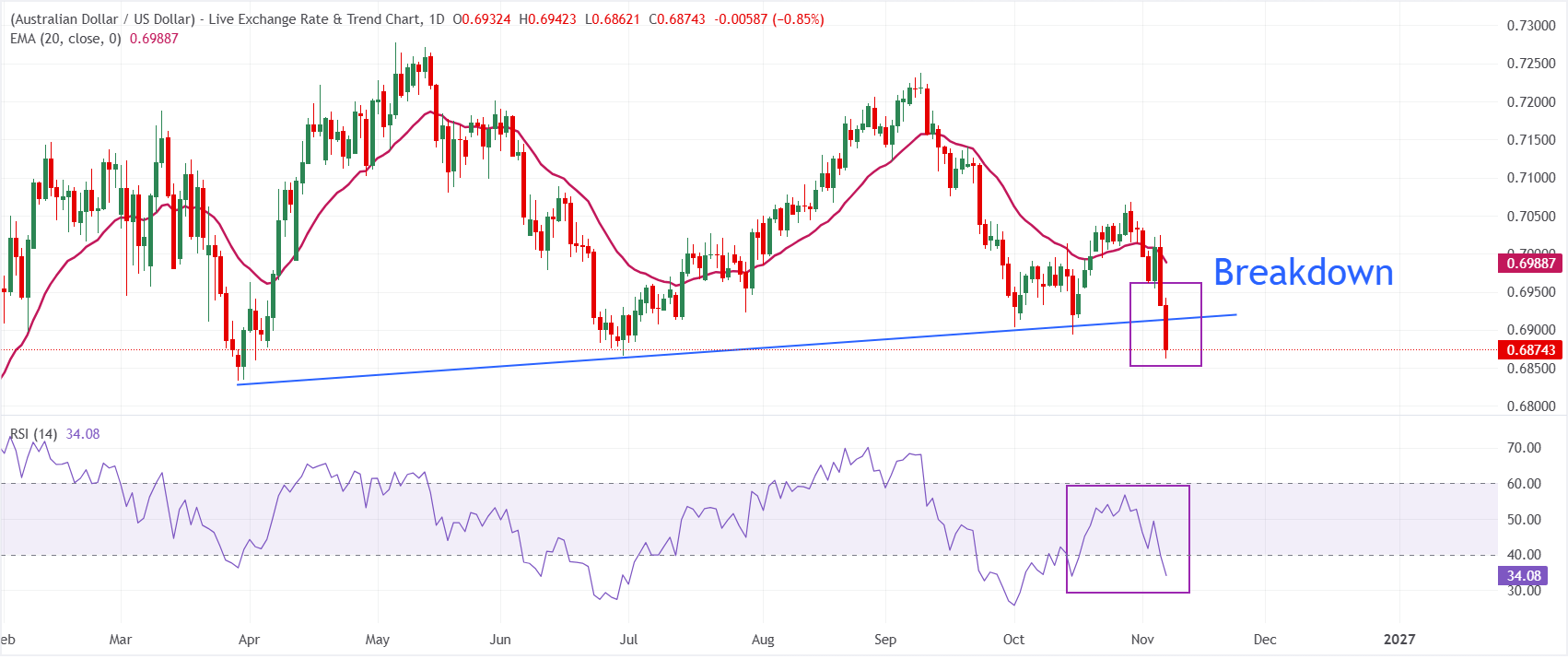
Trading at 0.6874 on the daily chart, AUD/USD retains a bearish short-term outlook. Both the 20-period exponential moving average (EMA) at 0.6989 and former trend-line support, now resistance near 0.6913, continue to cap the spot price. With the pair below these important overhead levels, pressure persists. A Relative Strength Index (14) reading of 34 points to subdued, though not extreme, bearish momentum, suggesting sellers remain in control despite the recent loss of pace.
The broken rising trend line near 0.6913 provides the first resistance, ahead of the 20-day EMA at 0.6989. While that average remains above the price, it reinforces the wider bearish structure. Nearby structural support lies at the earlier trend-line anchor around 0.6828. A clear breach of this level would pave the way for additional declines; holding above it would indicate only consolidation within a market that remains capped overall.
(The technical analysis of this story was written with the help of an AI tool. Know more.)
Published by the US Bureau of Labor Statistics (BLS), Nonfarm Payrolls reports how many new jobs were created across US non-agricultural businesses in the preceding month. Monthly payroll changes can fluctuate sharply, and substantial revisions to the figures can themselves generate volatility in foreign exchange markets. A strong reading is generally considered positive for the US Dollar (USD), whereas a weak result is viewed as negative. However, revisions to earlier months and the Unemployment Rate carry as much relevance as the headline number. How markets interpret the full set of data in the BLS report therefore determines their response.
Find out more.Next publication: Fri 06 Nov 2026 13:30
Release frequency: Monthly
Consensus forecast: 65K
Previous reading: 29K
Data source: US Bureau of Labor Statistics
The monthly change in US employment is closely linked to the economy’s overall performance, making America’s jobs report what is regarded as the most important economic indicator for forex traders. Policymakers closely track the report, which is published on the first Friday after the month it covers. With full employment among its mandates, the Federal Reserve takes labour market developments into account when setting policy, with consequences for currencies. Although several leading indicators inform forecasts, Nonfarm Payrolls often catch markets by surprise, prompting substantial volatility. A reading above the consensus forecast tends to support the USD.







Phone: +61 2 8036 8388
Fax: +61 2 8036 8388
Email: support@tmgm.com



The information provided on this website is of a general nature only and does not constitute personal financial advice. Before acting on any information on this website, you should consider the suitability of the information in relation to your objectives, financial situation and needs. Investing in CFDs and FX Margin Contracts carries significant risks and is not suitable for all investors. You may lose more than your initial deposit. You do not own, or have, any interest in the underlying asset. We recommend that you seek independent advice and ensure you fully understand the risks involved before trading. It is important that you read and consider the disclosure document before you acquire any product listed on the website. The information and advertisements offered on this website are not intended for use by any person in any country or jurisdiction where such use would be contrary to local laws and regulations. The Products and Services offered on this website are not intended for residents of the United States, Malaysia and Thailand.
TMGM is authorized and regulated in various jurisdictions.
Trademax Australia Limited, trading as TMGM, is regulated by the Australian Securities and Investments Commission (ASIC), AFSL no. 436416 and is located at Level 28, One International Tower, 100 Barangaroo Avenue, 2000 Sydney, NSW Australia.
Email: support@tmgm.com.au
Trademax Global Limited, trading as TMGM, is authorized and regulated by the Vanuatu Financial Services Commission (VFSC), registration number 40356 and registered at 1276, Kumul Highway, Port Vila, Vanuatu, Republic of Vanuatu.
Email: support@tmgm.com
Trademax Global Markets (SE) Limited, trading as TMGM, is authorized and regulated by the Financial Services Authority (FSA) of Seychelles, with license number SD224. The company is registered at Office No 13, Providence Estate ABIS Centre, Mahe, Seychelles.
Email: support@tmgm.com
Trademax Global Markets (International) Pty Ltd, trading as TMGM, is authorized and regulated by the Financial Services Commission, Mauritius (FSC) with license no. GB22201012, and registered at 33, Edith Cavell Street C/o IQ EQ Fund Services (Mauritius) Ltd Port Louis, 11324 Mauritius.
Email: support@tmgm.com
Copyright © TMGM. All rights reserved


