
News & AnalysisCareer

Across the last 22 US midterm elections, the ruling party has added House seats only twice, while the three most recent contests coincided with Bitcoin’s bear-market lows. Congressional elections have historically been unfavourable for both the president’s party and Bitcoin. Now, just a week after the $6 billion hack from Binance, Bitcoin (BTC) is preparing for the impact of the next US midterms.

Ahead of the next vote on Tuesday, 3 November, the wider crypto market is weighing the question: “Will Bitcoin extend its losses after the elections?”
Corrections in Bitcoin’s price have historically accompanied US midterm elections. Following the November 2022 vote, BTC took just 13 days to reach its 2022 bear-market low of $15,476. After the 2018 and 2014 elections, the respective lows of $3,156 and $171 arrived within 39 days and 71 days.
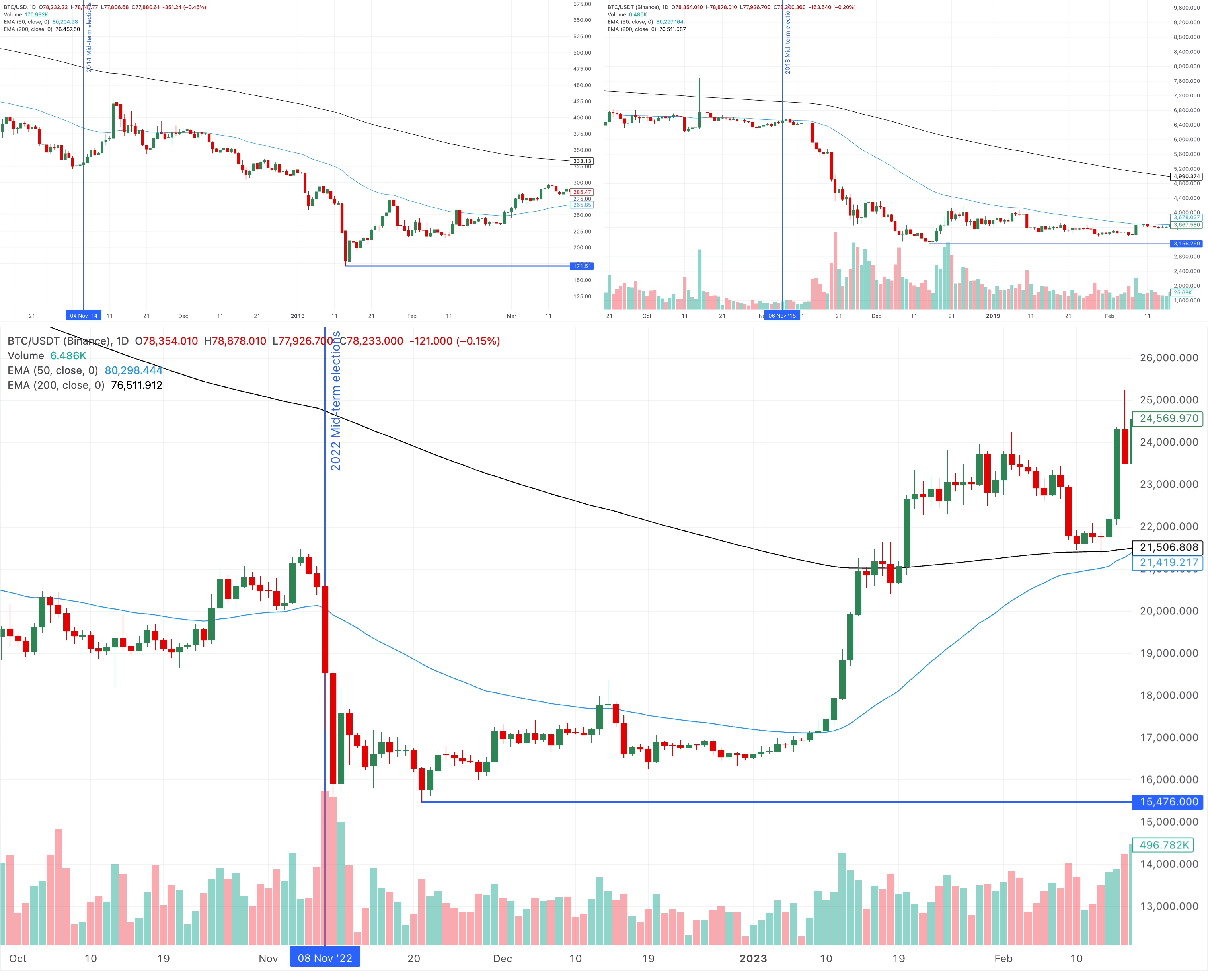
As FXStreet previously explained, the pullback towards the end of midterm years fits Bitcoin’s four-year cycle. US presidential elections occur alongside Bitcoin halvings, placing the November midterm vote in the middle of BTC’s four-year cycle. Historically, this is when the market has been nearing or reaching a cyclical bear-market low.
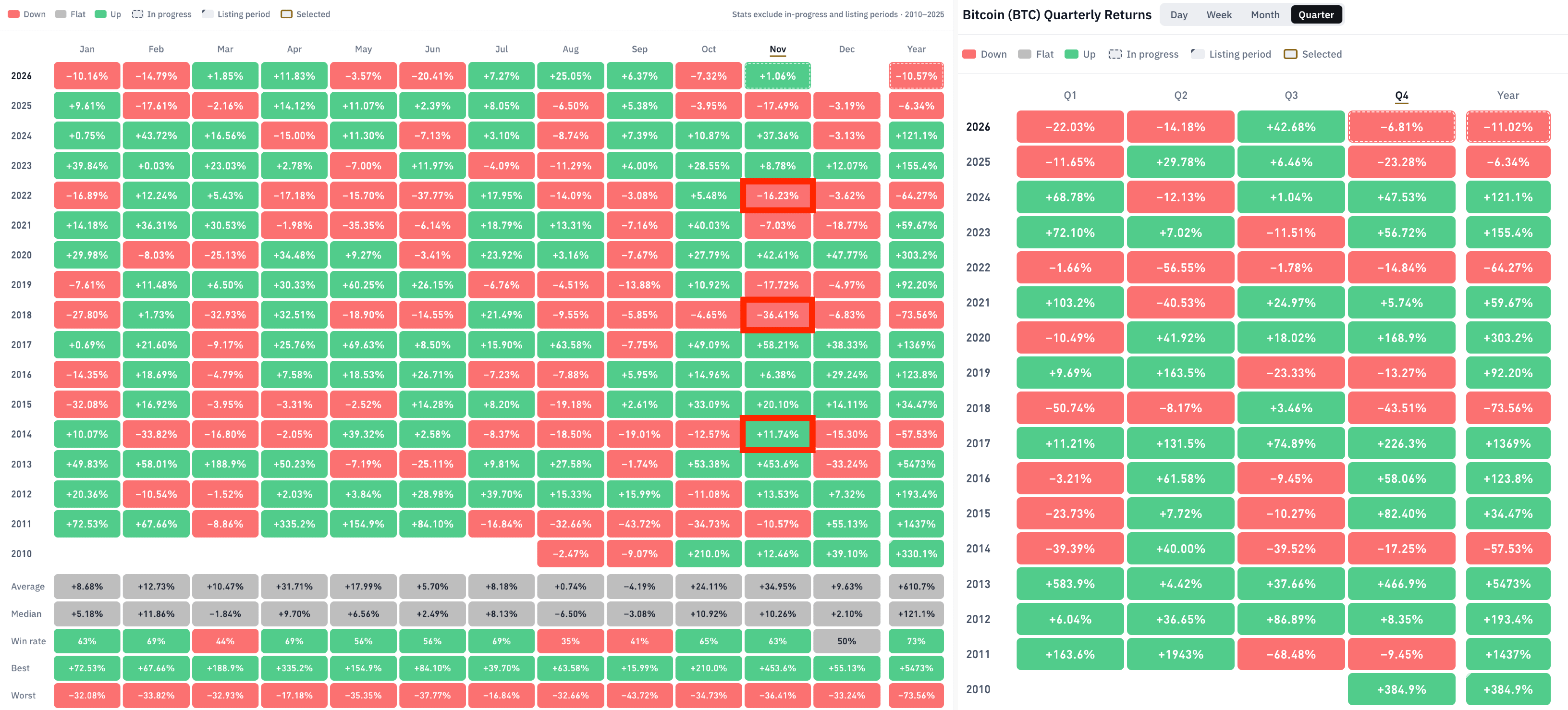
The final quarter has also proved difficult for Bitcoin in US midterm election years. Although CoinGlass data puts Bitcoin’s average November gain at 34%, the midterm votes in 2022 and 2018 were accompanied by November declines of 16% and 36%, respectively. December then brought further losses of 3% and 6%, leaving the final quarter down 14% and 43%.
By contrast, November 2014 delivered an 11% gain during the midterm election period. A subsequent 15% fall in December left Bitcoin with a net loss of 17% over the final three months.
A repeat of the historical cycle could bring a steep Bitcoin correction by the end of 2026, putting the annual low of $57,800 back in sight. Yet the shrinking interval between election day and bear-market lows also points to the possibility of a swift recovery, which could contain the downside.
Without institutional inflows, Bitcoin has generally faced bearish conditions around the November elections. The presence of Bitcoin spot exchange-traded funds (ETFs), however, could alter that pattern this year.
As of 30 October, total net assets held by Bitcoin ETFs stand at $98 billion, compared with a peak of $152 billion in July 2025. Inflows into these funds have been a major influence on Bitcoin’s spot price since their launch in January 2024.
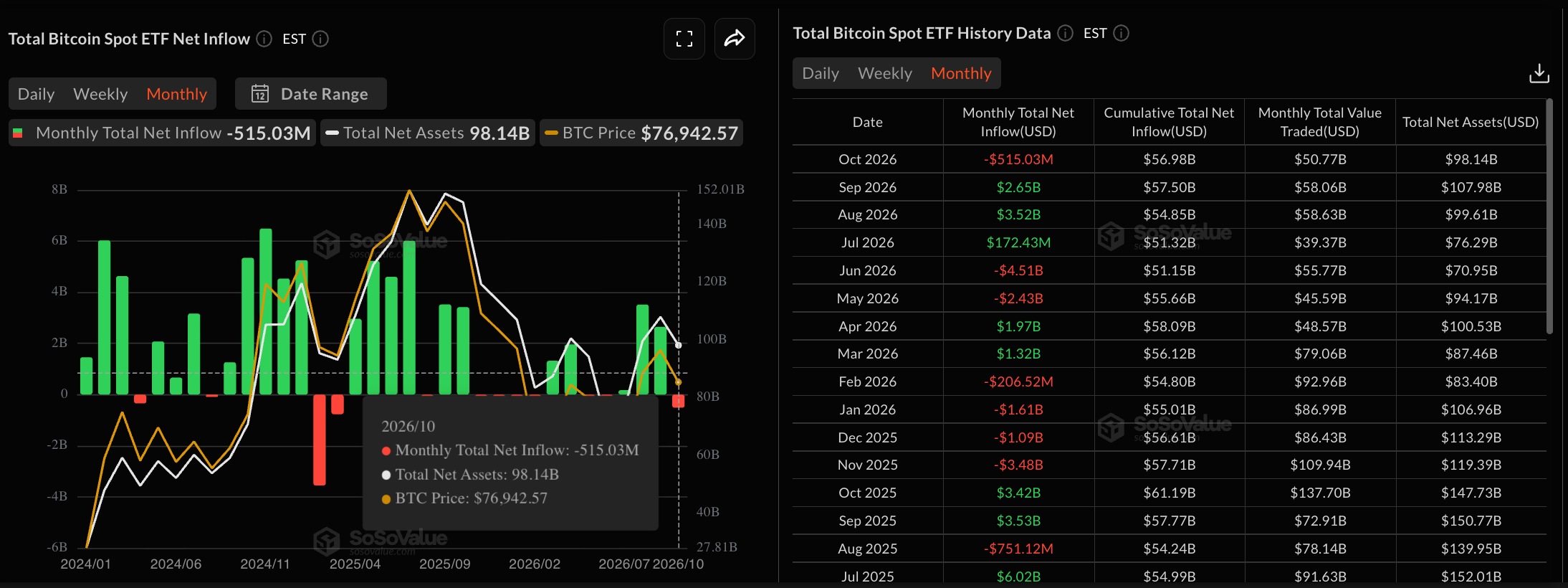
Should Bitcoin spot ETFs attract inflows in November and December, they could cushion the impact of a change in control of the US Senate and the House of Representatives.
In US politics, the midterm curse appears likely to endure. Kalshi’s midterm forecast data gives the Democratic Party a strong chance of winning control of both chambers of Congress, assigning a 94% probability to a Democratic majority in the House and a 74% probability in the Senate.

For Bitcoin, however, institutional inflows will determine the bearish impact. Holding the crucial 200-day Exponential Moving Average (EMA) baseline at $76,459 will be the ultimate test of whether the leading digital asset has finally escaped its midterm curse. A break below that support could send Bitcoin back to its annual low of $57,800, or lower.







Phone: +61 2 8036 8388
Fax: +61 2 8036 8388
Email: support@tmgm.com



The information provided on this website is of a general nature only and does not constitute personal financial advice. Before acting on any information on this website, you should consider the suitability of the information in relation to your objectives, financial situation and needs. Investing in CFDs and FX Margin Contracts carries significant risks and is not suitable for all investors. You may lose more than your initial deposit. You do not own, or have, any interest in the underlying asset. We recommend that you seek independent advice and ensure you fully understand the risks involved before trading. It is important that you read and consider the disclosure document before you acquire any product listed on the website. The information and advertisements offered on this website are not intended for use by any person in any country or jurisdiction where such use would be contrary to local laws and regulations. The Products and Services offered on this website are not intended for residents of the United States, Malaysia and Thailand.
TMGM is authorized and regulated in various jurisdictions.
Trademax Australia Limited, trading as TMGM, is regulated by the Australian Securities and Investments Commission (ASIC), AFSL no. 436416 and is located at Level 28, One International Tower, 100 Barangaroo Avenue, 2000 Sydney, NSW Australia.
Email: support@tmgm.com.au
Trademax Global Limited, trading as TMGM, is authorized and regulated by the Vanuatu Financial Services Commission (VFSC), registration number 40356 and registered at 1276, Kumul Highway, Port Vila, Vanuatu, Republic of Vanuatu.
Email: support@tmgm.com
Trademax Global Markets (SE) Limited, trading as TMGM, is authorized and regulated by the Financial Services Authority (FSA) of Seychelles, with license number SD224. The company is registered at Office No 13, Providence Estate ABIS Centre, Mahe, Seychelles.
Email: support@tmgm.com
Trademax Global Markets (International) Pty Ltd, trading as TMGM, is authorized and regulated by the Financial Services Commission, Mauritius (FSC) with license no. GB22201012, and registered at 33, Edith Cavell Street C/o IQ EQ Fund Services (Mauritius) Ltd Port Louis, 11324 Mauritius.
Email: support@tmgm.com
Copyright © TMGM. All rights reserved

