
News & AnalysisCareer

More than $202 million left spot exchange-traded funds (ETFs) last week, signalling softer institutional demand as Bitcoin (BTC) trades below $78,000 at the time of writing on Monday following its fourth consecutive weekly decline. Meanwhile, the repercussions of last week’s Binance security breach continue to undermine trader sentiment, holding back the leading cryptocurrency’s recovery attempts.

Net outflows from BTC spot ETFs reached $202.59 million last week, according to SoSoValue data. The figures underline fading investor appetite and signs of weaker institutional demand for Bitcoin.
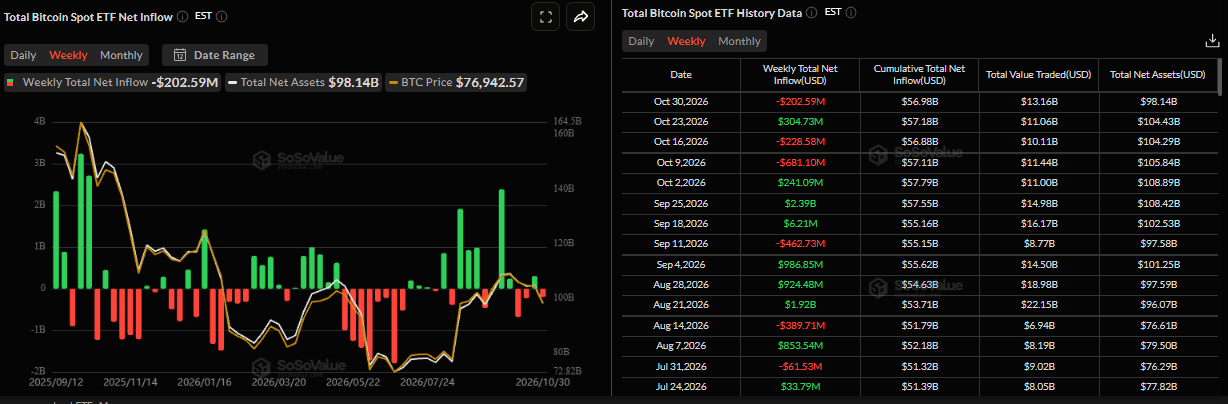
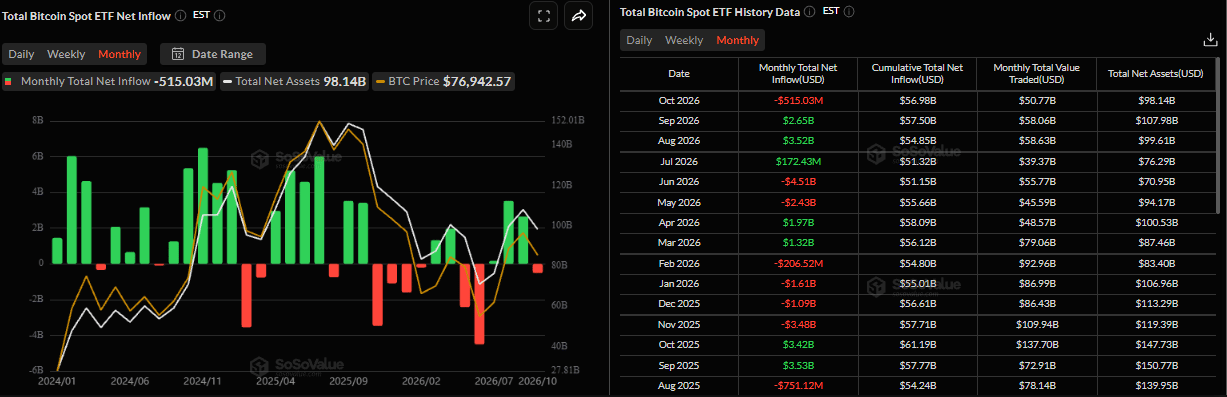
The monthly figures also point to a reversal: October brought net outflows of $515.03 million from spot ETFs, bringing three consecutive months of net inflows to an end.
Should withdrawals continue at this pace or accelerate, further selling pressure could leave Bitcoin facing a more pronounced correction.
An estimated $6.3 billion was stolen across ten blockchains in a major security breach at Binance last Thursday. Binance is the largest centralised cryptocurrency exchange.
In a statement on Friday, the exchange said, “It will cover all losses from the Secure Asset Fund for Users (SAFU) fund and the company’s funds. User funds are safe.” It added that its team was carrying out security checks, with withdrawals set to restart once the problem had been fully resolved.
As operations resumed on Sunday, Binance customers withdrew $3.64 billion, or 2.1% of the exchange’s assets, Reuters reported. The withdrawals followed the theft of billions from the platform by hackers linked by the FBI to North Korea.
Following an initial surge on Sunday, withdrawals were stabilising, according to Binance, while deposit volumes remained “substantial.” Binance added that 95% of the $6.3 billion in stolen assets had been recovered or secured.
The transfer of stolen funds nevertheless remains a concern. On Monday, Wu Blockchain confirmed that approximately $242 million had been moved by the attacker through Tron-related channels within two days. By contrast, more than $3 billion in stolen assets across other blockchains remained largely untouched.
A QCP Capital analyst also said the attacker continued to hold the stolen Bitcoin and had begun dividing it into batches of 1,000 BTC and 100 BTC.
Investors remain cautious in light of the breach’s scale, sizeable customer withdrawals and the ongoing transfer of stolen funds, constraining Bitcoin’s recovery.
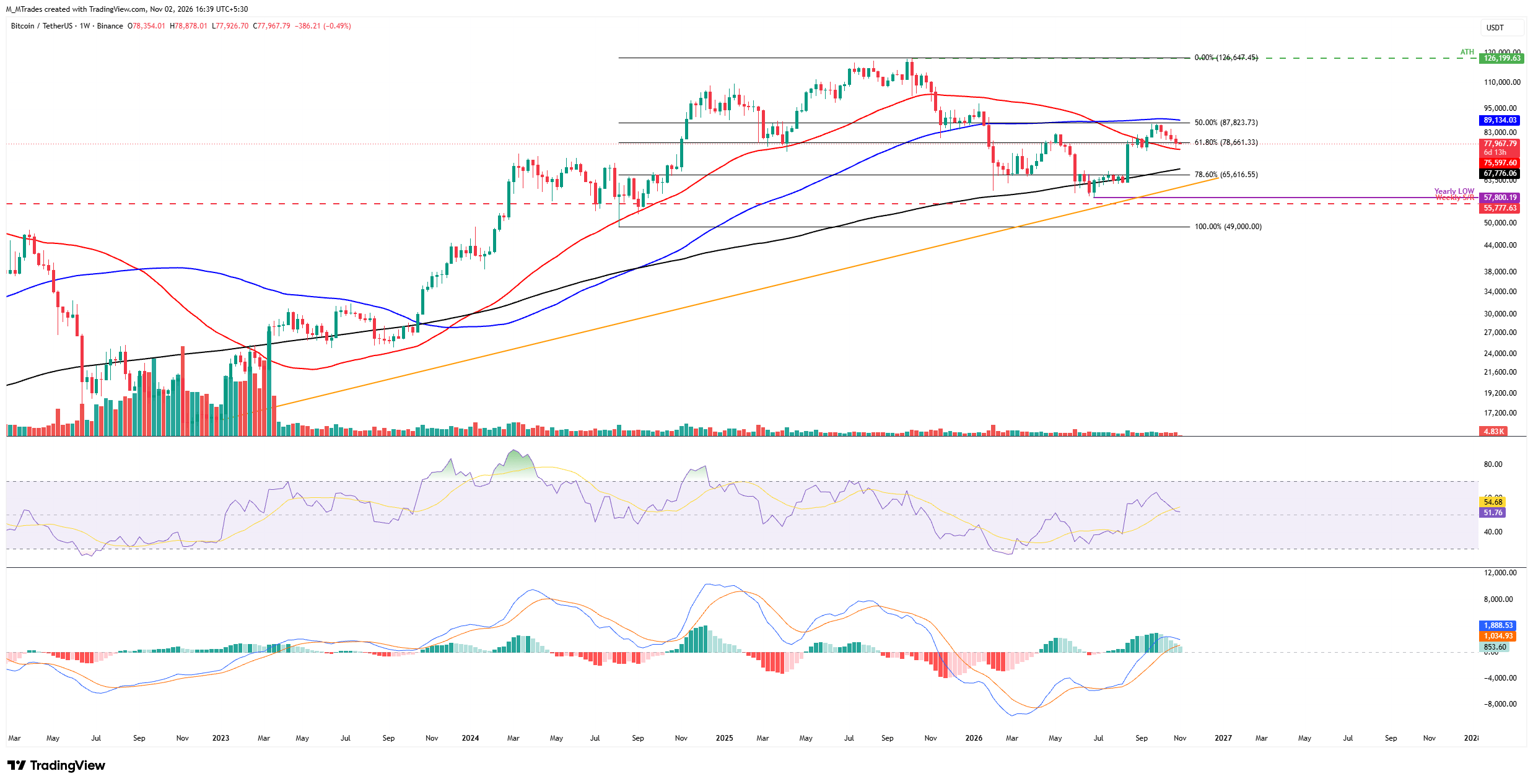
A 2.25% correction last week left Bitcoin with its fourth consecutive weekly decline since early October. At the time of writing on Monday, the cryptocurrency remains lower at around $77,967 as the new week begins.
A continuation of BTC’s correction could bring the 50-week simple moving average (SMA) at $75,597 into focus. Should the week close below that level, further declines towards the 200-week SMA at $67,776 could follow.
At 51, the weekly Relative Strength Index (RSI) sits close to the neutral 50 mark, indicating that bullish momentum is easing. The Moving Average Convergence Divergence (MACD) histogram, meanwhile, is still positive, but its bars are shrinking. Taken together, these readings suggest that the broader upward momentum has not broken down, although it is fading amid nearby resistance and the continuing pullback.
A recovery, however, could take BTC towards the 61.8% Fibonacci retracement level at $78,661, measured from the August 2024 low of $49,000 to the October 2025 record high of $126,199. Should this level hold, the next potential destinations would be the 50% retracement at $87,823, followed by the 100-week SMA at $89,134.
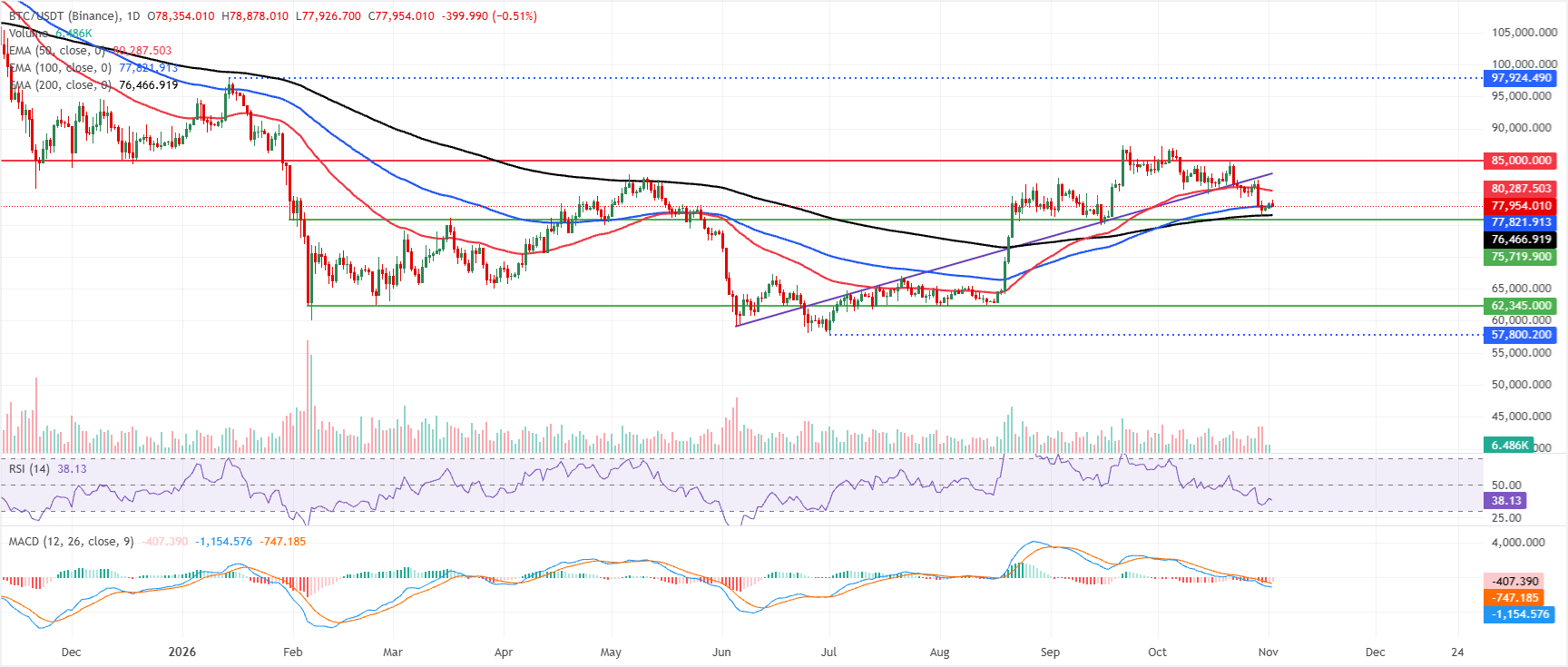
Holding above both the 100-day exponential moving average (EMA) near $77,821 and the 200-day EMA around $76,466 leaves Bitcoin with a mildly constructive bias on the daily chart.
The 50-day EMA at approximately $80,287 nevertheless continues to cap the price, restricting any immediate extension higher. Despite the supportive medium-term structure, a subdued daily RSI near 38 and a MACD histogram in negative territory below zero indicate that bullish momentum is still fragile.
The first upside hurdle is the 50-day EMA at $80,287, followed by the more significant horizontal resistance level at $85,000.
Nearby downside support comes from the 100-day EMA at $77,821, while the 200-day EMA around $76,466 provides a further buffer. Closing a daily session below the latter would undermine the current constructive bias and leave the price vulnerable to a broader correction.
(The technical analysis of this story was written with the help of an AI tool. Know more.)
Designed to function as money, Bitcoin is a virtual currency and the largest cryptocurrency by market capitalisation. No single person, group or entity can control this payment method, removing the need for third parties to take part in financial transactions.
The term altcoin covers any cryptocurrency other than Bitcoin. Some also exclude Ethereum, however, on the grounds that forks originate from these two cryptocurrencies. On that basis, Litecoin would be the first altcoin: a fork of the Bitcoin protocol and therefore an “improved” version of it.
A stablecoin is a cryptocurrency intended to maintain a stable price, backed by reserves of the asset it represents. Its value is pegged to a commodity or financial instrument, such as the US Dollar (USD), while an algorithm or demand regulates its supply. Stablecoins primarily give investors a route into and out of cryptocurrency trading and investment. They also offer a way to store value, given that cryptocurrencies are generally subject to volatility.
The ratio of Bitcoin’s market capitalisation to the combined market capitalisation of all cryptocurrencies is known as Bitcoin dominance. This measure gives a clear indication of investor interest in Bitcoin. BTC dominance is typically high ahead of and during a bull run, when investors favour relatively stable cryptocurrencies with large market capitalisations, such as Bitcoin. Conversely, falling BTC dominance usually signals that investors are shifting capital and/or profits into altcoins in pursuit of higher returns, often setting off a surge in altcoin rallies.







Phone: +61 2 8036 8388
Fax: +61 2 8036 8388
Email: support@tmgm.com



The information provided on this website is of a general nature only and does not constitute personal financial advice. Before acting on any information on this website, you should consider the suitability of the information in relation to your objectives, financial situation and needs. Investing in CFDs and FX Margin Contracts carries significant risks and is not suitable for all investors. You may lose more than your initial deposit. You do not own, or have, any interest in the underlying asset. We recommend that you seek independent advice and ensure you fully understand the risks involved before trading. It is important that you read and consider the disclosure document before you acquire any product listed on the website. The information and advertisements offered on this website are not intended for use by any person in any country or jurisdiction where such use would be contrary to local laws and regulations. The Products and Services offered on this website are not intended for residents of the United States, Malaysia and Thailand.
TMGM is authorized and regulated in various jurisdictions.
Trademax Australia Limited, trading as TMGM, is regulated by the Australian Securities and Investments Commission (ASIC), AFSL no. 436416 and is located at Level 28, One International Tower, 100 Barangaroo Avenue, 2000 Sydney, NSW Australia.
Email: support@tmgm.com.au
Trademax Global Limited, trading as TMGM, is authorized and regulated by the Vanuatu Financial Services Commission (VFSC), registration number 40356 and registered at 1276, Kumul Highway, Port Vila, Vanuatu, Republic of Vanuatu.
Email: support@tmgm.com
Trademax Global Markets (SE) Limited, trading as TMGM, is authorized and regulated by the Financial Services Authority (FSA) of Seychelles, with license number SD224. The company is registered at Office No 13, Providence Estate ABIS Centre, Mahe, Seychelles.
Email: support@tmgm.com
Trademax Global Markets (International) Pty Ltd, trading as TMGM, is authorized and regulated by the Financial Services Commission, Mauritius (FSC) with license no. GB22201012, and registered at 33, Edith Cavell Street C/o IQ EQ Fund Services (Mauritius) Ltd Port Louis, 11324 Mauritius.
Email: support@tmgm.com
Copyright © TMGM. All rights reserved


