
News & AnalysisCareer

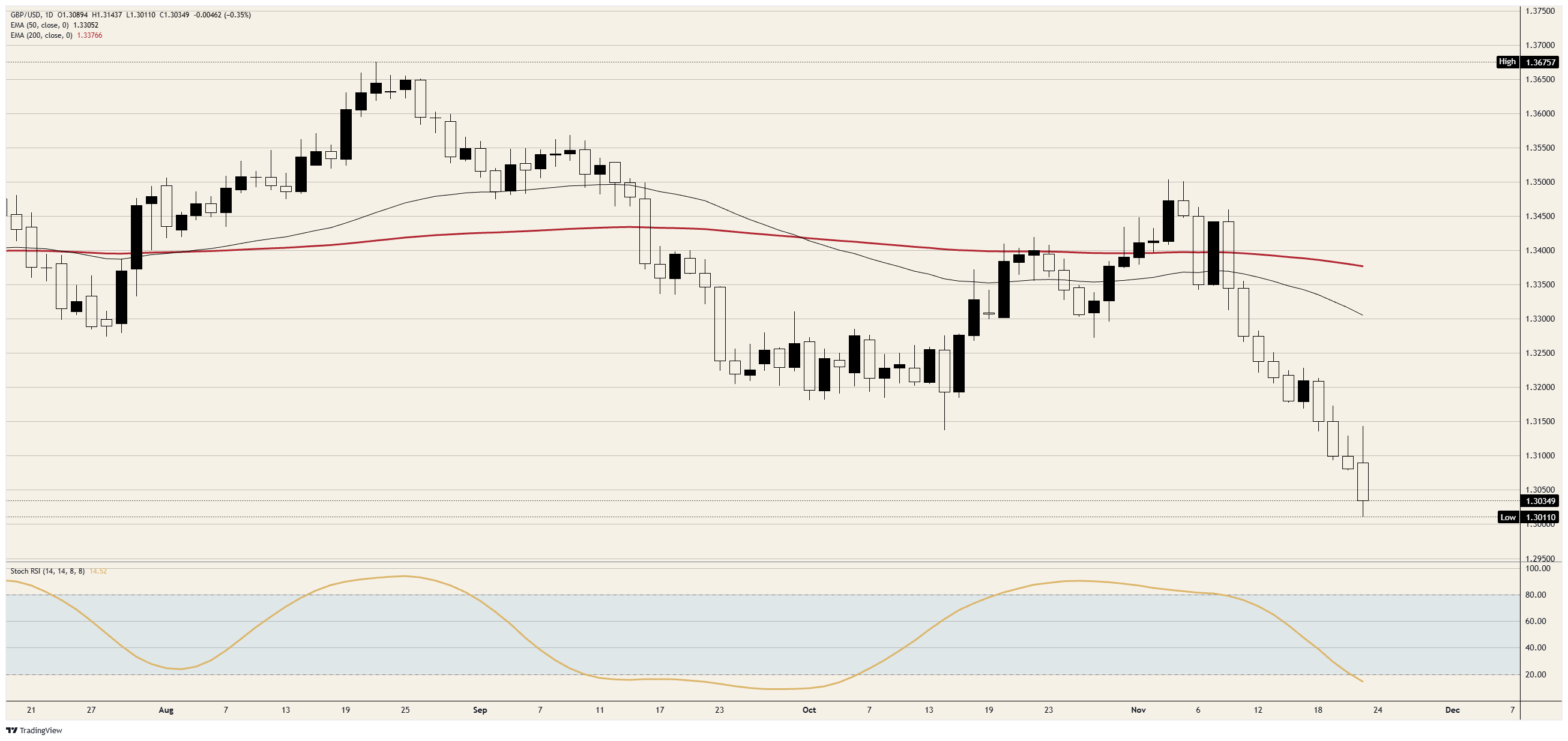
A 19-month low marked GBP/USD's ninth decline in ten sessions, despite Bank of England (BoE) Chief Economist Pill urging an immediate rate rise that day. The pair initially recovered to its October low just below 1.3150, a level breached on Thursday, then retreated to just above 1.3000. It is now trading below 1.3050.
Following Nvidia's (NVDA) reinstatement of Jensen Huang as chief executive, US equities and the Dollar advanced together. GBP/USD's decline accelerated most sharply after the US equity market opened. The probability traders assign to a quarter-point Fed rate rise on December 8-9 has increased to 98%, compared with 88% before the weekend, while the two-year Treasury yield has also climbed. Markets are consequently pricing in a December Fed increase more firmly than a BoE rise.
November's S&P Global UK services Purchasing Managers Index (PMI) slipped to 52.0, missing the 53 forecast, while the composite reading eased from 52.9 to 52.3. Speaking in Vienna, BoE Chief Economist Pill argued that action was needed now, noting that inflation had been below the Bank's 2% target in only three of the past 62 months. GBP/USD peaked ahead of the PMI figures, continued to weaken during his comments and touched its low afterwards.
At 12:30 GMT on Tuesday, BoE external member Greene is due to speak in London. Having backed the November 5 increase in the UK's Bank Rate to 4%, she said on November 19 that the BoE had raised rates too slowly. Markets assign roughly an 84% probability to a further increase on December 17. The BoE's Monetary Policy Report hearings are scheduled for Wednesday at 14:15 GMT.
Tuesday's US releases begin with the ADP four-week employment average at 13:15 GMT, following a reading of 23.75K, before November consumer confidence at 15:00 GMT. On Wednesday at 13:30 GMT, October's core Personal Consumption Expenditures Price Index (PCE) is expected to show 3.2% YoY, up from 3.1% previously. All three releases have implications for the Fed's December 8-9 decision and thus for the Dollar side of the interest rate differential.
Matching the November 2025 trough, the session low marks a level below which GBP/USD last traded in April 2025. Since its November 4 peak just above 1.3500, the pair has declined in 11 of 13 sessions. It remains beneath both its 50-day Exponential Moving Average (EMA), near 1.3300, and its 200-day EMA, just above 1.3350. Daily momentum has entered oversold territory for the first time since early October.
Dating back to 886 AD, the Pound Sterling (GBP) is the world's oldest currency and serves as the United Kingdom's official currency. According to 2022 data, it ranks fourth globally in foreign exchange (FX) trading, representing 12% of all transactions, with average daily turnover of $630 billion. Among its principal pairs, GBP/USD, known as ‘Cable’, represents 11% of FX trading. GBP/JPY, referred to by traders as the ‘Dragon’, accounts for 3%, while EUR/GBP makes up 2%. Responsibility for issuing the Pound Sterling rests with the Bank of England (BoE).
Monetary policy set by the Bank of England is the foremost influence on the Pound Sterling's value. In making policy decisions, the BoE assesses whether it is meeting its central objective of “price stability” – inflation holding steady at around 2%. Interest rate changes are its main means of pursuing that objective. To curb excessively high inflation, the BoE seeks to raise borrowing costs through higher interest rates, making credit more expensive for households and businesses. Such increases generally support GBP by making the UK a more appealing destination for international investors' funds. By contrast, inflation that is too low signals slowing economic growth. The BoE will then consider cutting interest rates to reduce borrowing costs and encourage businesses to finance investment in projects that generate growth.
As measures of economic health, data releases can affect the Pound Sterling's value. GDP, Manufacturing and Services PMIs, and employment figures are among the indicators capable of moving GBP. Sterling benefits from a robust economy, which draws in more overseas investment and may also prompt the BoE to raise interest rates, directly strengthening GBP. Weak economic readings, on the other hand, are likely to weigh on the Pound Sterling.
The Trade Balance is another important release for the Pound Sterling, showing the gap between a country's export earnings and its spending on imports during a specified period. Strong demand for a country's exports supports its currency through the additional demand from overseas buyers purchasing those goods. A positive net Trade Balance therefore strengthens the currency, whereas a negative balance has the opposite effect.







Phone: +61 2 8036 8388
Fax: +61 2 8036 8388
Email: support@tmgm.com



The information provided on this website is of a general nature only and does not constitute personal financial advice. Before acting on any information on this website, you should consider the suitability of the information in relation to your objectives, financial situation and needs. Investing in CFDs and FX Margin Contracts carries significant risks and is not suitable for all investors. You may lose more than your initial deposit. You do not own, or have, any interest in the underlying asset. We recommend that you seek independent advice and ensure you fully understand the risks involved before trading. It is important that you read and consider the disclosure document before you acquire any product listed on the website. The information and advertisements offered on this website are not intended for use by any person in any country or jurisdiction where such use would be contrary to local laws and regulations. The Products and Services offered on this website are not intended for residents of the United States, Malaysia and Thailand.
TMGM is authorized and regulated in various jurisdictions.
Trademax Australia Limited, trading as TMGM, is regulated by the Australian Securities and Investments Commission (ASIC), AFSL no. 436416 and is located at Level 28, One International Tower, 100 Barangaroo Avenue, 2000 Sydney, NSW Australia.
Email: support@tmgm.com.au
Trademax Global Limited, trading as TMGM, is authorized and regulated by the Vanuatu Financial Services Commission (VFSC), registration number 40356 and registered at 1276, Kumul Highway, Port Vila, Vanuatu, Republic of Vanuatu.
Email: support@tmgm.com
Trademax Global Markets (SE) Limited, trading as TMGM, is authorized and regulated by the Financial Services Authority (FSA) of Seychelles, with license number SD224. The company is registered at Office No 13, Providence Estate ABIS Centre, Mahe, Seychelles.
Email: support@tmgm.com
Trademax Global Markets (International) Pty Ltd, trading as TMGM, is authorized and regulated by the Financial Services Commission, Mauritius (FSC) with license no. GB22201012, and registered at 33, Edith Cavell Street C/o IQ EQ Fund Services (Mauritius) Ltd Port Louis, 11324 Mauritius.
Email: support@tmgm.com
Copyright © TMGM. All rights reserved

