
News & AnalysisCareer

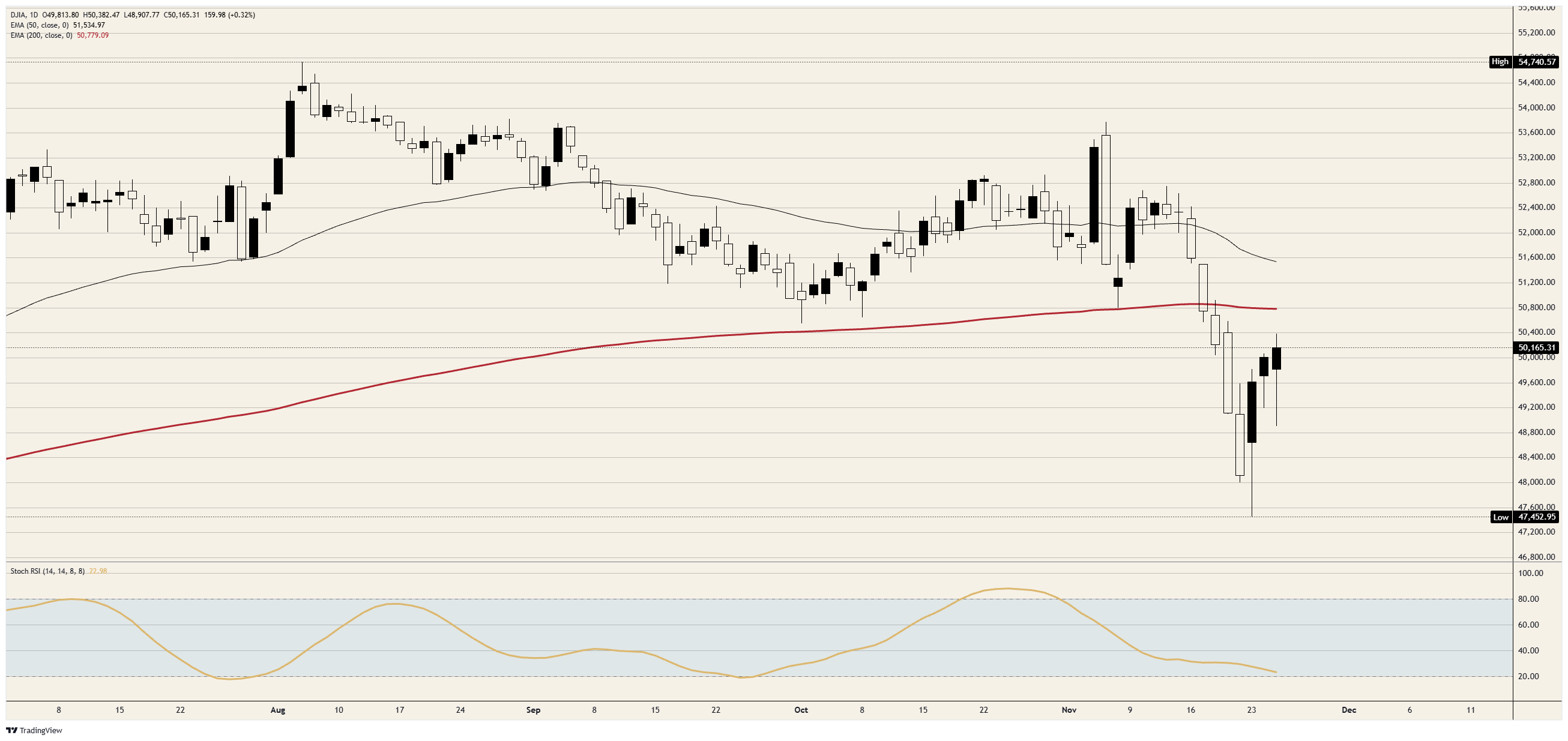
A fall towards 48,900 took the Dow Jones Industrial Average below Tuesday's low before it regained 50,000, leaving it on course for a third consecutive advance. Selling in artificial intelligence (AI) shares extended into a second day and spread across the wider market, although the subsequent recovery has been confined to stocks outside AI. At its weakest, the Nasdaq Composite had lost 4.6%, while the S&P 500 was down 3.2%; both remain in negative territory.

Losses of nearly 5% in Nvidia (NVDA) accompany declines of 4%-5% in Micron (MU) and Oracle (ORCL). Investors have instead bought into the S&P 500's materials, energy and real estate sectors, all gaining more than 1%. IBM (IBM), Salesforce (CRM) and Sherwin-Williams (SHW) are supporting the Dow's advance. Thin holiday trading and investor Michael Burry's decision to close his bets against the NASDAQ 100 and become a buyer for now explain part of the recovery, according to traders.
An annual rise of 3.3% in October's core Personal Consumption Expenditures Price Index (PCE), against a 3.2% forecast, left the priced-in probability of a December Fed rate increase near 94%. Alongside this, the White House proposed tariffs on 14 trading partners, including an additional 20% on China. With third-quarter Gross Domestic Product (GDP) growth reaching 4.3%, ahead of the 3.4% forecast, interest rates and tariffs, rather than a weakening economy, lay behind the Dow's decline.
Thanksgiving will keep US stock markets closed on Thursday, followed by an early finish at 18:00 GMT on Friday rather than the usual 21:00 GMT. Friday also marks the final opportunity for Fed officials to comment before the decision: the quiet period ahead of the 8–9 December Federal Open Market Committee (FOMC) meeting begins on Saturday. An increase on 9 December would lift the Fed's rate to 4.00%-4.25%. Traders have linked that borrowing cost to the selling in AI shares that spread to the Dow on Wednesday.
About two-fifths of the decline from the 5 November high near 53,800 has been retraced over three advancing sessions, starting from Monday's low near 47,500. Even so, the index remains beneath its 200-day Exponential Moving Average (EMA), which sits just under 50,800 and was breached on 17 November. The 50-day EMA stands near 51,500. Despite the three-session recovery, daily momentum continues to weaken and is close to oversold territory.
Comprising the 30 most actively traded US stocks, the Dow Jones Industrial Average ranks among the world's oldest stock market indices. Rather than using market capitalisation, it weights constituents by their share prices: the combined prices are divided by a factor currently set at 0.152. Charles Dow, who also established the Wall Street Journal, founded the index. Its narrow coverage has drawn criticism in later years, as tracking just 30 conglomerates makes it less broadly representative than indices such as the S&P 500.
Among the various influences on the Dow Jones Industrial Average (DJIA), the combined performance of its constituents, as shown in quarterly earnings reports, is the most important. Macroeconomic releases from the US and elsewhere also shape the index through their effect on investor sentiment. Another influence is the interest rate set by the Federal Reserve (Fed), which determines the cost of borrowing for the many companies heavily dependent on credit. Inflation can therefore have a significant bearing on the DJIA, alongside other indicators that inform Fed decisions.
Developed by Charles Dow, Dow Theory seeks to establish the stock market's primary trend. It involves comparing the direction of the Dow Jones Industrial Average (DJIA) with that of the Dow Jones Transportation Average (DJTA), following a trend only when the two move in the same direction. Trading volume serves as confirmation, while analysis of peaks and troughs also forms part of the approach. Dow's framework sets out three phases: accumulation, as smart money begins buying or selling; public participation, as the wider public follows; and distribution, as smart money withdraws.
Investors can access the DJIA through several instruments. ETFs offer a way to trade it through one security without purchasing shares in each of its 30 constituents; the SPDR Dow Jones Industrial Average ETF (DIA) is a prominent example. Futures contracts allow traders to speculate on the index's future value. Options, meanwhile, confer the right, without an obligation, to buy or sell the index at a pre-agreed price at a future date. Through mutual funds, investors can purchase a stake in a diversified portfolio of DJIA shares, gaining exposure to the index as a whole.







Phone: +61 2 8036 8388
Fax: +61 2 8036 8388
Email: support@tmgm.com



The information provided on this website is of a general nature only and does not constitute personal financial advice. Before acting on any information on this website, you should consider the suitability of the information in relation to your objectives, financial situation and needs. Investing in CFDs and FX Margin Contracts carries significant risks and is not suitable for all investors. You may lose more than your initial deposit. You do not own, or have, any interest in the underlying asset. We recommend that you seek independent advice and ensure you fully understand the risks involved before trading. It is important that you read and consider the disclosure document before you acquire any product listed on the website. The information and advertisements offered on this website are not intended for use by any person in any country or jurisdiction where such use would be contrary to local laws and regulations. The Products and Services offered on this website are not intended for residents of the United States, Malaysia and Thailand.
TMGM is authorized and regulated in various jurisdictions.
Trademax Australia Limited, trading as TMGM, is regulated by the Australian Securities and Investments Commission (ASIC), AFSL no. 436416 and is located at Level 28, One International Tower, 100 Barangaroo Avenue, 2000 Sydney, NSW Australia.
Email: support@tmgm.com.au
Trademax Global Limited, trading as TMGM, is authorized and regulated by the Vanuatu Financial Services Commission (VFSC), registration number 40356 and registered at 1276, Kumul Highway, Port Vila, Vanuatu, Republic of Vanuatu.
Email: support@tmgm.com
Trademax Global Markets (SE) Limited, trading as TMGM, is authorized and regulated by the Financial Services Authority (FSA) of Seychelles, with license number SD224. The company is registered at Office No 13, Providence Estate ABIS Centre, Mahe, Seychelles.
Email: support@tmgm.com
Trademax Global Markets (International) Pty Ltd, trading as TMGM, is authorized and regulated by the Financial Services Commission, Mauritius (FSC) with license no. GB22201012, and registered at 33, Edith Cavell Street C/o IQ EQ Fund Services (Mauritius) Ltd Port Louis, 11324 Mauritius.
Email: support@tmgm.com
Copyright © TMGM. All rights reserved


