
News & AnalysisCareer

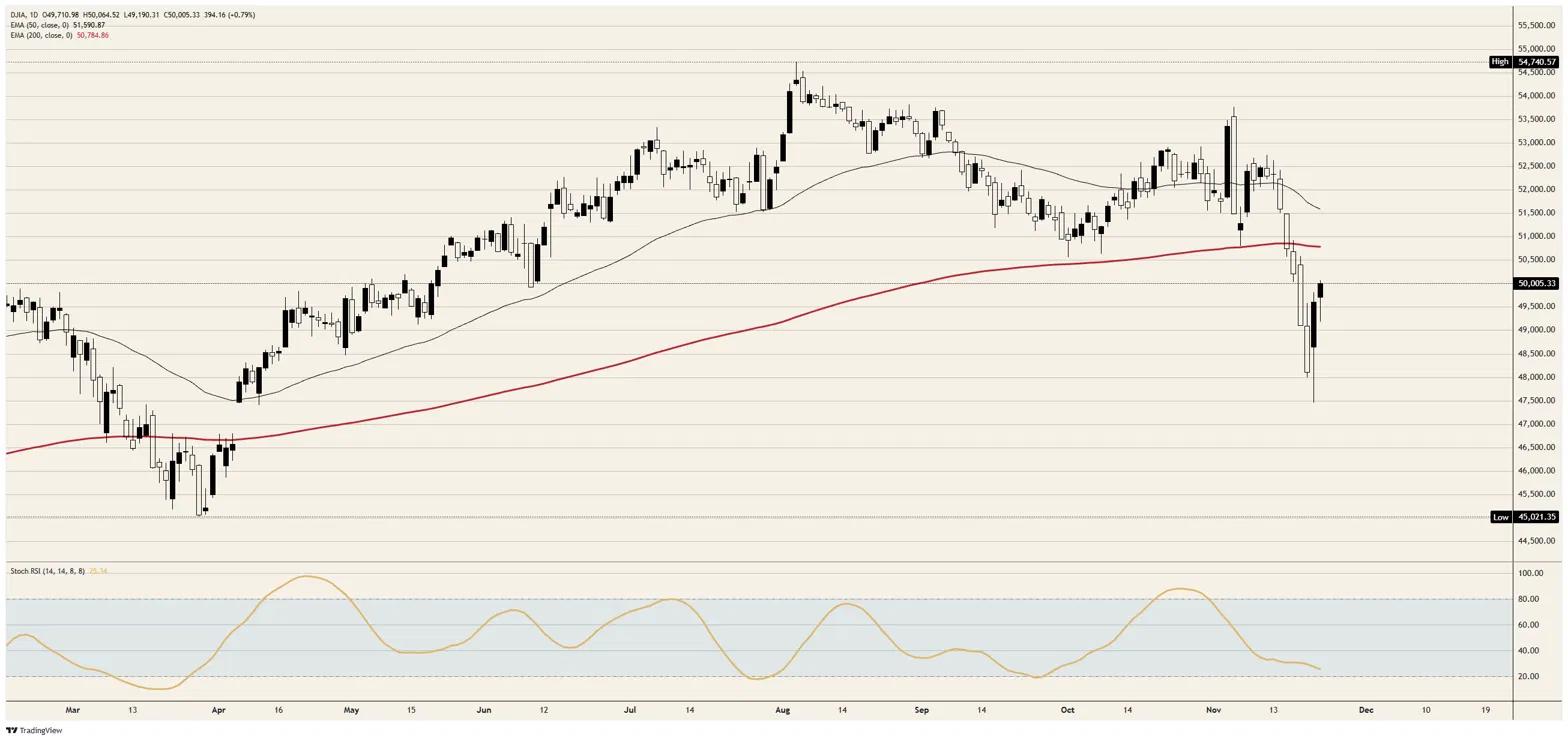
Back at 50,000 for the first time since 19 November, the Dow Jones Industrial Average is advancing for a second session despite a partial reversal in the chip stocks that drove Monday's rally. After falling as low as 25,750, the NASDAQ 100 is trading around 26,200, while the S&P 500 sits slightly above 7,200 and remains within Monday's trading range.

Following Monday's 31% surge, Nvidia (NVDA) has fallen nearly 6%. That rally coincided with the return of Nvidia Chief Executive Huang, 11 days after his resignation. Losses of 11% for Micron Technology (MU) and almost 9% for Advanced Micro Devices (AMD) mean the chip shares that joined Monday's advance are now leading the NASDAQ 100 lower. On 17 November, Nvidia assured investors that its search for a permanent chief executive would be thorough; the process continued for another six days.
Trading below its $83 initial public offering (IPO) price only days after its listing, Anthropic (ANT) shows that selling in artificial intelligence (AI) shares extends beyond chipmakers and into the S&P 500. Further selling followed a Wall Street Journal report that the US is preparing tariff increases on dozens of countries, including China. Other sectors supported the Dow, where Amgen (AMGN), Nike (NKE) and Salesforce (CRM) ranked among the strongest performers.
Wednesday's releases at 13:30 GMT include October's Personal Consumption Expenditures Price Index (PCE), the second estimate of third-quarter Gross Domestic Product (GDP) and weekly jobless claims. New home sales follow at 15:00 GMT. The probability traders assign to a quarter-point Fed rate increase on 9 December is close to 94%. Higher interest rates have contributed to selling in indebted AI companies and, in turn, the NASDAQ 100.
Thanksgiving will close US stock markets on Thursday, followed by a shortened Friday session finishing at 18:00 GMT. From 28 November, Fed officials enter their public-comment blackout ahead of the 8–9 December meeting.
Having ended Friday more than 10% below their respective peaks, the Dow and the S&P 500 have both moved back within that threshold. Around 40% of the Dow's decline from its 5 November high near 53,750 has been recouped, although the index remains below its 200-day Exponential Moving Average (EMA), around 50,800. Almost a third of Monday's rise has been erased from the NASDAQ 100, leaving it roughly a sixth below its October peak.
Comprising the 30 most actively traded US stocks, the Dow Jones Industrial Average ranks among the world's oldest stock market indices. Prices, rather than market capitalisation, determine its weightings: the constituent share prices are added together and divided by a factor that currently stands at 0.152. Charles Dow, also the founder of the Wall Street Journal, established the index. More recently, critics have questioned how broadly representative it is, since it follows only 30 conglomerates rather than the wider market covered by indices such as the S&P 500.
The combined performance of its constituent companies, as shown in their quarterly earnings reports, is the principal influence on the Dow Jones Industrial Average (DJIA). Economic releases from the US and overseas also shape the index through their effect on investor sentiment. By determining borrowing costs, interest rates set by the Federal Reserve (Fed) affect the many companies that depend heavily on credit and therefore influence the DJIA. Inflation, alongside other indicators that inform Fed decisions, can consequently be another important driver.
Developed by Charles Dow, Dow Theory seeks to establish the stock market's primary trend. It involves comparing movements in the Dow Jones Industrial Average (DJIA) with those in the Dow Jones Transportation Average (DJTA), following a trend only when the two indices move in the same direction. Trading volume provides confirmation, while analysis of peaks and troughs also forms part of the method. Three phases underpin Dow's theory: accumulation, as smart money begins to buy or sell; public participation, as the wider public enters the market; and distribution, as smart money withdraws.
Investors can gain exposure to the DJIA through several routes. ETFs offer a way to trade it as one security without purchasing shares in each of its 30 constituents; the SPDR Dow Jones Industrial Average ETF (DIA) is a prominent example. Futures contracts allow traders to speculate on the index's future value. Options, meanwhile, confer the right, without an obligation, to buy or sell the index at a price fixed in advance for a future date. Through mutual funds, investors can purchase a stake in a diversified portfolio of DJIA shares, gaining exposure to the index as a whole.







Phone: +61 2 8036 8388
Fax: +61 2 8036 8388
Email: support@tmgm.com



The information provided on this website is of a general nature only and does not constitute personal financial advice. Before acting on any information on this website, you should consider the suitability of the information in relation to your objectives, financial situation and needs. Investing in CFDs and FX Margin Contracts carries significant risks and is not suitable for all investors. You may lose more than your initial deposit. You do not own, or have, any interest in the underlying asset. We recommend that you seek independent advice and ensure you fully understand the risks involved before trading. It is important that you read and consider the disclosure document before you acquire any product listed on the website. The information and advertisements offered on this website are not intended for use by any person in any country or jurisdiction where such use would be contrary to local laws and regulations. The Products and Services offered on this website are not intended for residents of the United States, Malaysia and Thailand.
TMGM is authorized and regulated in various jurisdictions.
Trademax Australia Limited, trading as TMGM, is regulated by the Australian Securities and Investments Commission (ASIC), AFSL no. 436416 and is located at Level 28, One International Tower, 100 Barangaroo Avenue, 2000 Sydney, NSW Australia.
Email: support@tmgm.com.au
Trademax Global Limited, trading as TMGM, is authorized and regulated by the Vanuatu Financial Services Commission (VFSC), registration number 40356 and registered at 1276, Kumul Highway, Port Vila, Vanuatu, Republic of Vanuatu.
Email: support@tmgm.com
Trademax Global Markets (SE) Limited, trading as TMGM, is authorized and regulated by the Financial Services Authority (FSA) of Seychelles, with license number SD224. The company is registered at Office No 13, Providence Estate ABIS Centre, Mahe, Seychelles.
Email: support@tmgm.com
Trademax Global Markets (International) Pty Ltd, trading as TMGM, is authorized and regulated by the Financial Services Commission, Mauritius (FSC) with license no. GB22201012, and registered at 33, Edith Cavell Street C/o IQ EQ Fund Services (Mauritius) Ltd Port Louis, 11324 Mauritius.
Email: support@tmgm.com
Copyright © TMGM. All rights reserved


