
News & AnalysisCareer

At around $4,130 at the time of writing, Gold (XAU/USD) is trading close to two-week highs on Thursday. Its continued advance takes it further above last week’s year-to-date low of $3,870. Buyers are turning to the metal as the US midterm election results stir volatility across financial markets.

Wednesday brought a 3.64% jump in the precious metal and an 8% fall in West Texas Intermediate (WTI). Behind those moves was speculation among traders that a Democratic sweep of Congress could curtail funding for Trump’s military campaign against Iran and intensify pressure to end the war, which is now in its ninth month.
The possibility of divided government also allays worries about the fiscal outlook, since securing approval for further tax cuts or spending packages could prove harder. That prospect encourages purchases of Treasuries, lowering yields and putting pressure on the US Dollar (USD). Meanwhile, falling Oil prices provide some respite from inflation worries. Together, these factors are reviving demand for Gold.
Thursday has, however, seen selling pressure ease across the US Dollar, Treasury yields and Oil prices after the previous day’s sharp declines. This should limit the scope for further gains in Gold.
A hawkish outlook for the Federal Reserve (Fed) continues to present another major obstacle for bullion. Inflation risks persist because Oil prices remain substantially above their pre-war levels. As the Fed remains committed to returning inflation to its 2% target, traders expect interest rates to stay high for longer and foresee a rate increase in December. The CME FedWatch Tool places the probability of that increase at around 79%.
By raising the opportunity cost of holding an asset that pays no yield, higher borrowing costs put pressure on the metal.
US employment figures are now in focus for their potential influence on expectations for the Fed’s policy course. Thursday’s Initial Jobless Claims release will be followed by Friday’s Nonfarm Payrolls (NFP) report.
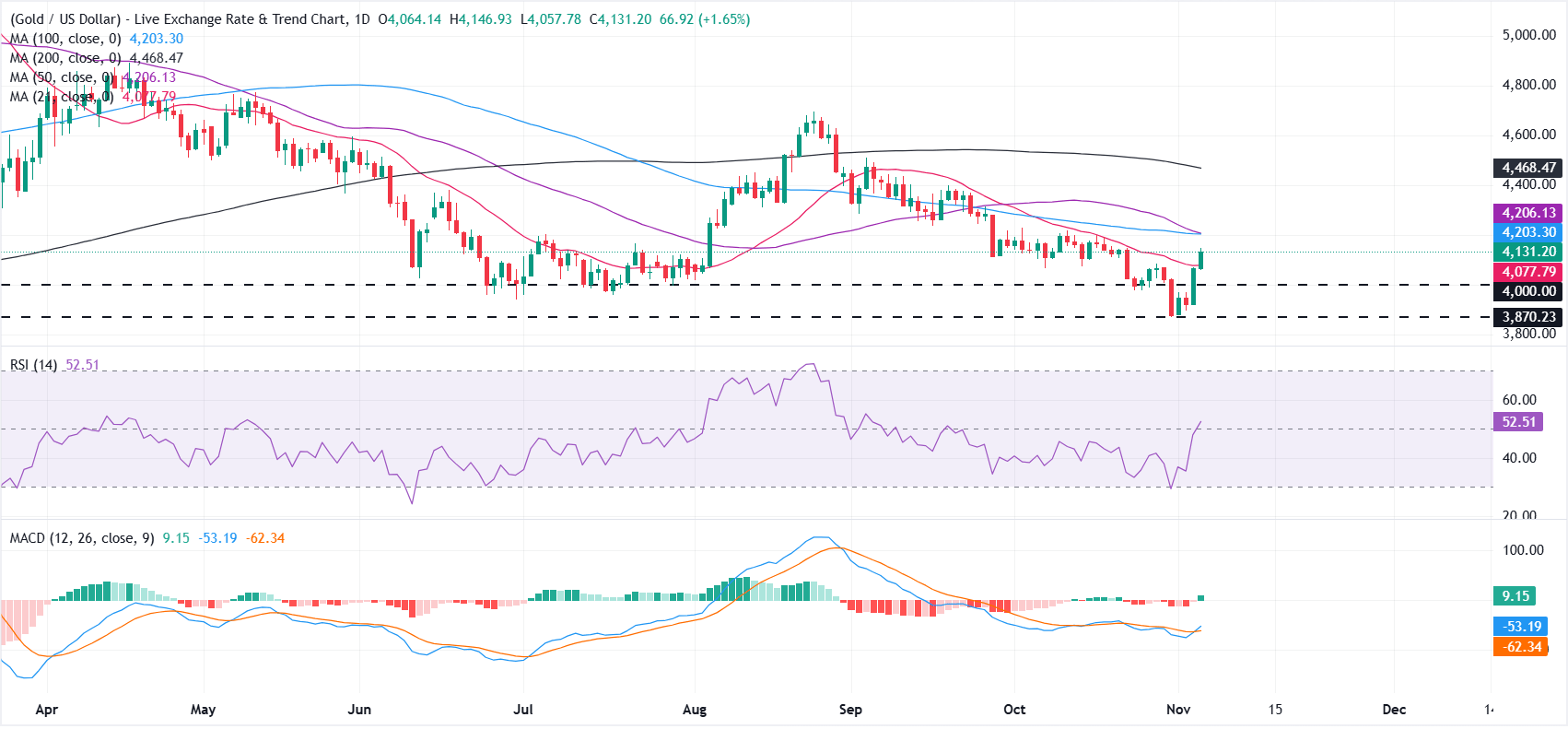
Trading beneath its medium- and long-term moving averages leaves XAU/USD’s upside constrained on the daily chart. Although the 21-day simple moving average (SMA) at $4,077 provides immediate support for the recovery, the price has yet to regain the 50-day, 100-day and 200-day SMAs.
A Relative Strength Index reading near 52 and a move into positive territory by the Moving Average Convergence Divergence (MACD) indicate firmer momentum. These signals suggest bullish pressure is building again, but they have not yet reversed the underlying bearish structure.
Should the price retreat, the 21-day SMA around $4,077 offers the first support level. Below it lie the psychological $4,000 mark and the year-to-date trough of $3,870.
Any advance would first encounter the closely grouped 100-day and 50-day SMAs, at $4,203 and $4,206 respectively. Further up, the 200-day SMA near $4,468 presents a more substantial hurdle. A clear daily close above these clustered moving averages would be needed before the prevailing bearish bias began to ease.
(The technical analysis of this story was written with the help of an AI tool. Know more.)
Widely used both to preserve wealth and to facilitate exchange, Gold has held an important place throughout human history. Beyond its lustre and use in jewellery, the precious metal is now broadly regarded as a safe-haven asset, making it a favoured investment in unsettled periods. Its independence from any particular issuer or government also underpins its widespread reputation as a hedge against inflation and currency depreciation.
The largest holders of Gold are central banks. To support their currencies during periods of turbulence, they typically diversify their reserves and purchase Gold, seeking to bolster perceptions of economic and currency strength. Substantial Gold reserves can help inspire confidence in a country’s solvency. According to the World Gold Council, central banks increased their reserves by 1,136 tonnes of Gold in 2022, valued at around $70 billion. No larger annual purchase has been recorded since records began. Emerging-economy central banks, including those in China, India and Turkey, are expanding their Gold reserves rapidly.
Both the US Dollar and US Treasuries are major reserve and safe-haven assets, and Gold is inversely correlated with them. A weakening Dollar typically accompanies a rise in Gold, allowing investors and central banks to diversify their holdings in turbulent periods. Risk assets also have an inverse relationship with Gold: rising equity markets tend to weigh on its price, whereas selling in riskier markets generally supports the precious metal.
A broad set of influences can affect Gold prices. Its safe-haven appeal means geopolitical turmoil or concerns about a severe recession can prompt rapid price increases. Because Gold pays no yield, lower interest rates generally support it, while a higher cost of borrowing usually weighs on the metal. Nevertheless, the behaviour of the US Dollar (USD) drives most price movements, as Gold is quoted in dollars (XAU/USD). Dollar strength tends to restrain Gold prices; a weaker Dollar, by contrast, is likely to lift them.







Phone: +61 2 8036 8388
Fax: +61 2 8036 8388
Email: support@tmgm.com



The information provided on this website is of a general nature only and does not constitute personal financial advice. Before acting on any information on this website, you should consider the suitability of the information in relation to your objectives, financial situation and needs. Investing in CFDs and FX Margin Contracts carries significant risks and is not suitable for all investors. You may lose more than your initial deposit. You do not own, or have, any interest in the underlying asset. We recommend that you seek independent advice and ensure you fully understand the risks involved before trading. It is important that you read and consider the disclosure document before you acquire any product listed on the website. The information and advertisements offered on this website are not intended for use by any person in any country or jurisdiction where such use would be contrary to local laws and regulations. The Products and Services offered on this website are not intended for residents of the United States, Malaysia and Thailand.
TMGM is authorized and regulated in various jurisdictions.
Trademax Australia Limited, trading as TMGM, is regulated by the Australian Securities and Investments Commission (ASIC), AFSL no. 436416 and is located at Level 28, One International Tower, 100 Barangaroo Avenue, 2000 Sydney, NSW Australia.
Email: support@tmgm.com.au
Trademax Global Limited, trading as TMGM, is authorized and regulated by the Vanuatu Financial Services Commission (VFSC), registration number 40356 and registered at 1276, Kumul Highway, Port Vila, Vanuatu, Republic of Vanuatu.
Email: support@tmgm.com
Trademax Global Markets (SE) Limited, trading as TMGM, is authorized and regulated by the Financial Services Authority (FSA) of Seychelles, with license number SD224. The company is registered at Office No 13, Providence Estate ABIS Centre, Mahe, Seychelles.
Email: support@tmgm.com
Trademax Global Markets (International) Pty Ltd, trading as TMGM, is authorized and regulated by the Financial Services Commission, Mauritius (FSC) with license no. GB22201012, and registered at 33, Edith Cavell Street C/o IQ EQ Fund Services (Mauritius) Ltd Port Louis, 11324 Mauritius.
Email: support@tmgm.com
Copyright © TMGM. All rights reserved


