
News & AnalysisCareer

At around 0.5630, NZD/USD remains 0.2% higher during Thursday’s European session, having pulled back from an intraday peak of 0.5658. The retreat leaves the New Zealand Dollar (NZD) with half of its earlier gains against the US Dollar (USD).

A recovery in the US Dollar, which has moved into positive territory, is weighing on the Kiwi pair. Markets are now turning their attention to October’s United States (US) Nonfarm Payrolls (NFP) report, due on Friday.
Having rebounded sharply from a retest of the previous day’s monthly low of 101.01, the US Dollar Index (DXY) stands near 101.60, up 0.1% at the time of writing. The index tracks the Greenback against six major currencies.
For investors seeking further indications of the Federal Reserve’s (Fed) monetary policy outlook, the US NFP release will be a key focus.
Only limited job creation is expected in October’s US employment report, according to TD Securities, whose economists expect nonfarm payrolls to “remain subdued at 40k after job gains moderated to 29k in September.” Underlying momentum may nevertheless be firmer than the headline suggests: the economists observe that “despite the subdued, below-consensus print, our forecast would be within the range of breakeven job gains and result in an increase in the three-month moving average,”. TD also sees scope for a stronger outcome, stating that “risks to our payrolls forecast are to the upside,” and warning that “seasonal factors could reverse again more than expected and lead to a stronger print.” With “underlying activity in the economy robust and inflation risks still prominent,” the bank’s assessment is that “a hike in December is likely.”
Before its recovery, the US Dollar had lagged as the Democrats’ victory in the US midterm elections cast uncertainty over the economic outlook.
Over the medium term, US politics could present another obstacle for the Dollar, in the view of ING analysts. Their assessment is that “the dollar could see a little more weakness into 2027, however, if an emboldened Democratic Party takes greater issue with Republican policy, including deregulation and the AI build-out.” A further concern is that “the potential for a prolonged government shutdown in mid-2027 adds to the case for a weaker dollar next summer,” ING says. This supports the analysts’ view that mounting political tensions may increasingly undermine the currency’s appeal.
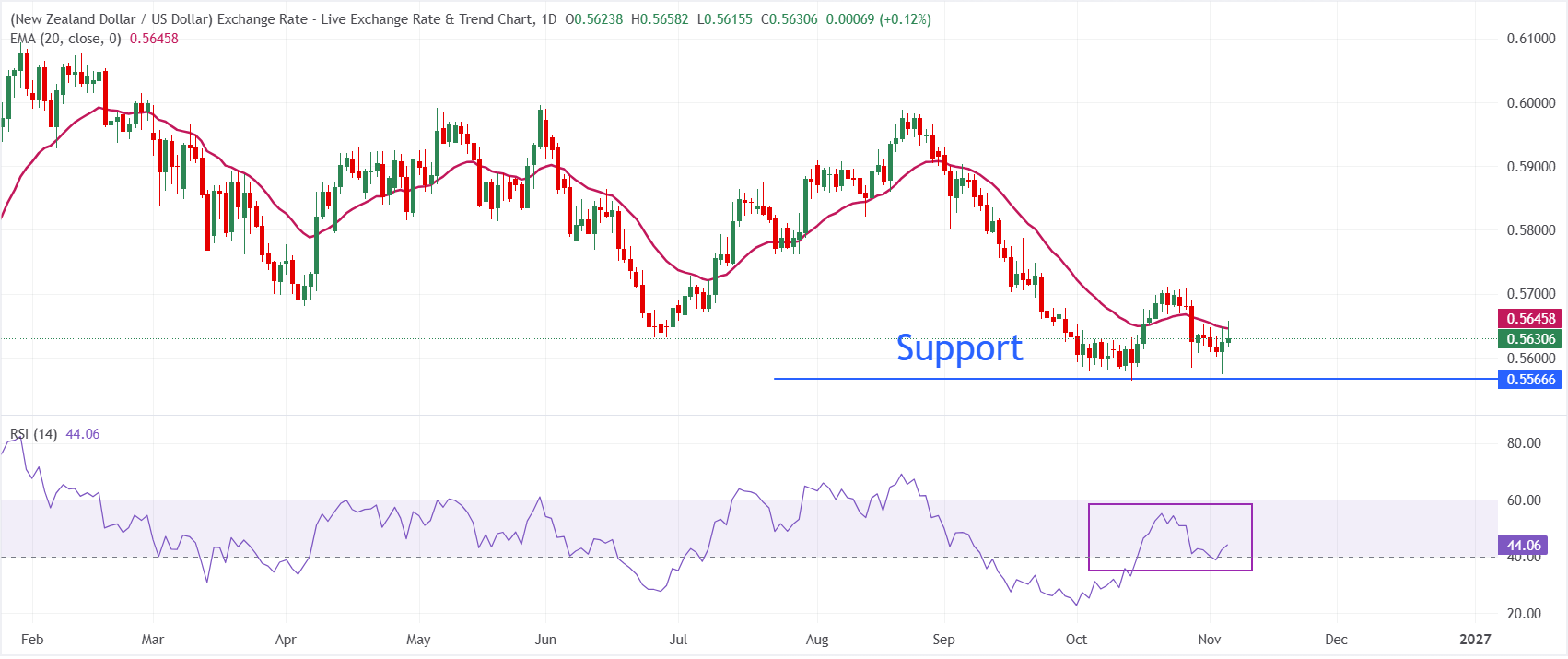
With NZD/USD at 0.5631 on the daily chart, trading below the 20-day exponential moving average (EMA) of 0.5646 leaves the near-term outlook bearish. This nearby dynamic resistance continues to constrain the pair, implying that rallies may struggle until it is overcome. Meanwhile, the Relative Strength Index (RSI) is recovering towards the mid-40s, pointing to downside pressure that is easing but remains modest.
A daily close above the first resistance level, the 20-day EMA at 0.5646, would be required to temper the bearish outlook and create scope for a corrective rise. Below the current price, the supplied indicators identify no clear nearby support. Traders may therefore turn to recent chart lows to locate potential demand zones, while remaining mindful of the prevailing downside bias for as long as NZD/USD stays below its short-term EMA.
(The technical analysis of this story was written with the help of an AI tool. Know more.)
Published within the US Bureau of Labor Statistics’ monthly employment report, Nonfarm Payrolls (NFP) measure the change in US employment over the preceding month. Jobs in farming are excluded from this component.
By indicating how well the Federal Reserve is fulfilling its mandate of full employment and 2% inflation, the Nonfarm Payrolls figure can help shape its policy decisions. When NFP is relatively strong, more people are working and earning more money, making higher spending more likely. A relatively weak reading, by contrast, may indicate that people are finding it difficult to secure work. To counter high inflation arising from low unemployment, the Fed will usually increase interest rates; to revive a stagnant labour market, it will typically reduce them.
The US Dollar tends to rise when payrolls exceed expectations and fall when they disappoint, reflecting a generally positive correlation between NFP and the currency. This relationship stems from the report’s effects on inflation, monetary policy expectations and interest rates. A stronger NFP reading generally points towards tighter Federal Reserve policy, which supports the USD.
Gold prices tend to move in the opposite direction to Nonfarm Payrolls. An above-forecast reading therefore generally puts downward pressure on Gold, while a weaker-than-expected result has the reverse effect. Stronger NFP figures usually support the USD. Since Gold, like most major commodities, is priced in US Dollars, an appreciation in the currency means fewer Dollars are needed to purchase an ounce. Higher interest rates, which stronger NFP figures typically encourage, also make Gold less appealing relative to holding cash, where funds can at least earn interest.
Other elements of the broader employment report can eclipse Nonfarm Payrolls, which represent just one component. For example, markets have sometimes overlooked the potentially inflationary implications of an above-forecast NFP figure when Average Weekly Earnings fell short of expectations, treating the decline in earnings as deflationary instead. The Participation Rate and Average Weekly Hours can also shape the response, although this is rare and tends to occur during exceptional episodes such as the “Great Resignation” or the Global Financial Crisis.







Phone: +61 2 8036 8388
Fax: +61 2 8036 8388
Email: support@tmgm.com



The information provided on this website is of a general nature only and does not constitute personal financial advice. Before acting on any information on this website, you should consider the suitability of the information in relation to your objectives, financial situation and needs. Investing in CFDs and FX Margin Contracts carries significant risks and is not suitable for all investors. You may lose more than your initial deposit. You do not own, or have, any interest in the underlying asset. We recommend that you seek independent advice and ensure you fully understand the risks involved before trading. It is important that you read and consider the disclosure document before you acquire any product listed on the website. The information and advertisements offered on this website are not intended for use by any person in any country or jurisdiction where such use would be contrary to local laws and regulations. The Products and Services offered on this website are not intended for residents of the United States, Malaysia and Thailand.
TMGM is authorized and regulated in various jurisdictions.
Trademax Australia Limited, trading as TMGM, is regulated by the Australian Securities and Investments Commission (ASIC), AFSL no. 436416 and is located at Level 28, One International Tower, 100 Barangaroo Avenue, 2000 Sydney, NSW Australia.
Email: support@tmgm.com.au
Trademax Global Limited, trading as TMGM, is authorized and regulated by the Vanuatu Financial Services Commission (VFSC), registration number 40356 and registered at 1276, Kumul Highway, Port Vila, Vanuatu, Republic of Vanuatu.
Email: support@tmgm.com
Trademax Global Markets (SE) Limited, trading as TMGM, is authorized and regulated by the Financial Services Authority (FSA) of Seychelles, with license number SD224. The company is registered at Office No 13, Providence Estate ABIS Centre, Mahe, Seychelles.
Email: support@tmgm.com
Trademax Global Markets (International) Pty Ltd, trading as TMGM, is authorized and regulated by the Financial Services Commission, Mauritius (FSC) with license no. GB22201012, and registered at 33, Edith Cavell Street C/o IQ EQ Fund Services (Mauritius) Ltd Port Louis, 11324 Mauritius.
Email: support@tmgm.com
Copyright © TMGM. All rights reserved


