
News & AnalysisCareer

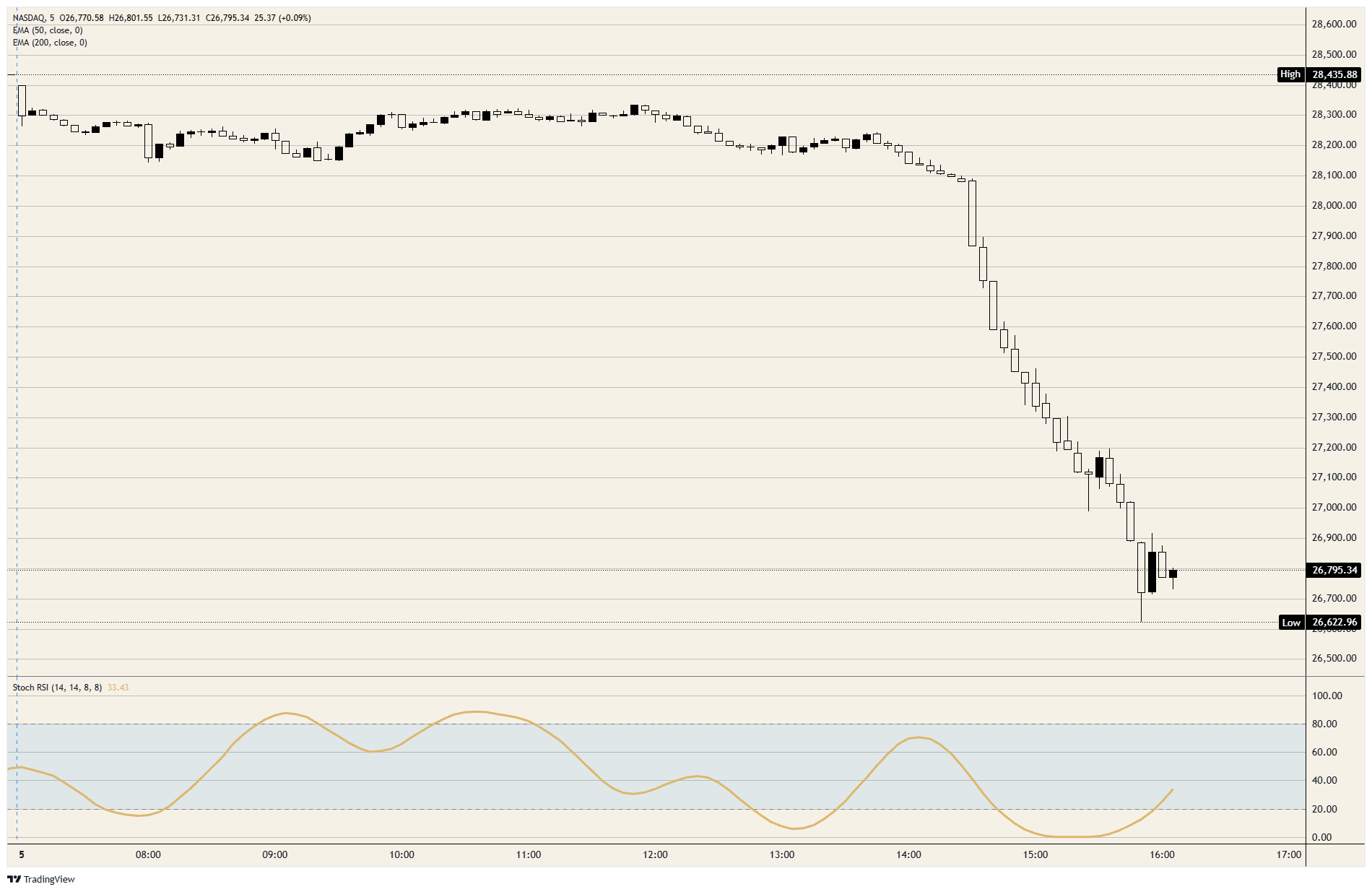
Democratic victories in both the upper and lower houses have heightened concerns that AI data centre projects could encounter renewed moratoriums and regulatory pressure. The resulting wave of selling in AI-linked shares is leaving Wall Street on course for one of its worst sessions in recent memory.
Sharp losses in the AI sector's 'pick and shovel' businesses have fuelled concerns about repercussions for microchip and semiconductor companies, pushing the wider market lower. A decline of around 1,400 points has left the Nasdaq technology index down 5%; the S&P 500 and Dow Jones Industrial Average have lost roughly 3% and 2%, respectively.

According to Fitch, incoming governors in Texas, Georgia and Ohio could impose regulatory obstacles affecting a substantial proportion of planned data centre capacity. The NASDAQ 100's largest companies either build that capacity or supply it.
Based in the US, the Nasdaq began as an electronic system for stock quotations before developing into a stock exchange. Its initial role was limited to quoting over-the-counter (OTC) stocks. By 1991, it accounted for 46% of the entire US securities market, and in 1998 it became the country's first stock exchange to offer online trading. Several indices are also compiled by the Nasdaq. These include the Nasdaq 100 and, most comprehensively, the Nasdaq Composite, which covers all 2,500-plus stocks listed on the exchange.
Comprising 100 non-financial companies listed on the Nasdaq stock exchange, the Nasdaq 100 is a large-cap index. This small share of the exchange's thousands of stocks nevertheless accounts for over 90% of its movement. Each constituent's influence is weighted by market capitalisation. Technology-focused businesses feature prominently, alongside companies from other industries and those based outside the US. Since 1986, the Nasdaq 100 has delivered an average annual return of 17.23%.
Traders can gain exposure to the Nasdaq 100 through several instruments. Contracts for difference (CFD) are available for bets through most retail brokers and spread betting platforms. For investors with a longer-term horizon, exchange-traded funds (ETFs), such as the Invesco QQQ Trust (QQQ), trade like shares and track the index's movements without requiring purchases of all 100 constituent companies. Futures contracts on the Nasdaq 100 enable speculation on the index's future direction. Options, meanwhile, give holders the right, without an obligation, to buy or sell the Nasdaq 100 at a specified price (the strike price) in the future.
The combined performance of its constituent companies, as reported in quarterly and annual earnings releases, is the principal driver of the Nasdaq 100, although numerous other factors play a part. Economic data from the US and elsewhere also shape investor sentiment, with positive sentiment supporting gains. Interest rates set by the Federal Reserve (Fed) affect the index through the cost of borrowing, on which many companies depend heavily. Inflation can therefore be another important influence, alongside other indicators that inform the Fed's decisions.







Phone: +61 2 8036 8388
Fax: +61 2 8036 8388
Email: support@tmgm.com



The information provided on this website is of a general nature only and does not constitute personal financial advice. Before acting on any information on this website, you should consider the suitability of the information in relation to your objectives, financial situation and needs. Investing in CFDs and FX Margin Contracts carries significant risks and is not suitable for all investors. You may lose more than your initial deposit. You do not own, or have, any interest in the underlying asset. We recommend that you seek independent advice and ensure you fully understand the risks involved before trading. It is important that you read and consider the disclosure document before you acquire any product listed on the website. The information and advertisements offered on this website are not intended for use by any person in any country or jurisdiction where such use would be contrary to local laws and regulations. The Products and Services offered on this website are not intended for residents of the United States, Malaysia and Thailand.
TMGM is authorized and regulated in various jurisdictions.
Trademax Australia Limited, trading as TMGM, is regulated by the Australian Securities and Investments Commission (ASIC), AFSL no. 436416 and is located at Level 28, One International Tower, 100 Barangaroo Avenue, 2000 Sydney, NSW Australia.
Email: support@tmgm.com.au
Trademax Global Limited, trading as TMGM, is authorized and regulated by the Vanuatu Financial Services Commission (VFSC), registration number 40356 and registered at 1276, Kumul Highway, Port Vila, Vanuatu, Republic of Vanuatu.
Email: support@tmgm.com
Trademax Global Markets (SE) Limited, trading as TMGM, is authorized and regulated by the Financial Services Authority (FSA) of Seychelles, with license number SD224. The company is registered at Office No 13, Providence Estate ABIS Centre, Mahe, Seychelles.
Email: support@tmgm.com
Trademax Global Markets (International) Pty Ltd, trading as TMGM, is authorized and regulated by the Financial Services Commission, Mauritius (FSC) with license no. GB22201012, and registered at 33, Edith Cavell Street C/o IQ EQ Fund Services (Mauritius) Ltd Port Louis, 11324 Mauritius.
Email: support@tmgm.com
Copyright © TMGM. All rights reserved


