
News & AnalysisCareer

Expectations of a hawkish Federal Reserve (Fed) at its December meeting, the risk of renewed escalation in Middle East conflicts and a further upward revision to Alphabet’s Artificial Intelligence (AI) spending plans are weighing heavily on Silver. Against these headwinds, the Silver price (XAG/USD) touches a new 11-month low around $52.60 in Thursday’s European trading session.
Following September’s increase, the Fed held the fed funds rate at 3.75–4.00%, delivering the widely expected pause, according to analysts at MUFG/BTMU. However, they emphasise that the decision "included two dissents in favour of another rate increase," reflecting the committee’s persistent hawkish leanings. The analysts also point out that Fed Chair Kevin Warsh "reiterated the Fed’s commitment to returning inflation to 2%".
Investors continue to anticipate additional action this year, MUFG/BTMU say, noting that "markets continue to price around an 87% probability of a December rate hike," in their assessment.
In principle, Fed interest rate increases are unfavourable for assets that pay no yield, including Silver.
An immediate adverse reaction in Silver is nevertheless less likely, given that financial markets have been confident for weeks that the central bank will raise rates in December.
In a note, Deutsche Bank strategists stated that "the Wall Street Journal (WSJ) reported the United States (US) President Donald Trump’s administration warning Gulf states to be prepared for a new operation against Iran after the midterms." Meanwhile, Danske Bank’s research team points to further support from geopolitical concerns: in his post-election address, Israel’s Prime Minister (PM) Benjamin Netanyahu raised the prospect of “renewed joint action with President Trump against Iran”.
Although concerns about renewed escalation in the Middle East have strengthened expectations of a bullish outlook for oil, WTI Oil is trading 0.5% lower at around $100.74 at the time of writing. That decline rules out expectations of an immediate bearish effect on Silver.
Alphabet kept its full-year capital expenditure forecast unchanged on Wednesday. This followed an increase in guidance to between $195 billion and $205 billion during the second quarter (Q2), from $190 billion in its Q3 earnings call. Annual capex is forecast to surpass $200 billion and then exceed $300 billion in 2027. CNBC reported that Alphabet finance chief Anat Ashkenazi told analysts on an earnings call: “We continue to expect our capex to increase significantly in 2027, and will provide further details on our Q4 call,” in outlining the company’s plans.
Yields on government-backed securities are likely to rise following an upward revision to US hyperscalers’ AI spending plans. This would make non-yielding assets such as Silver less attractive.
Meta likewise reaffirmed substantial AI infrastructure spending plans last week. In a note, Deutsche Bank observed that Meta has “slightly boosted its 2026 capex plan from a $130bn-145bn range to $135bn-145bn,” reflecting its ongoing commitment to AI investment.
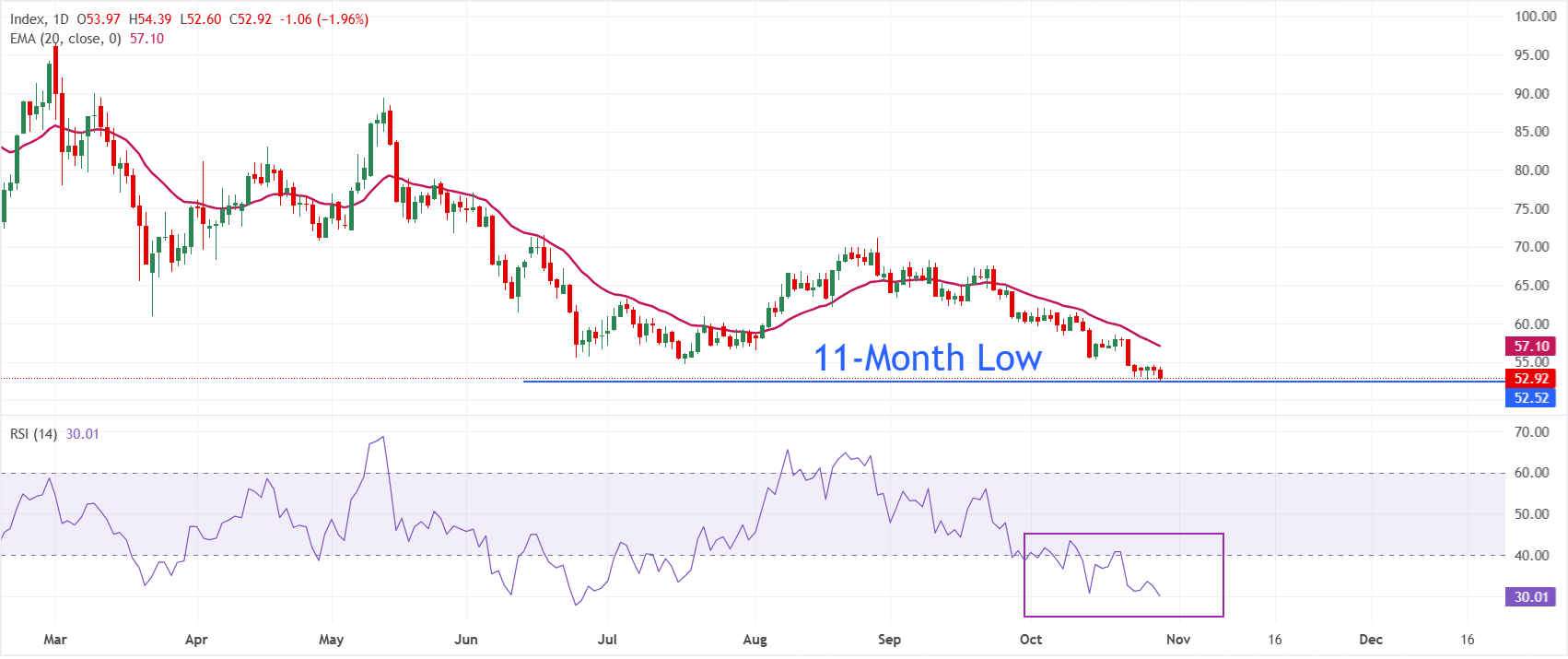
Trading at $52.91 on the daily chart, XAG/USD retains a bearish near-term bias, with spot prices well beneath the 20-day Exponential Moving Average (EMA) of $57.10. Remaining below this short-term trend indicator suggests that rallies are likely to meet resistance. Meanwhile, a Relative Strength Index (RSI) reading of 30.01 moves into oversold territory, suggesting that downward momentum is stretched without yet showing a reversal.
The first upside hurdle is the 20-day EMA at $57.10. Recoveries are likely to encounter selling there unless buyers establish a sustained daily close above that level. As noted earlier, an RSI close to 30 indicates oversold conditions, which could temporarily cushion the downtrend. Nevertheless, the technical outlook will continue to favour renewed weakness on corrective rebounds until XAG/USD regains the $57 area.
(The technical analysis of this story was written with the help of an AI tool. Find out more.)
Widely traded by investors, Silver is a precious metal with a long history as both a store of value and a means of exchange. Gold remains more popular, but traders may choose Silver for its intrinsic worth, to diversify their portfolios or as a possible hedge in periods of high inflation. Exposure can take the form of physical coins or bars, or investment vehicles such as Exchange Traded Funds that follow Silver’s price on international markets.
A broad set of influences can move Silver prices. Its safe-haven status means that geopolitical turmoil or concerns about a severe recession can lift its price, though less markedly than Gold’s. Lower interest rates also tend to support Silver because it pays no yield. With the metal priced in dollars (XAG/USD), movements in the US Dollar (USD) matter too: a firmer Dollar generally restrains Silver prices, while a weaker currency is likely to push them higher. Investment demand, recycling rates and mining supply can also influence prices; Silver is far more abundant than Gold.
Among metals, Silver has one of the highest levels of electrical conductivity, exceeding both Copper and Gold. This makes it widely used in industry, notably electronics and solar energy. Stronger demand can push prices up, whereas falling demand tends to bring them down. Developments in the US, Chinese and Indian economies can also cause price fluctuations. Large industrial sectors in the US, and especially China, use Silver in numerous processes, while Indian consumer demand for Silver jewellery is another important influence on pricing.
Gold’s price movements are generally mirrored by Silver. Their similar role as safe-haven assets means that a rise in Gold typically brings a corresponding increase in Silver. To assess the metals’ relative valuations, investors may use the Gold/Silver ratio: the number of ounces of Silver equal in value to one ounce of Gold. A high ratio may be viewed by some investors as a sign that Silver is undervalued or Gold overvalued. Conversely, a low ratio could indicate that Gold is undervalued compared with Silver.







Phone: +61 2 8036 8388
Fax: +61 2 8036 8388
Email: support@tmgm.com



The information provided on this website is of a general nature only and does not constitute personal financial advice. Before acting on any information on this website, you should consider the suitability of the information in relation to your objectives, financial situation and needs. Investing in CFDs and FX Margin Contracts carries significant risks and is not suitable for all investors. You may lose more than your initial deposit. You do not own, or have, any interest in the underlying asset. We recommend that you seek independent advice and ensure you fully understand the risks involved before trading. It is important that you read and consider the disclosure document before you acquire any product listed on the website. The information and advertisements offered on this website are not intended for use by any person in any country or jurisdiction where such use would be contrary to local laws and regulations. The Products and Services offered on this website are not intended for residents of the United States, Malaysia and Thailand.
TMGM is authorized and regulated in various jurisdictions.
Trademax Australia Limited, trading as TMGM, is regulated by the Australian Securities and Investments Commission (ASIC), AFSL no. 436416 and is located at Level 28, One International Tower, 100 Barangaroo Avenue, 2000 Sydney, NSW Australia.
Email: support@tmgm.com.au
Trademax Global Limited, trading as TMGM, is authorized and regulated by the Vanuatu Financial Services Commission (VFSC), registration number 40356 and registered at 1276, Kumul Highway, Port Vila, Vanuatu, Republic of Vanuatu.
Email: support@tmgm.com
Trademax Global Markets (SE) Limited, trading as TMGM, is authorized and regulated by the Financial Services Authority (FSA) of Seychelles, with license number SD224. The company is registered at Office No 13, Providence Estate ABIS Centre, Mahe, Seychelles.
Email: support@tmgm.com
Trademax Global Markets (International) Pty Ltd, trading as TMGM, is authorized and regulated by the Financial Services Commission, Mauritius (FSC) with license no. GB22201012, and registered at 33, Edith Cavell Street C/o IQ EQ Fund Services (Mauritius) Ltd Port Louis, 11324 Mauritius.
Email: support@tmgm.com
Copyright © TMGM. All rights reserved

