
News & AnalysisCareer

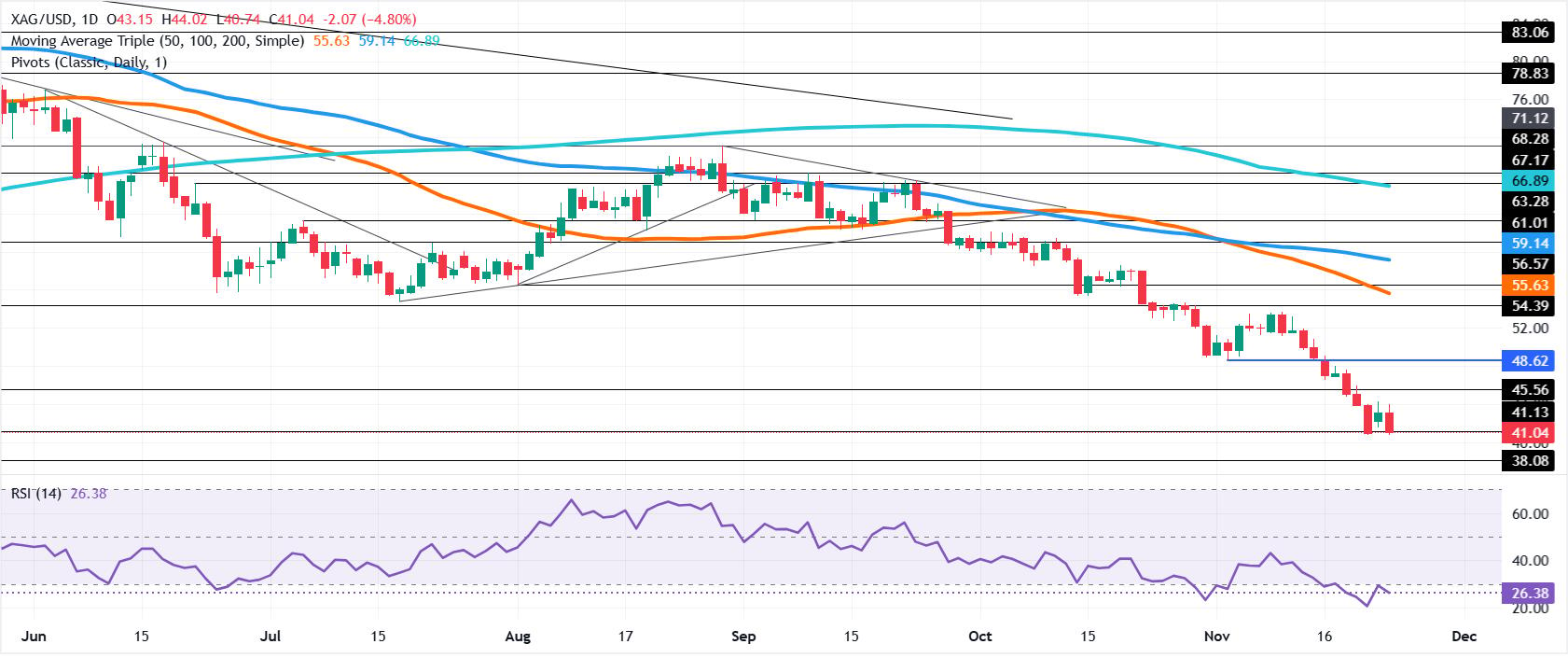
Wednesday’s US inflation report could solidify the case for a Fed rate hike in December and shape the interest-rate path in 2027. Ahead of the release, Silver falls more than 4.70% on Tuesday, giving back part of Monday’s advance. XAG/YSD is trading at $41.06.

A continuing pattern of lower highs and lower lows keeps Silver’s downward trend intact. Meanwhile, the Simple Moving Averages (SMAs) sit well above XAG’s spot price, reinforcing the picture of a market dominated by sellers.
As the Relative Strength Index (RSI) nears oversold territory, it signals that momentum remains on the sellers’ side. The white metal therefore faces a path of least resistance to the downside.
At $40.00, Silver faces its initial support level. Below that threshold, the daily low of $38.08 recorded on 22 August 2025 would come into focus, ahead of $35.00. Further down, $30.00 is the next level.
A move above $45,0 is required for a bullish reversal in XAG/USD. Buyers could then test $48.62, the 3 November swing low that now acts as resistance. Clearing that level would bring $50.00 into view.
Historically a store of value and a means of exchange, Silver remains an actively traded precious metal. Gold attracts greater interest, but traders may choose Silver for its intrinsic value, to diversify their portfolios or as a potential hedge against high inflation. Exposure is available through physical coins and bars, or through instruments such as Exchange Traded Funds that follow Silver’s price in international markets.
A broad set of influences can drive Silver prices. Its safe-haven appeal can lift prices during geopolitical turmoil or amid concerns about a severe recession, though the effect is generally smaller than for Gold. Lower interest rates also tend to support Silver because it pays no yield. With the metal quoted in dollars (XAG/USD), movements in the US Dollar (USD) are another important influence: a stronger Dollar tends to restrain Silver prices, while a weaker currency is likely to push them higher. Investment demand, the supply from mines and recycling rates can also move prices; Silver is considerably more abundant than Gold.
Among metals, Silver has one of the highest levels of electrical conductivity, exceeding both Copper and Gold. This makes it widely used in industrial applications, notably electronics and solar energy. Stronger demand can push prices higher, whereas weaker demand tends to weigh on them. Economic developments in the US, China and India can also generate price fluctuations. Large industrial sectors in the US and, especially, China consume Silver in a range of processes, while Indian consumers’ demand for Silver jewellery is another important influence on prices.
Given the two metals’ similar safe-haven status, gains in Gold are usually accompanied by a rise in Silver, whose prices tend to track Gold’s movements. Their relative valuation may be assessed using the Gold/Silver ratio: the number of ounces of Silver equivalent in value to one ounce of Gold. A high reading may be interpreted by some investors as a sign that Silver is undervalued or Gold overvalued. A low reading, by contrast, might indicate that Gold is undervalued compared with Silver.







Phone: +61 2 8036 8388
Fax: +61 2 8036 8388
Email: support@tmgm.com



The information provided on this website is of a general nature only and does not constitute personal financial advice. Before acting on any information on this website, you should consider the suitability of the information in relation to your objectives, financial situation and needs. Investing in CFDs and FX Margin Contracts carries significant risks and is not suitable for all investors. You may lose more than your initial deposit. You do not own, or have, any interest in the underlying asset. We recommend that you seek independent advice and ensure you fully understand the risks involved before trading. It is important that you read and consider the disclosure document before you acquire any product listed on the website. The information and advertisements offered on this website are not intended for use by any person in any country or jurisdiction where such use would be contrary to local laws and regulations. The Products and Services offered on this website are not intended for residents of the United States, Malaysia and Thailand.
TMGM is authorized and regulated in various jurisdictions.
Trademax Australia Limited, trading as TMGM, is regulated by the Australian Securities and Investments Commission (ASIC), AFSL no. 436416 and is located at Level 28, One International Tower, 100 Barangaroo Avenue, 2000 Sydney, NSW Australia.
Email: support@tmgm.com.au
Trademax Global Limited, trading as TMGM, is authorized and regulated by the Vanuatu Financial Services Commission (VFSC), registration number 40356 and registered at 1276, Kumul Highway, Port Vila, Vanuatu, Republic of Vanuatu.
Email: support@tmgm.com
Trademax Global Markets (SE) Limited, trading as TMGM, is authorized and regulated by the Financial Services Authority (FSA) of Seychelles, with license number SD224. The company is registered at Office No 13, Providence Estate ABIS Centre, Mahe, Seychelles.
Email: support@tmgm.com
Trademax Global Markets (International) Pty Ltd, trading as TMGM, is authorized and regulated by the Financial Services Commission, Mauritius (FSC) with license no. GB22201012, and registered at 33, Edith Cavell Street C/o IQ EQ Fund Services (Mauritius) Ltd Port Louis, 11324 Mauritius.
Email: support@tmgm.com
Copyright © TMGM. All rights reserved


