
News & AnalysisCareer

At around $43.20, Silver (XAG/USD) is little changed in Tuesday’s Asian session, retaining its recovery gains. The rebound followed last week’s slide to a fresh 14-month low of $40.78.
Oversold indicators following last week’s turmoil appear to explain Silver’s rebound better than any structural change. Financial markets, meanwhile, are becoming more convinced that the Federal Reserve (Fed) will deliver consecutive interest rate increases in the near term.

According to Rabobank analysts, the OIS curve now “implies that investors are positioned for a full hike in December, followed by close to 70% of a 25bp hike priced in for the January meeting,” an arrangement they describe as “in line with Waller’s comments, after having moved from one of the most hawkish to one of the most dovish FOMC members and now back among the most hawkish.” His latest guidance has also grown more explicit, Rabobank says, citing “recent calls…for either a 50bp hike at the December meeting or a 25bp hike accompanied by clear forward guidance from Warsh that an additional hike will follow in January,” which highlights the market’s renewed attention to a more forceful Fed tightening path.
For assets that pay no yield, including Silver, higher Fed interest rates are theoretically unfavourable.
Precious metals are also likely to become less attractive as global Artificial Intelligence (AI) shares regain considerable appeal following chipmaker Nvidia’s board calling Jensen Huang back to lead the company into the future.
Nvidia’s share price surged by more than 31% in a single trading day after the company called for Jensen Huang’s return on Monday.
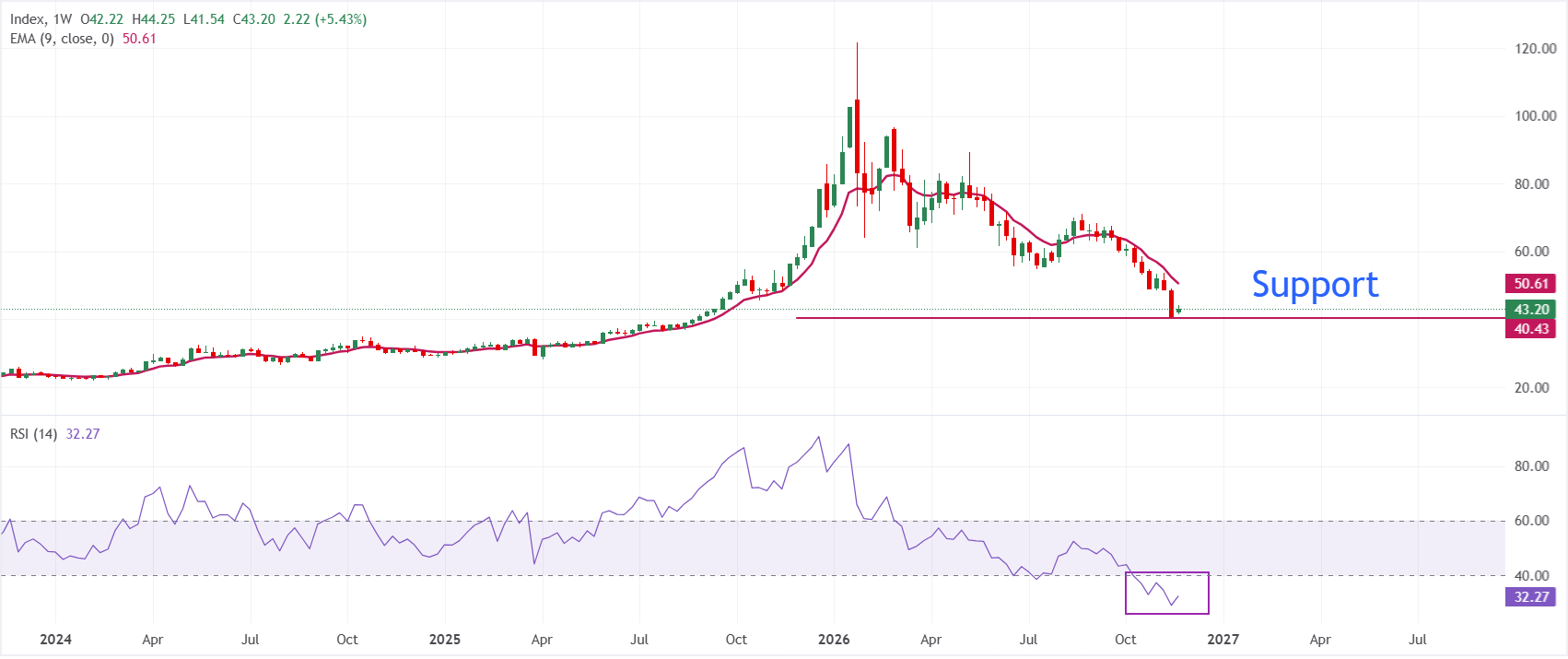
With XAG/USD trading at $43.18 on the weekly chart, the near-term outlook remains bearish: the price is still well beneath the 9-period exponential moving average (EMA) of $50.61. That sizeable gap below the EMA points to continued selling pressure. At 32.24, the Relative Strength Index (RSI) sits close to oversold territory, suggesting that downward momentum still prevails but could be becoming stretched.
The 9-period EMA of $50.61 provides the first resistance on any advance. While the price stays below it, this level constrains recovery attempts and maintains the broader bearish structure. On the downside, last week’s low of $40.78 provides key support.
(The technical analysis of this story was written with the help of an AI tool. Know more.)
Historically a store of value and a means of exchange, Silver remains a heavily traded precious metal among investors. Gold is more popular, but traders may choose Silver for its intrinsic value, to diversify their portfolios or as a possible hedge when inflation is high. Exposure can take the form of physical Silver coins or bars, or instruments such as exchange-traded funds that follow its price on international markets.
A broad range of influences can drive movements in Silver. Its safe-haven role means geopolitical instability or concerns about a severe recession can lift prices, though less strongly than for Gold. Lower interest rates also tend to support Silver because it pays no yield. As Silver is denominated in dollars (XAG/USD), the performance of the US Dollar (USD) matters too: dollar strength tends to restrain prices, while a weaker dollar is likely to lift them. Investment demand, recycling rates and mine supply can also influence prices, with Silver far more abundant than Gold.
With electrical conductivity among the highest of any metal, exceeding that of Copper and Gold, Silver has extensive industrial uses, notably in electronics and solar energy. A sharp increase in demand can push prices higher, whereas falling demand generally weighs on them. Developments in the US, Chinese and Indian economies can also drive price fluctuations. Large industrial sectors in the US and especially China consume Silver in a variety of processes, while Indian consumers’ demand for Silver jewellery is another important influence on prices.
Gold’s price movements are often mirrored by Silver, which typically rises alongside Gold because the two metals share a similar safe-haven status. Their relative valuations can be assessed using the Gold/Silver ratio: the number of ounces of Silver required to match the value of one ounce of Gold. A high reading may, in some investors’ view, signal that Silver is undervalued or Gold overvalued. Conversely, a low reading could indicate that Gold is undervalued compared with Silver.







Phone: +61 2 8036 8388
Fax: +61 2 8036 8388
Email: support@tmgm.com



The information provided on this website is of a general nature only and does not constitute personal financial advice. Before acting on any information on this website, you should consider the suitability of the information in relation to your objectives, financial situation and needs. Investing in CFDs and FX Margin Contracts carries significant risks and is not suitable for all investors. You may lose more than your initial deposit. You do not own, or have, any interest in the underlying asset. We recommend that you seek independent advice and ensure you fully understand the risks involved before trading. It is important that you read and consider the disclosure document before you acquire any product listed on the website. The information and advertisements offered on this website are not intended for use by any person in any country or jurisdiction where such use would be contrary to local laws and regulations. The Products and Services offered on this website are not intended for residents of the United States, Malaysia and Thailand.
TMGM is authorized and regulated in various jurisdictions.
Trademax Australia Limited, trading as TMGM, is regulated by the Australian Securities and Investments Commission (ASIC), AFSL no. 436416 and is located at Level 28, One International Tower, 100 Barangaroo Avenue, 2000 Sydney, NSW Australia.
Email: support@tmgm.com.au
Trademax Global Limited, trading as TMGM, is authorized and regulated by the Vanuatu Financial Services Commission (VFSC), registration number 40356 and registered at 1276, Kumul Highway, Port Vila, Vanuatu, Republic of Vanuatu.
Email: support@tmgm.com
Trademax Global Markets (SE) Limited, trading as TMGM, is authorized and regulated by the Financial Services Authority (FSA) of Seychelles, with license number SD224. The company is registered at Office No 13, Providence Estate ABIS Centre, Mahe, Seychelles.
Email: support@tmgm.com
Trademax Global Markets (International) Pty Ltd, trading as TMGM, is authorized and regulated by the Financial Services Commission, Mauritius (FSC) with license no. GB22201012, and registered at 33, Edith Cavell Street C/o IQ EQ Fund Services (Mauritius) Ltd Port Louis, 11324 Mauritius.
Email: support@tmgm.com
Copyright © TMGM. All rights reserved

