
News & AnalysisCareer

Following the previous day’s correction, Wednesday brings a recovery for the US Dollar (USD) against its major counterparts. At the time of writing, a 0.2% gain leaves the US Dollar Index (DXY) near 104.05. The index tracks the Greenback against a basket of six major currencies.

With October’s United States (US) Personal Consumption Expenditure (PCE) Price Index due at 13:30 GMT, investor caution is underpinning the DXY’s rebound.
October’s PCE figures have become the clear focus, according to analysts at Commerzbank. The bank notes that “the Bloomberg consensus expects headline PCE inflation to pick up to 3.8% yoy from 3.6% in September.” A slight strengthening in the underlying trend is also anticipated, with the analysts adding that “the core PCE deflator is expected at 3.2% yoy from 3.1% previously,” highlighting expectations for a modest renewed acceleration in the Fed’s preferred inflation measures.
Expectations for Federal Reserve (Fed) interest rates are likely to be strongly influenced by the US PCE inflation figures. For now, traders are confident of a Fed rate increase at December’s policy meeting, according to the CME FedWatch tool.
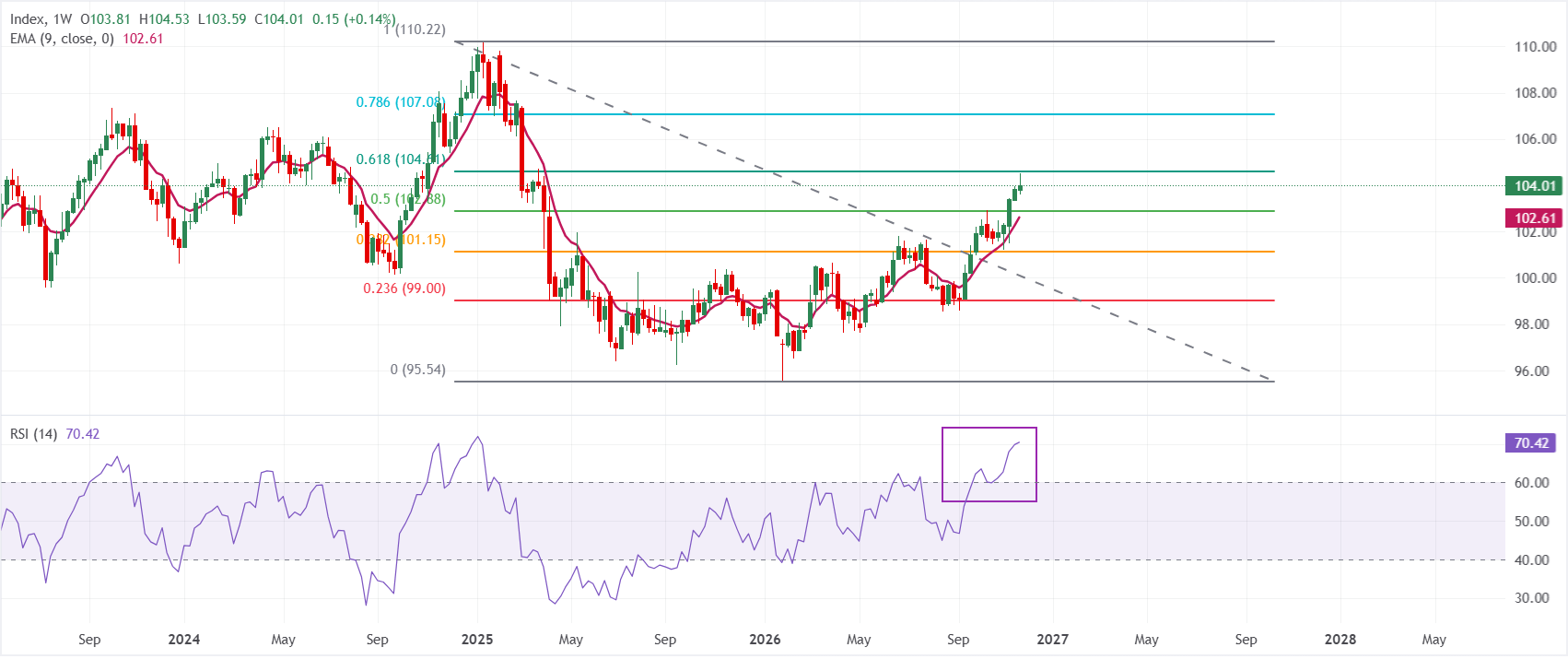
A weekly chart reading of 104.01 leaves Dollar Index Spot above its 9-week exponential moving average (EMA) of 102.61 and the 50.0% Fibonacci retracement at 102.88. That positioning maintains a bullish near-term bias as the index tests further into the upper half of its recent range. Meanwhile, the Relative Strength Index (14) has reached overbought territory at 70.42. This signals robust upward momentum, but also suggests the rally risks becoming overstretched as it approaches the next Fibonacci hurdles.
The first upside barrier lies at 104.61, the 61.8% Fibonacci retracement. Beyond that, resistance comes at the 78.6% level near 107.08, followed by the cycle-high region at 110.22, corresponding to the 100% retracement. Should the index retreat, the 50.0% retracement at 102.88 offers initial support alongside the nearby 9-week EMA at 102.61. Further down, structural support lies at the 38.2% retracement of 101.15 and the 23.6% level of 99.00, before the anchor low of 95.54.
(The technical analysis of this story was written with the help of an AI tool. Know more.)
The increase in the cost of a representative basket of goods and services is measured by inflation. Headline inflation is generally reported as a percentage change both month-on-month (MoM) and year-on-year (YoY). By stripping out more volatile components, including food and fuel, core inflation excludes prices that can swing with geopolitical developments and seasonal influences. Economists concentrate on this core measure, which is also targeted by central banks under their mandate to maintain inflation at a manageable rate, typically around 2%.
Changes in the prices of a basket of goods and services over time are captured by the Consumer Price Index (CPI). The measure is generally reported as a percentage change month-on-month (MoM) and year-on-year (YoY). Central banks target core CPI because it strips out volatile food and fuel components. A core CPI reading above 2% typically leads to higher interest rates, while a reading below 2% tends to produce the reverse. Higher rates support a currency, so rising inflation generally strengthens it; falling inflation usually has the opposite effect.
A country’s currency tends to strengthen when inflation is high and weaken when inflation is lower, despite this relationship appearing counter-intuitive. The explanation lies in monetary policy: central banks normally raise interest rates to tackle higher inflation. Those higher rates draw in more global capital from investors seeking attractive returns on their money.
Historically, investors sought out Gold during periods of high inflation for its ability to retain value. Although its safe-haven qualities still often attract buyers during severe market turmoil, that pattern no longer holds most of the time. High inflation prompts central banks to raise interest rates in response. For Gold, higher rates are a headwind: they raise the opportunity cost of owning the metal rather than holding an interest-bearing asset or keeping money in a cash deposit account. Conversely, lower inflation generally supports Gold by bringing interest rates down and making the precious metal a more attractive investment alternative.







Phone: +61 2 8036 8388
Fax: +61 2 8036 8388
Email: support@tmgm.com



The information provided on this website is of a general nature only and does not constitute personal financial advice. Before acting on any information on this website, you should consider the suitability of the information in relation to your objectives, financial situation and needs. Investing in CFDs and FX Margin Contracts carries significant risks and is not suitable for all investors. You may lose more than your initial deposit. You do not own, or have, any interest in the underlying asset. We recommend that you seek independent advice and ensure you fully understand the risks involved before trading. It is important that you read and consider the disclosure document before you acquire any product listed on the website. The information and advertisements offered on this website are not intended for use by any person in any country or jurisdiction where such use would be contrary to local laws and regulations. The Products and Services offered on this website are not intended for residents of the United States, Malaysia and Thailand.
TMGM is authorized and regulated in various jurisdictions.
Trademax Australia Limited, trading as TMGM, is regulated by the Australian Securities and Investments Commission (ASIC), AFSL no. 436416 and is located at Level 28, One International Tower, 100 Barangaroo Avenue, 2000 Sydney, NSW Australia.
Email: support@tmgm.com.au
Trademax Global Limited, trading as TMGM, is authorized and regulated by the Vanuatu Financial Services Commission (VFSC), registration number 40356 and registered at 1276, Kumul Highway, Port Vila, Vanuatu, Republic of Vanuatu.
Email: support@tmgm.com
Trademax Global Markets (SE) Limited, trading as TMGM, is authorized and regulated by the Financial Services Authority (FSA) of Seychelles, with license number SD224. The company is registered at Office No 13, Providence Estate ABIS Centre, Mahe, Seychelles.
Email: support@tmgm.com
Trademax Global Markets (International) Pty Ltd, trading as TMGM, is authorized and regulated by the Financial Services Commission, Mauritius (FSC) with license no. GB22201012, and registered at 33, Edith Cavell Street C/o IQ EQ Fund Services (Mauritius) Ltd Port Louis, 11324 Mauritius.
Email: support@tmgm.com
Copyright © TMGM. All rights reserved


