

Trading
Explore a wide range of markets with competitive pricing, deep liquidity, and advanced trading tools.
Learn More 
Platform
Trade seamlessly with TMGM's powerful platform, built for speed, precision, and a superior trading experience.
Learn More Trading Platform
Academy
Learn the fundamentals of trading with beginner-friendly resources, including guides, webinars, and market insights.
Learn More News & Analysis
Get real-time market updates and expert analysis to stay ahead of trading opportunities
Learn More News & Analysis
About
Learn what sets TMGM apart — our global presence, regulatory strength, and commitment to innovation in trading.
Learn More Why Choose TMGM
Sponsorship
AUD/USD Price Forecast: Is a further fall towards 0.6660 likely?
- Selling pressure leaves the Australian Dollar weaker against its major currency peers.
- Another RBA interest rate increase would face a very high threshold, according to financial experts.
- At 1.1%, the rise in Australia's Q3 Wage Growth Index exceeds expectations.
Selling pressure weighs on the Australian Dollar (AUD) against its major currency peers on Wednesday, with the currency down 0.2% near 0.6720 against the US Dollar (USD) in the European session. Heightened concerns over the economy have led market experts to question whether the Reserve Bank of Australia (RBA) will extend its monetary tightening cycle, weighing on the AUD.

Will the RBA stay on hold as minutes point to a high threshold for further tightening?
With the RBA having only just raised its policy rate to 4.85%, Commerzbank analysts say the latest minutes “underscore once again that the threshold for another rate hike is likely to be rather high,” describing the rate as “its highest level since the global financial crisis in 2008” and already “well above the RBA’s estimate of the neutral rate of around 3-4%.” The analysts draw attention to the warning that “the three members who voted against the latest rate hike warned that the economy could already be close to a sharper downturn,” which, in their assessment, “suggests that the RBA is likely to be cautious about further rate hikes for now.”
An upside inflation surprise could nevertheless alter that assessment. Commerzbank cautions that “the picture could still change: if next week’s inflation print comes in well above expectations, another rate hike cannot be ruled out.” Its overall conclusion, however, is that “overall…the threshold for further tightening appears rather high,” leaving the bank expecting the RBA “to remain on hold until there is more clarity on the inflation path.”
Faster wage growth could rekindle concerns about additional RBA interest rate increases in the near term. Australia's Q3 Wage Growth Index, released during the day, rose 1.1%, exceeding the 1% forecast and the previous reading of 0.7%.
AUD/USD Technical Analysis: Could Oversold Conditions Pause the Decline?
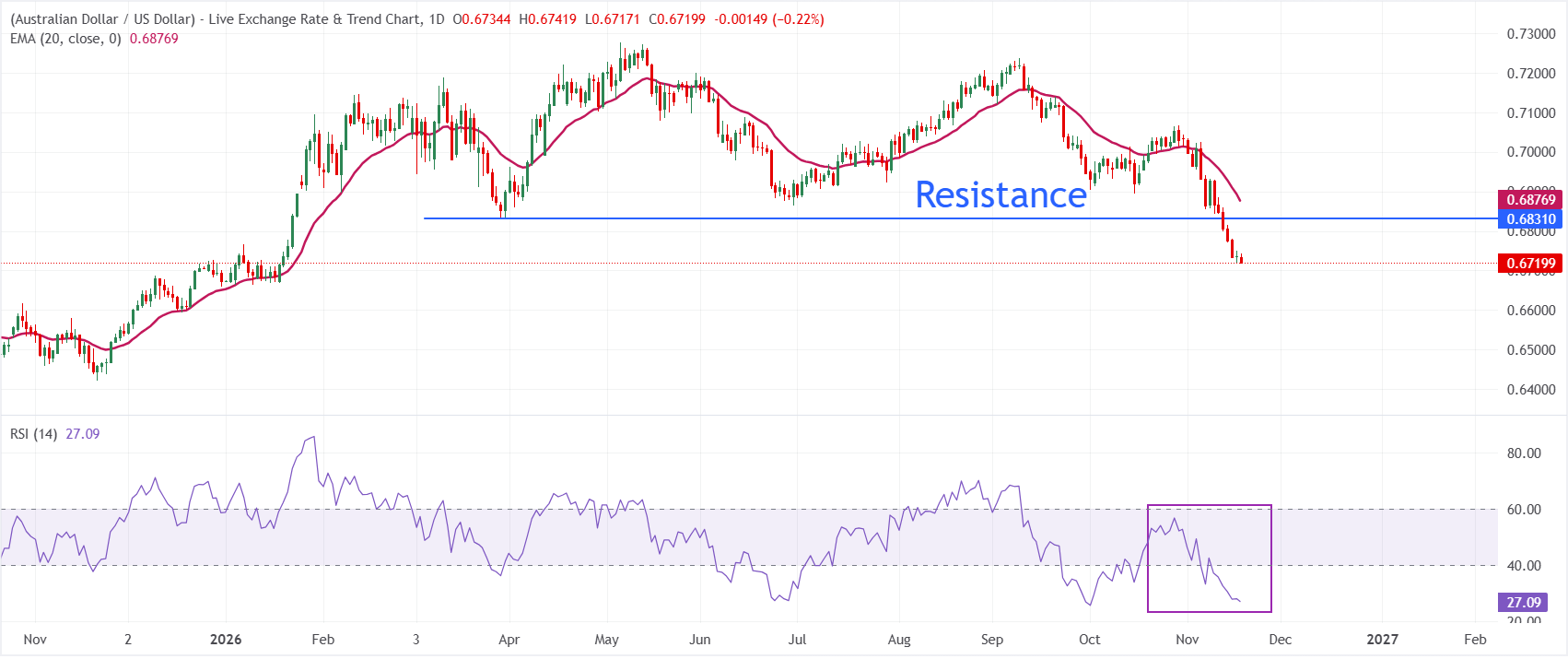
A bearish near-term outlook prevails on the daily AUD/USD chart, with the pair at 0.6720, well below its 20-day exponential moving average (EMA) of 0.6877. Trading beneath this dynamic resistance keeps the pair under pronounced downward pressure. However, with the Relative Strength Index (14) around 27, oversold conditions suggest that the latest decline may give way to a corrective pause rather than immediately gather pace, even as sellers retain control.
The March 30 low of 0.6733 marks the first resistance on any recovery, after the break below that level triggered a steep fall. Further weakness, meanwhile, could take the pair towards 0.6660.
(The technical analysis of this story was written with the help of an AI tool. Know more.)
Economic Data in Focus
Wage Price Index (QoQ)
Published by the Australian Bureau of Statistics, the Wage Price Index measures labour cost inflation and provides an indication of labour market tightness. It is closely monitored by the Reserve Bank of Australia in its interest rate decisions. For the AUD, a high reading is positive (or bullish), whereas a low reading is regarded as negative (or bearish).
Explore further.Most recent release: Wed 18 Nov 2026 00:30
Release frequency: Every quarter
Reported figure: 1.1%
Consensus estimate: 1%
Prior reading: 0.8%
Data source: Australian Bureau of Statistics
POPULAR ARTICLES
1AUD/USD Price Forecast: Is a further fall towards 0.6660 likely?2Euro: A further slide against US Dollar to 1.0950 is less likely – UOB3Solana Price Forecast: First ETF inflow in three weeks accompanies SOL’s recovery to $754Euro weakens below 1.1000 as December Fed hike odds increase; focus turns to FOMC Minutes5GBP/USD Price Forecast: Cautious Trading Keeps Pair Near 1.32006US Dollar holds firm ahead of FOMC Meeting Minutes as Swiss Franc loses ground7Indian Rupee extends gains as sustained foreign inflows support Indian equities8Bank Indonesia interest rate decision approaches as Indonesian Rupiah edges lower9KOSPI leads gains as Asian stocks diverge following Nvidia earnings


Get Started!
Sign up and access the Global Markets in less than 3 minutes

Connect With Us









Contacts
Phone: +61 2 8036 8388
Fax: +61 2 8036 8388
Email: support@tmgm.com



The information provided on this website is of a general nature only and does not constitute personal financial advice. Before acting on any information on this website, you should consider the suitability of the information in relation to your objectives, financial situation and needs. Investing in CFDs and FX Margin Contracts carries significant risks and is not suitable for all investors. You may lose more than your initial deposit. You do not own, or have, any interest in the underlying asset. We recommend that you seek independent advice and ensure you fully understand the risks involved before trading. It is important that you read and consider the disclosure document before you acquire any product listed on the website. The information and advertisements offered on this website are not intended for use by any person in any country or jurisdiction where such use would be contrary to local laws and regulations. The Products and Services offered on this website are not intended for residents of the United States, Malaysia and Thailand.
TMGM is authorized and regulated in various jurisdictions.
Trademax Australia Limited, trading as TMGM, is regulated by the Australian Securities and Investments Commission (ASIC), AFSL no. 436416 and is located at Level 28, One International Tower, 100 Barangaroo Avenue, 2000 Sydney, NSW Australia.
Email: support@tmgm.com.au
Trademax Global Limited, trading as TMGM, is authorized and regulated by the Vanuatu Financial Services Commission (VFSC), registration number 40356 and registered at 1276, Kumul Highway, Port Vila, Vanuatu, Republic of Vanuatu.
Email: support@tmgm.com
Trademax Global Markets (SE) Limited, trading as TMGM, is authorized and regulated by the Financial Services Authority (FSA) of Seychelles, with license number SD224. The company is registered at Office No 13, Providence Estate ABIS Centre, Mahe, Seychelles.
Email: support@tmgm.com
Trademax Global Markets (International) Pty Ltd, trading as TMGM, is authorized and regulated by the Financial Services Commission, Mauritius (FSC) with license no. GB22201012, and registered at 33, Edith Cavell Street C/o IQ EQ Fund Services (Mauritius) Ltd Port Louis, 11324 Mauritius.
Email: support@tmgm.com
Copyright © TMGM. All rights reserved