

Trading
Explore a wide range of markets with competitive pricing, deep liquidity, and advanced trading tools.
Learn More 
Platform
Trade seamlessly with TMGM's powerful platform, built for speed, precision, and a superior trading experience.
Learn More Trading Platform
Academy
Learn the fundamentals of trading with beginner-friendly resources, including guides, webinars, and market insights.
Learn More News & Analysis
Get real-time market updates and expert analysis to stay ahead of trading opportunities
Learn More News & Analysis
About
Learn what sets TMGM apart — our global presence, regulatory strength, and commitment to innovation in trading.
Learn More Why Choose TMGM
Sponsorship
Bitcoin Price Forecast: Can BTC Regain $78,000 as ETF Outflows Weigh?
- Selling pressure pushes Bitcoin below $78,000 on Monday, following a fourth consecutive weekly decline.
- Institutional appetite appears softer as US-listed BTC spot ETFs registered $202.59 million in net outflows last week.
- BTC’s attempts to recover remain constrained by subdued market sentiment following last week’s Binance security breach.
Bitcoin (BTC) remains under pressure on Monday, trading below $78,000 at the time of writing after a fourth consecutive weekly decline. Signs of softer institutional appetite are evident in last week’s outflows of over $202 million from spot Exchange Traded Funds (ETFs). Meanwhile, traders remain unsettled by the aftermath of last week’s Binance security breach, restraining the Crypto King’s efforts to recover.

Is softer demand adding to BTC’s pressure?
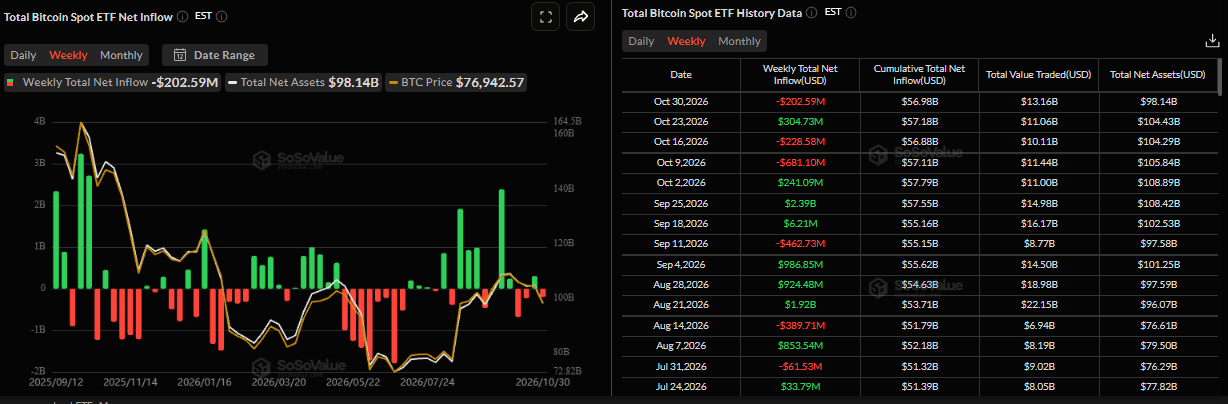
Appetite for Bitcoin among institutional investors appears to be fading. According to SoSoValue, BTC spot ETFs registered net outflows of $202.59 million last week, underscoring weaker investor demand.
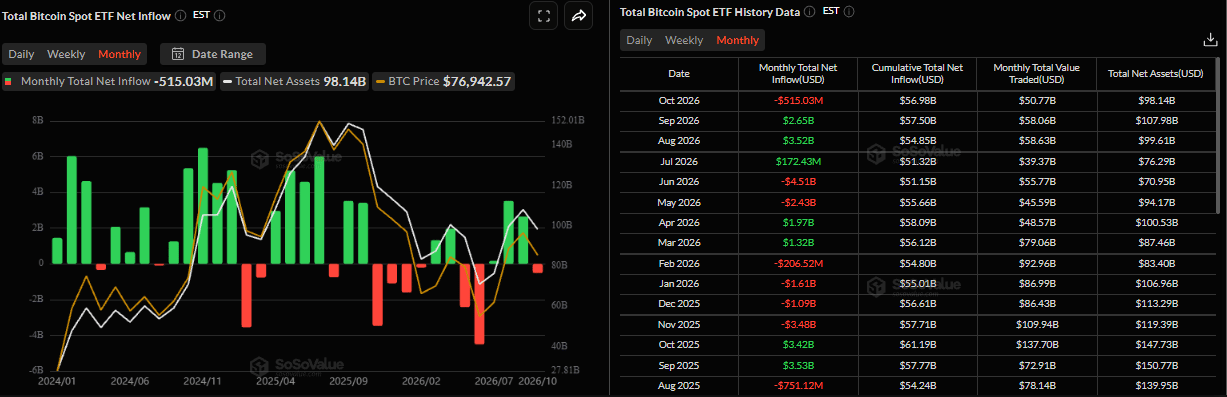
The monthly chart, meanwhile, indicates that October brought $515.03 million in net outflows from spot ETFs, breaking a run of three months of net inflows.
Should these outflows continue or gather pace, additional selling pressure could leave Bitcoin facing a sharper correction.
Can sentiment recover from the Binance security breach?
An estimated $6.3 billion was stolen across ten blockchains in a major security breach at Binance last Thursday. Binance is the largest centralised cryptocurrency exchange.
In a statement on Friday, the exchange said, “It will cover all losses from the Secure Asset Fund for Users (SAFU) fund and the company’s funds. User funds are safe.” It added that its team was carrying out security checks, with withdrawals set to restart only after the issue had been fully resolved.
As Binance resumed operations on Sunday, customers withdrew $3.64 billion, or 2.1% of its assets, Reuters reported. The resumption followed the theft of billions from the platform by hackers whom the FBI links to North Korea.
Following an initial surge on Sunday, withdrawals were stabilising, according to Binance, while deposit volumes remained “substantial.” Binance added that it had recovered or secured 95% of the stolen assets worth $6.3 billion.
The transfer of stolen funds nevertheless remains a concern. On Monday, Wu Blockchain confirmed that approximately $242 million had been moved by the attacker through Tron-related channels within two days. Meanwhile, more than $3 billion in stolen assets across other blockchains remained largely untouched.
A QCP Capital analyst also said the attacker continues to hold the stolen Bitcoin and has begun dividing it into batches of 1,000 BTC and 100 BTC.
Investors remain wary of the breach’s scale, sizeable customer withdrawals and the ongoing transfer of stolen funds, constraining the Crypto King’s recovery.
Bitcoin technical outlook: Is momentum fading?
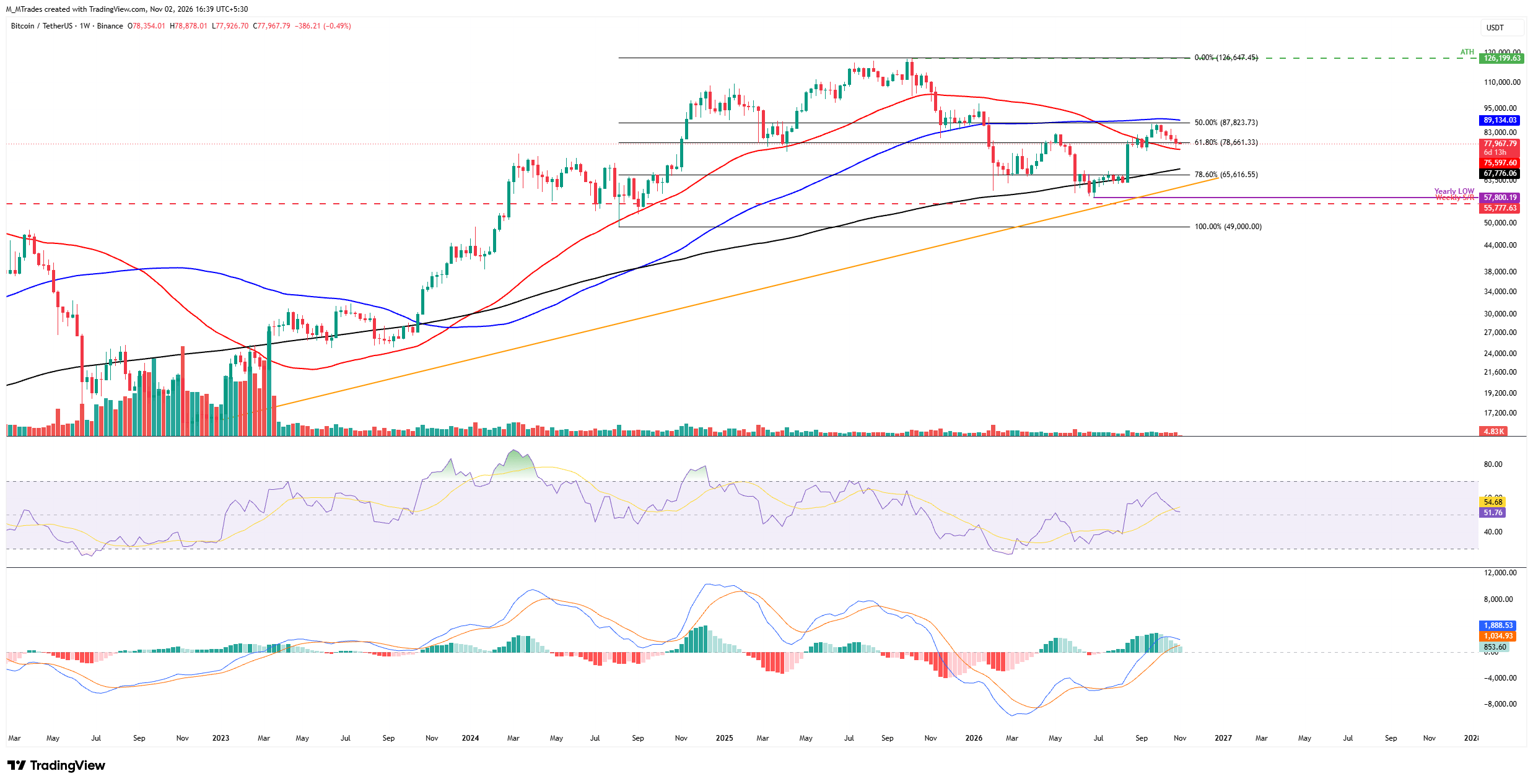
A 2.25% correction last week left the Crypto King with its fourth consecutive weekly decline since early October. BTC starts this week on a weaker footing, trading around $77,967 at the time of writing on Monday.
An extension of BTC’s correction could bring the 50-week Simple Moving Average (SMA) at $75,597 into focus. Should the weekly close fall below that level, further declines towards the 200-week SMA at $67,776 could follow.
At 51, the weekly Relative Strength Index (RSI) sits close to the neutral 50 mark, pointing to a cooling of bullish momentum. The Moving Average Convergence Divergence (MACD) histogram, although still positive, shows shrinking bars. Taken together, these signals indicate that the broader upward momentum is intact but weakening as nearby resistance and the continuing pullback weigh on it.
A recovery in BTC, by contrast, could carry the price towards the 61.8% Fibonacci retracement level at $78,661, measured from the August 2024 low of $49,000 to the October 2025 record high of $126,199. Should this level hold, the next potential objectives would be the 50% retracement at $87,823, followed by the 100-week SMA at $89,134.
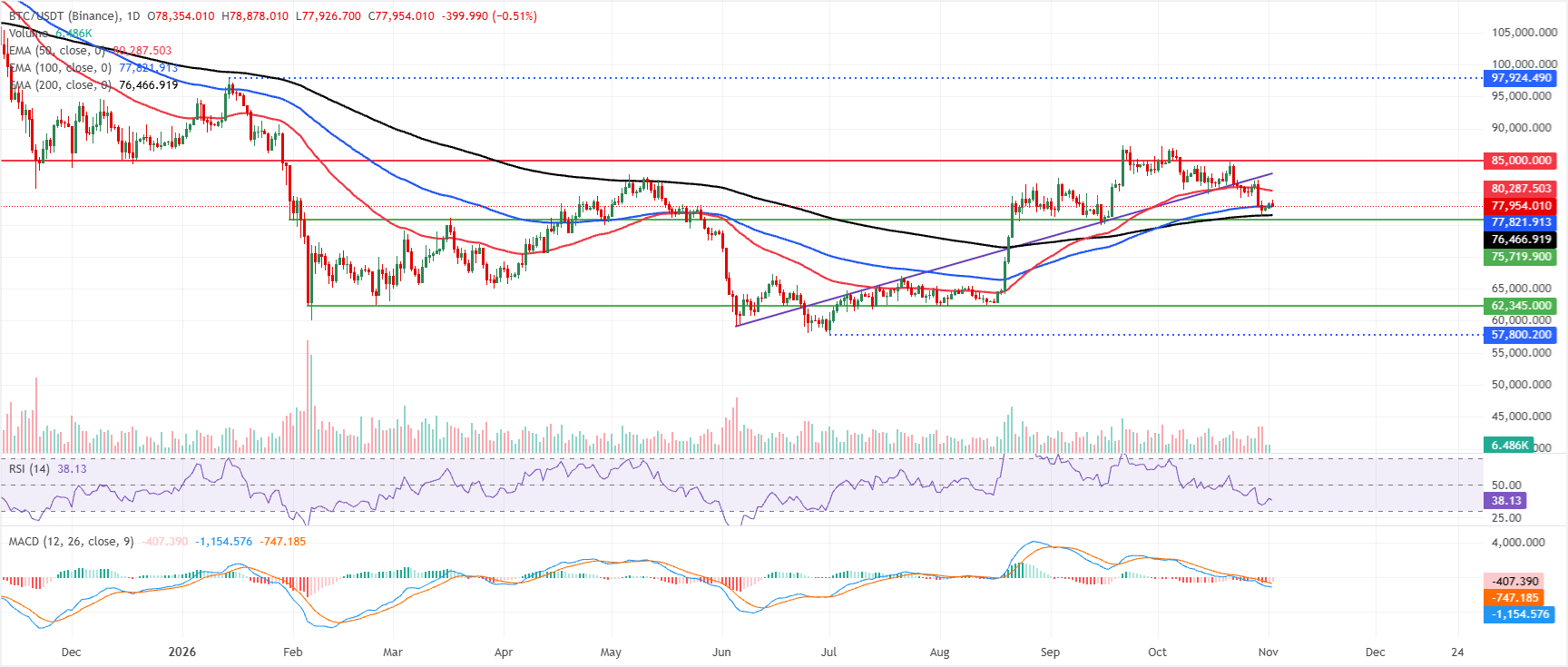
A modestly constructive bias persists on the Crypto King’s daily chart, with the price staying above both the 100-day Exponential Moving Average (EMA) near $77,821 and the 200-day EMA around $76,466.
Immediate upside progress remains restricted, however, by the 50-day EMA at approximately $80,287. Despite the supportive medium-term structure, bullish momentum appears fragile: the daily RSI is subdued near 38, while the MACD histogram remains negative, below zero.
The first upside hurdle lies at the 50-day EMA of $80,287, followed by the more significant horizontal resistance at $85,000.
Nearby downside support sits at the 100-day EMA of $77,821, ahead of a deeper buffer at the 200-day EMA around $76,466. Closing below the latter on a daily basis would undermine the current constructive bias and leave BTC exposed to a broader correction.
(The technical analysis of this story was written with the help of an AI tool. Know more.)
Bitcoin, altcoins and stablecoins: Common questions
Designed to function as money, Bitcoin is a virtual currency and the largest cryptocurrency by market capitalisation. No single person, group or entity can control this payment method, removing the need for third parties to participate in financial transactions.
Any cryptocurrency other than Bitcoin is classified as an altcoin. Some, however, exclude Ethereum too, on the grounds that forks originate from these two cryptocurrencies. Under that interpretation, Litecoin would be the first altcoin: it was forked from the Bitcoin protocol and is therefore an “improved” version of it.
A stablecoin is a cryptocurrency intended to maintain a stable price, backed by a reserve of the asset it represents. Its value is pegged to a commodity or financial instrument, such as the US Dollar (USD), while an algorithm or demand regulates its supply. Stablecoins primarily serve as an entry and exit route for investors seeking to trade and invest in cryptocurrencies. They also offer a way to store value, given the volatility generally associated with cryptocurrencies.
The ratio of Bitcoin’s market capitalisation to the combined market capitalisation of all cryptocurrencies is known as Bitcoin dominance. This measure offers a clear view of investor interest in Bitcoin. BTC dominance is typically high before and during a bull run, as investors turn to relatively stable cryptocurrencies with high market capitalisation, such as Bitcoin. When BTC dominance falls, it usually signals that investors are shifting capital and/or profits into altcoins in pursuit of higher returns, often triggering a surge in altcoin rallies.
POPULAR ARTICLES
1Euro area: How far can ECB intervention go amid French bond stress? - Societe Generale2Could Bitcoin face downside risks ahead of US midterm elections as historical sell-offs fuel concerns?3US Dollar: HSBC’s strong-dollar outlook remains unchanged after FOMC hold4EUR/USD Price Forecasts: Can EUR/USD overcome its struggle to extend gains above 1.1200?5Euro: Will a fall below 1.10 precede a 2H27 recovery against US Dollar? – OCBC6British Pound: How are BoE tightening bets supporting sterling? – ING7Confidence in the US Dollar could weaken amid US midterms and AI jitters, experts agree8Australian Dollar: Could an RBA Hike Fail to Sustain AUD Gains? – Rabobank9Can the British Pound hold modest gains against the Japanese Yen with the BoE decision in focus?


Get Started!
Sign up and access the Global Markets in less than 3 minutes

Connect With Us









Contacts
Phone: +61 2 8036 8388
Fax: +61 2 8036 8388
Email: support@tmgm.com



The information provided on this website is of a general nature only and does not constitute personal financial advice. Before acting on any information on this website, you should consider the suitability of the information in relation to your objectives, financial situation and needs. Investing in CFDs and FX Margin Contracts carries significant risks and is not suitable for all investors. You may lose more than your initial deposit. You do not own, or have, any interest in the underlying asset. We recommend that you seek independent advice and ensure you fully understand the risks involved before trading. It is important that you read and consider the disclosure document before you acquire any product listed on the website. The information and advertisements offered on this website are not intended for use by any person in any country or jurisdiction where such use would be contrary to local laws and regulations. The Products and Services offered on this website are not intended for residents of the United States, Malaysia and Thailand.
TMGM is authorized and regulated in various jurisdictions.
Trademax Australia Limited, trading as TMGM, is regulated by the Australian Securities and Investments Commission (ASIC), AFSL no. 436416 and is located at Level 28, One International Tower, 100 Barangaroo Avenue, 2000 Sydney, NSW Australia.
Email: support@tmgm.com.au
Trademax Global Limited, trading as TMGM, is authorized and regulated by the Vanuatu Financial Services Commission (VFSC), registration number 40356 and registered at 1276, Kumul Highway, Port Vila, Vanuatu, Republic of Vanuatu.
Email: support@tmgm.com
Trademax Global Markets (SE) Limited, trading as TMGM, is authorized and regulated by the Financial Services Authority (FSA) of Seychelles, with license number SD224. The company is registered at Office No 13, Providence Estate ABIS Centre, Mahe, Seychelles.
Email: support@tmgm.com
Trademax Global Markets (International) Pty Ltd, trading as TMGM, is authorized and regulated by the Financial Services Commission, Mauritius (FSC) with license no. GB22201012, and registered at 33, Edith Cavell Street C/o IQ EQ Fund Services (Mauritius) Ltd Port Louis, 11324 Mauritius.
Email: support@tmgm.com
Copyright © TMGM. All rights reserved