

Trading
Explore a wide range of markets with competitive pricing, deep liquidity, and advanced trading tools.
Learn More 
Platform
Trade seamlessly with TMGM's powerful platform, built for speed, precision, and a superior trading experience.
Learn More Trading Platform
Academy
Learn the fundamentals of trading with beginner-friendly resources, including guides, webinars, and market insights.
Learn More News & Analysis
Get real-time market updates and expert analysis to stay ahead of trading opportunities
Learn More News & Analysis
About
Learn what sets TMGM apart — our global presence, regulatory strength, and commitment to innovation in trading.
Learn More Why Choose TMGM
Sponsorship
Glassnode reports Bitcoin volatility has dropped to 2023 lows
- Bitcoin moved past $81,000 as a 10-2 Fed vote left interest rates unchanged at 3.75%-4.00%.
- Selling linked to realised losses showed signs of easing, with BTC losses shrinking to $27 million during the October 24 decline from $630 million at the August low.
- A likely rotation towards stocks among traders saw Hyperliquid’s HIP-3 markets average $2.6 billion in volume, ahead of the $2.4 billion recorded by its Bitcoin perpetual futures.
Bitcoin (BTC) advanced beyond $81,000 on Wednesday, with the Federal Reserve (Fed) voting 10–2 to leave interest rates at 3.75%–4.00%. The policy decision coincided with realised volatility in the leading cryptocurrency retreating to levels last recorded in the summer of 2023.

Do Bitcoin’s 2023 volatility levels and lower realised losses signal easing selling pressure?
An unusually subdued volatility reading featured in Glassnode’s Wednesday report: Bitcoin’s one-month realised volatility had fallen to around 25%, below its usual range over the past year. Lower readings have occurred on only about 5% of days since 2015.
Sharp price swings followed the previous two volatility lows, Glassnode observed. An August 2023 fall in volatility to 18% came before a steep Bitcoin decline; in contrast, a drop to 22% in August 2026 was followed by a price advance.
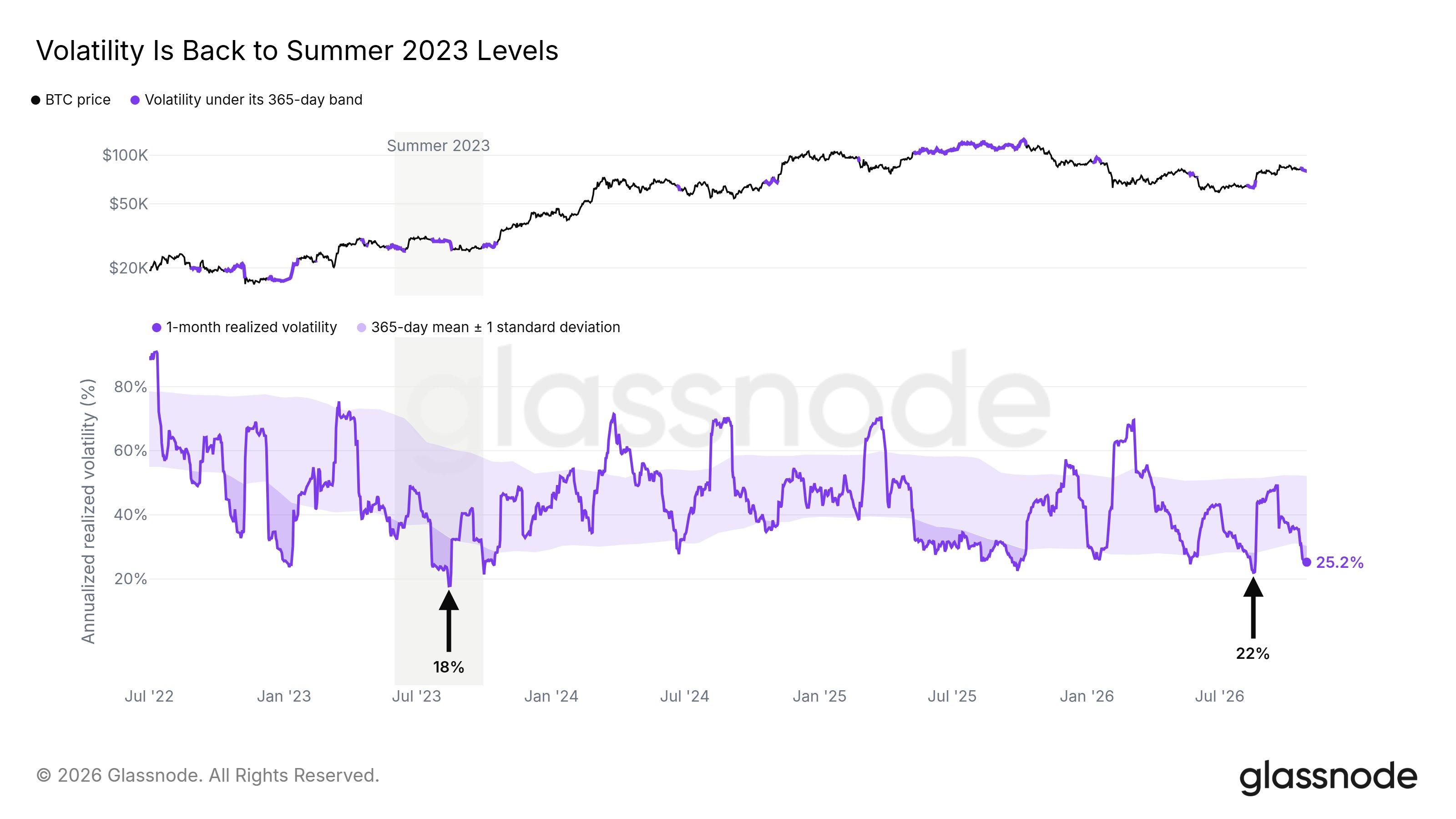
Ahead of the Fed announcement, Glassnode cautioned that persistently low volatility could expose Bitcoin to a sizeable price move after the policy decision.
Alongside the drop in volatility, realised losses have also moderated. Investors have crystallised smaller losses during recent market declines, indicating that selling pressure from holders sitting on losses has eased substantially relative to earlier downturns.
At the August low, daily net realised losses stood at around $630 million, according to Glassnode. The largest daily net loss during Bitcoin’s October 24 fall, by comparison, was $27 million.
With bids at $80,000 on Binance’s spot order book yet to reappear after the October 24 sell-off, Glassnode placed Bitcoin’s next significant support zone at 78,000-79,000.
Buy orders at $80,000 had dwindled to just $3.4 million. In the $78,000 to $79,000 range, however, bids had increased from $24 million in mid-October to approximately $42 million.
Another possible support level in the event of further price declines lies around $77,000, where the report identified accumulation by short-term holders (STH). Coins acquired around $64,000 form a separate cluster, reflecting buying near the 2026 lows.
Is speculative trading shifting towards stocks?
Higher daily volumes in stock and commodity perpetual futures than in Bitcoin perps on Hyperliquid point to speculative activity spreading beyond crypto.
Over the past week, daily trading volumes in Hyperliquid’s HIP-3 markets averaged approximately $2.6 billion, Glassnode said. These markets offer perpetual futures contracts for speculation on stocks, indices and commodities. Bitcoin perpetual futures on the same platform averaged about $2.4 billion a day, trailing HIP-3 activity.
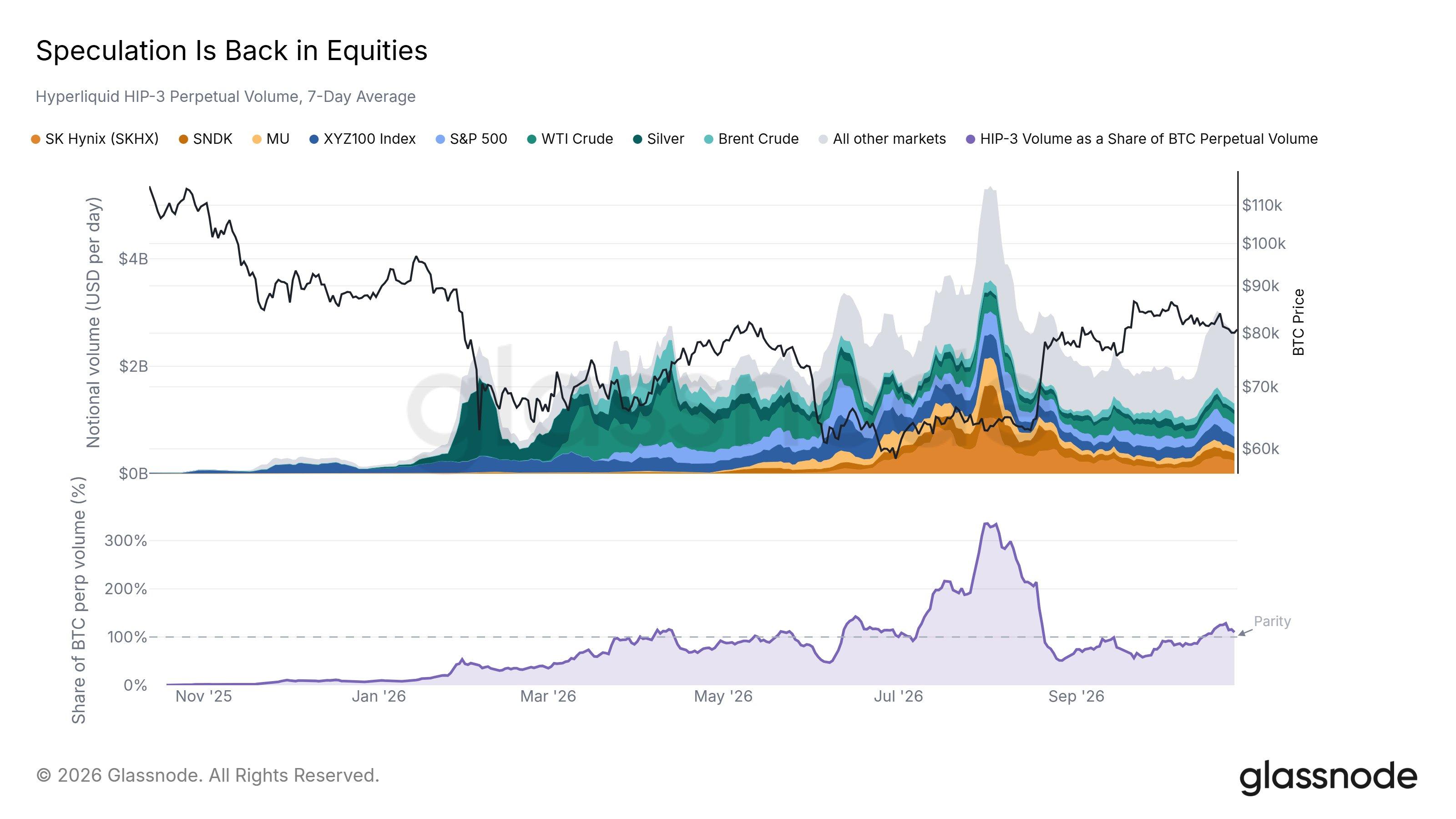
HIP-3 activity has thus recovered from the volume decline that followed an August market squeeze. Volumes had exceeded those of Bitcoin perpetual futures by more than three times at the beginning of that month, only to slip to roughly half Bitcoin’s level by late August.
SK Hynix, the S&P 500, a technology index and Crude Oil featured among the most actively traded individual markets.
The report stated: “Should this volume keep growing while Bitcoin perpetual volume stays flat, it would show speculative money still favoring stocks,”
POPULAR ARTICLES
1Yen faces Tokyo CPI and a BoJ decision as central bank week draws to a close2Can US data steer the New Zealand Dollar after both central banks hold rates?3Gold Slips to Around $4,050 After Fed Keeps Rates Unchanged; Markets Await US PCE Data4Can the Australian Dollar hold above 0.7050 as hot CPI strengthens RBA hike bets?5Euro returns to its October low as the ECB looms6Pound back above 1.33: what lies ahead as US inflation figures approach?7Glassnode reports Bitcoin volatility has dropped to 2023 lows8Ethereum posts 1% gain after Fed hold; Coinbase Premium remains negative9Forex Today: What happens if the ECB…?
LIVE QUOTES

ALL ABOUT FOREX
What Is a Stop Loss, How Does It Work and How Do You Set One?
Margin Call Meaning: What It Is, What Triggers It, and How to Avoid One
What Is an Islamic Account in Forex?
Best Indicators for Forex Trading and How to Use Them
The Top 10 Most Traded Currency Pairs in the World
What are the Major Forex Pairs? 7 Major Currency Pairs in the World
5 Best Forex Trading Apps In India In 2026
Top 15 Weakest Currencies in the World
Best Time to Trade Forex
Get Started!
Sign up and access the Global Markets in less than 3 minutes

Connect With Us









Contacts
Phone: +61 2 8036 8388
Fax: +61 2 8036 8388
Email: support@tmgm.com



The information provided on this website is of a general nature only and does not constitute personal financial advice. Before acting on any information on this website, you should consider the suitability of the information in relation to your objectives, financial situation and needs. Investing in CFDs and FX Margin Contracts carries significant risks and is not suitable for all investors. You may lose more than your initial deposit. You do not own, or have, any interest in the underlying asset. We recommend that you seek independent advice and ensure you fully understand the risks involved before trading. It is important that you read and consider the disclosure document before you acquire any product listed on the website. The information and advertisements offered on this website are not intended for use by any person in any country or jurisdiction where such use would be contrary to local laws and regulations. The Products and Services offered on this website are not intended for residents of the United States, Malaysia and Thailand.
TMGM is authorized and regulated in various jurisdictions.
Trademax Australia Limited, trading as TMGM, is regulated by the Australian Securities and Investments Commission (ASIC), AFSL no. 436416 and is located at Level 28, One International Tower, 100 Barangaroo Avenue, 2000 Sydney, NSW Australia.
Email: support@tmgm.com.au
Trademax Global Limited, trading as TMGM, is authorized and regulated by the Vanuatu Financial Services Commission (VFSC), registration number 40356 and registered at 1276, Kumul Highway, Port Vila, Vanuatu, Republic of Vanuatu.
Email: support@tmgm.com
Trademax Global Markets (SE) Limited, trading as TMGM, is authorized and regulated by the Financial Services Authority (FSA) of Seychelles, with license number SD224. The company is registered at Office No 13, Providence Estate ABIS Centre, Mahe, Seychelles.
Email: support@tmgm.com
Trademax Global Markets (International) Pty Ltd, trading as TMGM, is authorized and regulated by the Financial Services Commission, Mauritius (FSC) with license no. GB22201012, and registered at 33, Edith Cavell Street C/o IQ EQ Fund Services (Mauritius) Ltd Port Louis, 11324 Mauritius.
Email: support@tmgm.com
Copyright © TMGM. All rights reserved