

Trading
Explore a wide range of markets with competitive pricing, deep liquidity, and advanced trading tools.
Learn More 
Platform
Trade seamlessly with TMGM's powerful platform, built for speed, precision, and a superior trading experience.
Learn More Trading Platform
Academy
Learn the fundamentals of trading with beginner-friendly resources, including guides, webinars, and market insights.
Learn More News & Analysis
Get real-time market updates and expert analysis to stay ahead of trading opportunities
Learn More News & Analysis
About
Learn what sets TMGM apart — our global presence, regulatory strength, and commitment to innovation in trading.
Learn More Why Choose TMGM
Sponsorship
Bitcoin vs Gold: With volatility low and compressed, BTC surges above $80K as XAU clears $4,000
- Bullish momentum strengthens as Bitcoin regains $80,000, with buyers targeting highs beyond the 50-day EMA.
- Supported by a rising RSI momentum indicator, Gold edges higher above the crucial $4,000 mark.
- Ahead of the Fed decision and earnings from major tech companies, volatility remains largely muted.
Modest gains in Bitcoin (BTC) and Gold (XAU/USD) are unfolding amid subdued volatility as investors position for Wednesday’s Federal Reserve (Fed) decision and earnings from several major tech companies. On Monday, Bitcoin is recovering above $80,000 with a 0.34% rise, while Gold is rebounding past the crucial $4,000 mark, gaining 0.64%.

Why do expectations of a Fed rate pause remain strong?
A cautious yet stable mood across risk assets rests on firm expectations that the Fed will leave policy unchanged on Wednesday. According to CME Group’s FedWatch Tool, the probability of interest rates staying within the 3.75%-4.00% range is currently roughly 91%. A rate increase is expected by only 9% of traders, underscoring the widespread conviction in a pause that anchors the macroeconomic backdrop.
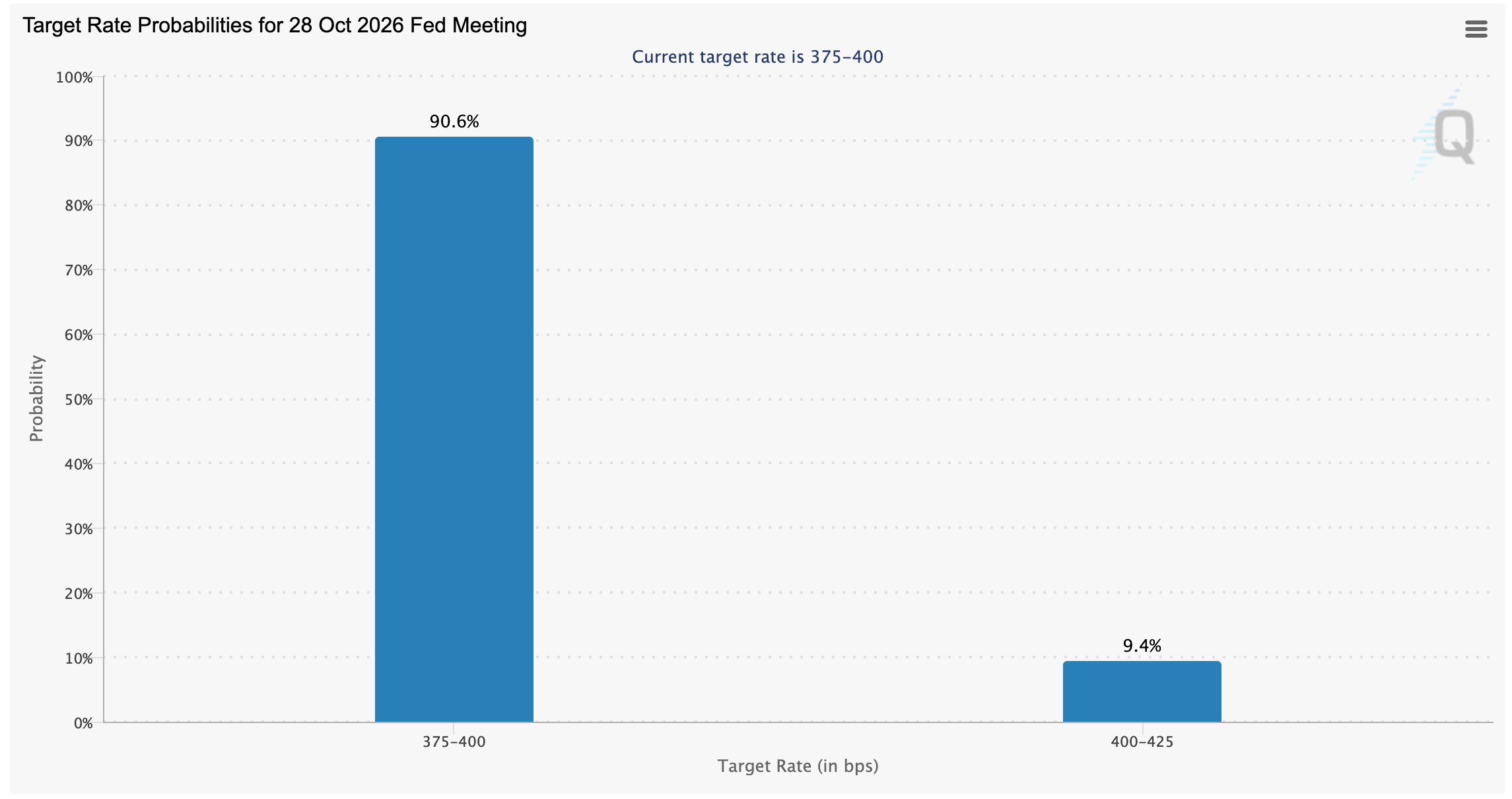
Subdued trading and persistently low volatility are also evident in broader cryptocurrency sentiment. The Fear & Greed Index has retreated to a Neutral reading of 50, considerably below the Greed readings of 59 last week and 74 last month.
In emailed commentary, ARP Digital Partner Yusuf Fakhro said, “What keeps me constructive is what is happening beneath the drift. Participation is extremely low. Volumes are thin, leverage is subdued, and holders are simply refusing to sell at these levels,” and added, “That combination, quiet price action with no one forced to sell, is exactly the pattern that has marked past bottoming phases rather than tops.”
For Gold, the recovery above $4,000 remains intact, but trading is confined to a narrow range with little follow-through buying. Muted volatility in both Gold and Bitcoin signals that participants are waiting for the Fed announcement.
A jump in volatility could nevertheless follow the Fed meeting, with this week’s scheduled earnings calls from Big Tech majors Microsoft (MSFT), Alphabet (GOOG), and Amazon (AMZN) also likely to influence it.
Fakhro further noted, “The honest read is that this is a waiting game, and the wait is nearly over. The calendar from late October is dense: the Fed decision, major tech earnings including the largest corporate Bitcoin holder, and the US midterms all land within a week,”
Bitcoin technical analysis: Can price clear nearby resistance?
At $80,454, Bitcoin remains caught between nearby dynamic levels, leaving its short-term outlook neutral to mildly bearish. Immediate resistance comes from the 50-day Exponential Moving Average (EMA) at $80,812, just above the current price. Beneath it, a closely packed support zone comprises the SuperTrend line near $79,664, followed by the 100-day EMA at $77,690 and the 200-day EMA at $76,313.
Downside momentum appears to be easing rather than giving way to a decisive bullish reversal. The Moving Average Convergence Divergence (MACD) indicator is still below zero, although its negative profile is contracting, while the Relative Strength Index (RSI) at 43 indicates weakness without reaching oversold territory.
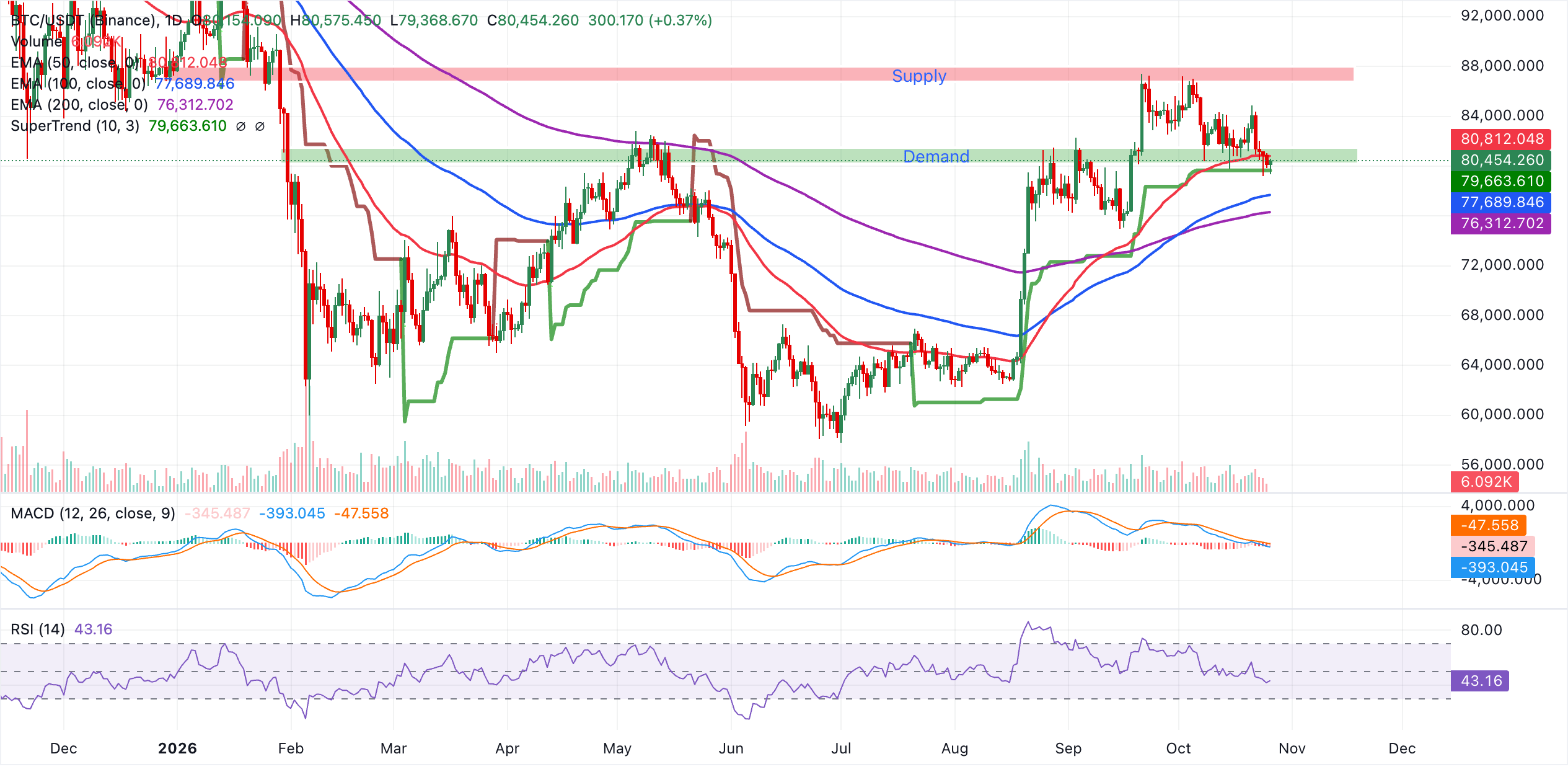
To remove the current upside constraint and restore scope for fresh highs, Bitcoin would need a sustained move above the 50-day EMA at $80,812. On a decline, the first area to monitor is the demand band around the prevailing price, alongside the SuperTrend signal at $79,664.
Should a daily close fall below that zone, the next support would be the 100-day EMA at $77,690, ahead of the more strategically important 200-day EMA at $76,313. Until BTC breaks clearly out of the $79,664-$80,813 range, trading is likely to stay choppy, with no firm direction.
Gold technical analysis: Can XAU sustain its recovery momentum?
With Gold trading at $4,021 beneath a concentration of moving averages and trend resistance, the near-term outlook remains bearish. Overhead resistance includes the 50-day EMA at $4,215, the 100-day EMA at $4,278 and the 200-day EMA at $4,284. This positioning leaves the metal in a corrective phase below its medium- and long-term trend benchmarks, with the SuperTrend at $4,211 adding to the upside pressure.
Buying interest remains weak rather than outright oversold, as indicated by the RSI at 36, still below the 50 threshold. Meanwhile, the MACD indicator remains negative and its latest reading has turned lower again, signalling continued bearish momentum despite earlier efforts to stabilise.
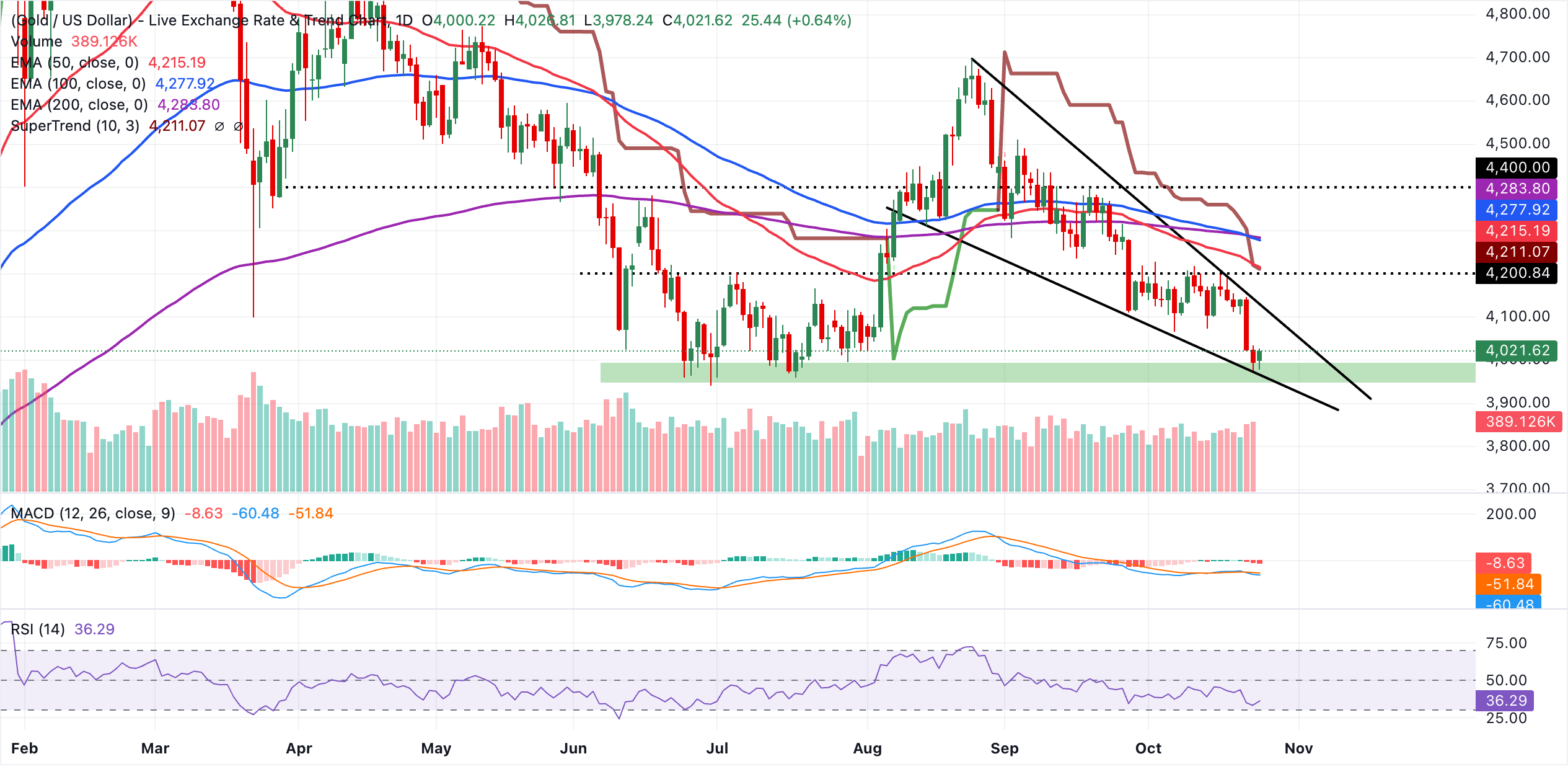
Near $4,074, the break level of the descending trendline provides initial resistance after turning back the latest rebound attempt. Beyond it, the SuperTrend at $4,211 and the 50-day EMA at $4,215 form a close resistance cluster. Gold would need to regain these levels to alleviate immediate selling pressure. Further up, the 100-day EMA at $4,278 and the 200-day EMA at $4,284 mark a wider resistance zone that constrains any recovery.
The daily chart offers no clearly defined technical support levels. Against this bearish backdrop, advances towards the overhead resistance markers could draw fresh selling until Gold records a decisive close above at least the trendline and the short-term EMA.
(The technical analysis of this story was written with the help of an AI tool. Find out more.)
FAQs on Bitcoin, altcoins and stablecoins
Designed to function as money, Bitcoin is a virtual currency and the largest cryptocurrency by market capitalisation. No single person, group or entity can control this payment method, removing the need for third parties to participate in financial transactions.
The term altcoin covers cryptocurrencies other than Bitcoin. Some also exclude Ethereum from this category, however, because forking takes place from these two cryptocurrencies. Under that interpretation, Litecoin is the first altcoin: it was forked from the Bitcoin protocol and is therefore an “improved” version of it.
A stablecoin is a cryptocurrency intended to maintain a steady price, backed by a reserve of the asset it represents. Its value is pegged to a commodity or financial instrument, such as the US Dollar (USD), while an algorithm or demand regulates its supply. Primarily, stablecoins offer investors a route into and out of cryptocurrency trading and investment. They also provide a way to store value, given that cryptocurrencies are generally prone to volatility.
By comparing Bitcoin’s market capitalisation with the combined market capitalisation of all cryptocurrencies, Bitcoin dominance offers a clear indication of investor interest in Bitcoin. BTC dominance is typically high ahead of and during a bull run, when investors favour a relatively stable cryptocurrency with a large market capitalisation, such as Bitcoin. Conversely, declining BTC dominance usually signals that investors are shifting capital and/or profits into altcoins in pursuit of better returns, often setting off a surge in altcoin rallies.
POPULAR ARTICLES
1Silver Price Forecast: Bearish structure persists as bulls defend $532China: How does a strong current account support Chinese Yuan appreciation? - Standard Chartered3Gold retakes $4,000 as Oil softens: Can the recovery withstand the Fed decision?4Why is the New Zealand Dollar retreating despite rising RBNZ rate hike expectations?5Taiwan Dollar: Foreign inflows remain key to recovery – OCBC6Bitcoin vs Gold: With volatility low and compressed, BTC surges above $80K as XAU clears $4,0007Brazilian Real: What post-election risks accompany Lula’s return? – Commerzbank8Canadian Dollar slips from six-week high as Fed, BoC rate decisions draw closer9United States: Resilient growth runs alongside sticky inflation - TD Securities
LIVE QUOTES


ALL ABOUT GOLD & PRECIOUS METALS
Gold ETF Taxation: What Is the Tax on Gold ETF in India?
How Much Gold Is Allowed From Dubai to India?
How much is the Tax on Gold in India?
Gold Market Open Time: XAUUSD Trading Hours & Best Time to Trade
How to Trade Gold
Top 10 Most Traded Commodities in India & The Best Commodity to Trade
Gold Price Chart India 10 Years: An Overview
Why Invest in Gold: The Advantages of Trading Gold CFDs
4 Strategies for Investing in Gold for Beginners in 2025
Get Started!
Sign up and access the Global Markets in less than 3 minutes

Connect With Us









Contacts
Phone: +61 2 8036 8388
Fax: +61 2 8036 8388
Email: support@tmgm.com



The information provided on this website is of a general nature only and does not constitute personal financial advice. Before acting on any information on this website, you should consider the suitability of the information in relation to your objectives, financial situation and needs. Investing in CFDs and FX Margin Contracts carries significant risks and is not suitable for all investors. You may lose more than your initial deposit. You do not own, or have, any interest in the underlying asset. We recommend that you seek independent advice and ensure you fully understand the risks involved before trading. It is important that you read and consider the disclosure document before you acquire any product listed on the website. The information and advertisements offered on this website are not intended for use by any person in any country or jurisdiction where such use would be contrary to local laws and regulations. The Products and Services offered on this website are not intended for residents of the United States, Malaysia and Thailand.
TMGM is authorized and regulated in various jurisdictions.
Trademax Australia Limited, trading as TMGM, is regulated by the Australian Securities and Investments Commission (ASIC), AFSL no. 436416 and is located at Level 28, One International Tower, 100 Barangaroo Avenue, 2000 Sydney, NSW Australia.
Email: support@tmgm.com.au
Trademax Global Limited, trading as TMGM, is authorized and regulated by the Vanuatu Financial Services Commission (VFSC), registration number 40356 and registered at 1276, Kumul Highway, Port Vila, Vanuatu, Republic of Vanuatu.
Email: support@tmgm.com
Trademax Global Markets (SE) Limited, trading as TMGM, is authorized and regulated by the Financial Services Authority (FSA) of Seychelles, with license number SD224. The company is registered at Office No 13, Providence Estate ABIS Centre, Mahe, Seychelles.
Email: support@tmgm.com
Trademax Global Markets (International) Pty Ltd, trading as TMGM, is authorized and regulated by the Financial Services Commission, Mauritius (FSC) with license no. GB22201012, and registered at 33, Edith Cavell Street C/o IQ EQ Fund Services (Mauritius) Ltd Port Louis, 11324 Mauritius.
Email: support@tmgm.com
Copyright © TMGM. All rights reserved