

Trading
Explore a wide range of markets with competitive pricing, deep liquidity, and advanced trading tools.
Learn More 
Platform
Trade seamlessly with TMGM's powerful platform, built for speed, precision, and a superior trading experience.
Learn More Trading Platform
Academy
Learn the fundamentals of trading with beginner-friendly resources, including guides, webinars, and market insights.
Learn More News & Analysis
Get real-time market updates and expert analysis to stay ahead of trading opportunities
Learn More News & Analysis
About
Learn what sets TMGM apart — our global presence, regulatory strength, and commitment to innovation in trading.
Learn More Why Choose TMGM
Sponsorship
Gold retakes $4,000 as Oil softens: Can the recovery withstand the Fed decision?
- Gold rises 0.6% to $4,020, recovering from $3,978.
- Declining Oil prices and Treasury yields ease pressure on Bullion.
- Ahead of Warsh's remarks, the probability of a December Fed hike hits 83%.
Gold has regained ground with a 0.6% rise, after closing last week below $4,000. Ahead of this week’s Federal Reserve (Fed) monetary policy meeting, expectations of a possible de-escalation in the US-Iran conflict have weighed on energy prices. Having recovered from a daily low of $3,978, XAU/USD is trading at $4,020.

Can Lower Treasury Yields and Middle East Diplomacy Sustain the XAU/USD Recovery?
Price movements remain driven by geopolitics, with Oil in particular showing a modest positive correlation with the US Dollar. The Mecca Pact members, Iran, Turkey, Pakistan and Saudi Arabia, have agreed to keep discussions going. At the same time, speculation persists about a coordinated US-Israel attack on Tehran, as Iranian officials have ruled out nuclear discussions at the Mecca Pact meeting.
Bullion has found room to recover as US Treasury yields ease and West Texas Intermediate (WTI), the US Oil benchmark, slips 0.5% to $102.90.
With investors removing expectations of a Fed rate increase this Wednesday, the US 10-year T-note yield has declined 2 basis points to 4.978%. This yield has an inverse relationship with Gold prices.
Money markets were assigning an 83% probability to a Fed rate increase at the December meeting at the time of writing. Attention nevertheless remains on Fed Chair Kevin Warsh's press conference. Although he does not offer guidance, his remarks could indicate the central bank’s next policy move.
For traders, the distinction is important: Gold offers a hedge against inflation but generally struggles when interest rates are high. A hawkish message from Warsh could put further pressure on XAU/USD, leaving a move below $4,000 possible.
Fresh indications of the interest-rate outlook may come from the forthcoming US Personal Consumption Expenditures (PCE) data, the Fed's preferred inflation measure, which traders are monitoring. Investors are also preparing for the US midterm elections on 3 November.
XAU/USD Technical Analysis: Can Gold Reach $4,050 as Buyers Step In Below $4,000?
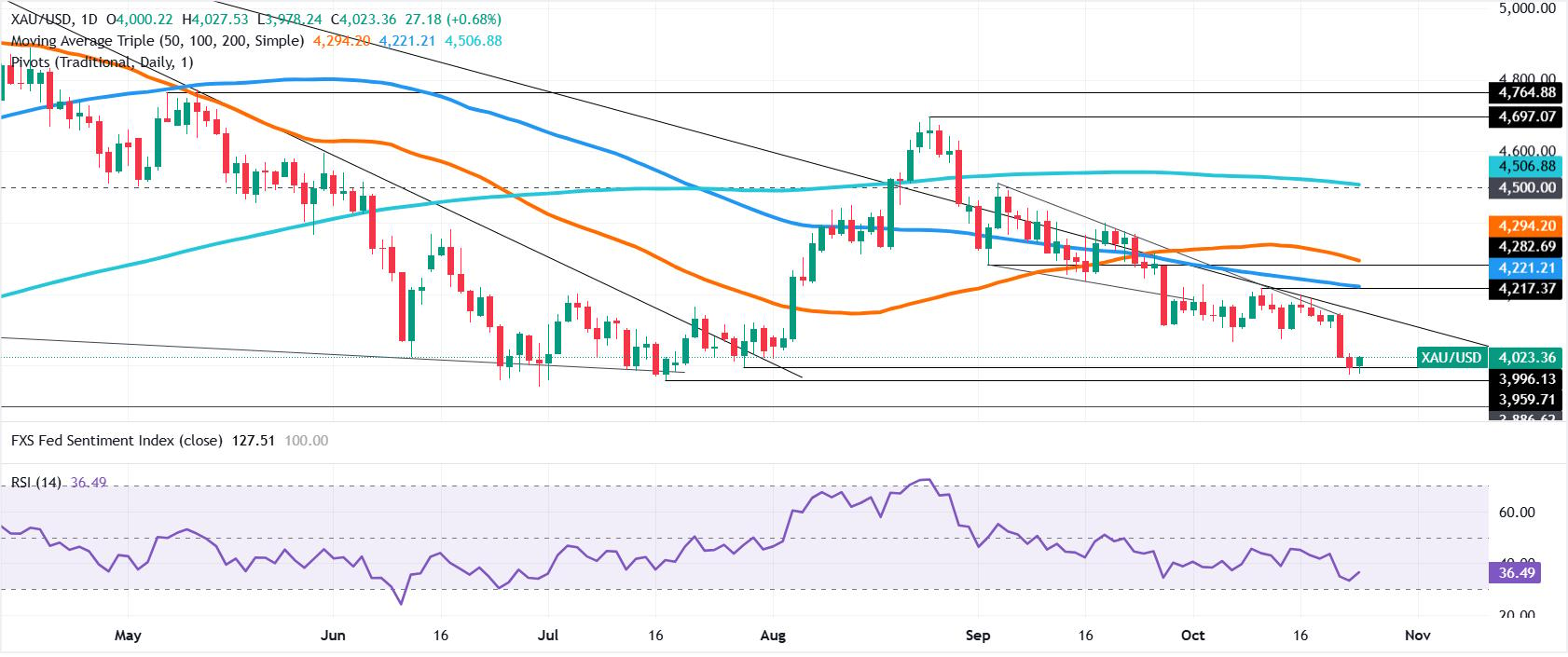
Gold is reversing course after falling to a two-month low of $3,975, with a ‘bullish engulfing’ candlestick pattern close to forming and pointing to further gains. The Relative Strength Index (RSI) is moving higher, lending momentum to the recovery. However, the 14-day RSI is still in bearish territory and could limit the advance.
For XAU/USD, an initial hurdle stands at $4,100. Moving above it would bring the psychological $4,150 level into focus, followed by $4,200. Beyond that, the next levels are the 100-day Simple Moving Average (SMA) at $4,221 and the 50-day SMA at $4,294.
If the bearish trend resumes, XAU/USD would first encounter support at $4,000 and then at October’s 23-day low of $3,975. Further key support lies at $3,959, the July 17 low, followed by the year-to-date (YTD) low of $3,941.
Gold: Key Questions Answered
Throughout human history, Gold has served extensively as both a store of value and a means of exchange. Beyond its lustre and use in jewellery, the precious metal is now widely regarded as a safe-haven asset, or an investment considered suitable during periods of turmoil. Its independence from any particular issuer or government also underpins its widespread appeal as a hedge against inflation and currency depreciation.
The largest holdings of Gold belong to central banks. To bolster their currencies during unsettled periods, they typically diversify reserves and purchase Gold, reinforcing perceptions of economic and currency strength. Substantial Gold reserves can also inspire confidence in a country’s solvency. According to World Gold Council data, central banks expanded their reserves by 1,136 tonnes of Gold, valued at around $70 billion, in 2022. No higher annual purchase has been recorded since records began. Emerging-economy central banks, including those in China, India and Turkey, are rapidly building their Gold holdings.
Both the US Dollar and US Treasuries, major reserve and safe-haven assets, tend to move inversely to Gold. Dollar weakness generally supports Gold, allowing investors and central banks to diversify their holdings during turbulent periods. A similar inverse relationship exists between Gold and risk assets: stock-market advances tend to pressure the metal, whereas selling in riskier markets generally supports it.
Several influences can shift Gold prices. Its safe-haven appeal means geopolitical turmoil or concerns about a severe recession can send prices sharply higher. Since Gold pays no yield, lower interest rates usually support it, while a higher cost of borrowing generally puts it under pressure. Even so, movements in the US Dollar (USD) account for much of the price action, as Gold is denominated in dollars (XAU/USD). Dollar strength tends to restrain Gold prices, while a weaker Dollar is likely to lift them.
POPULAR ARTICLES
1China: How does a strong current account support Chinese Yuan appreciation? - Standard Chartered2Gold retakes $4,000 as Oil softens: Can the recovery withstand the Fed decision?3Why is the New Zealand Dollar retreating despite rising RBNZ rate hike expectations?4Taiwan Dollar: Foreign inflows remain key to recovery – OCBC5Bitcoin vs Gold: With volatility low and compressed, BTC surges above $80K as XAU clears $4,0006Brazilian Real: What post-election risks accompany Lula’s return? – Commerzbank7Canadian Dollar slips from six-week high as Fed, BoC rate decisions draw closer8United States: Resilient growth runs alongside sticky inflation - TD Securities9British Pound slips: Can Sterling bulls withstand Fed decision and UK budget tests?
LIVE QUOTES


ALL ABOUT GOLD & PRECIOUS METALS
Gold ETF Taxation: What Is the Tax on Gold ETF in India?
How Much Gold Is Allowed From Dubai to India?
How much is the Tax on Gold in India?
Gold Market Open Time: XAUUSD Trading Hours & Best Time to Trade
How to Trade Gold
Top 10 Most Traded Commodities in India & The Best Commodity to Trade
Gold Price Chart India 10 Years: An Overview
Why Invest in Gold: The Advantages of Trading Gold CFDs
4 Strategies for Investing in Gold for Beginners in 2025
Get Started!
Sign up and access the Global Markets in less than 3 minutes

Connect With Us









Contacts
Phone: +61 2 8036 8388
Fax: +61 2 8036 8388
Email: support@tmgm.com



The information provided on this website is of a general nature only and does not constitute personal financial advice. Before acting on any information on this website, you should consider the suitability of the information in relation to your objectives, financial situation and needs. Investing in CFDs and FX Margin Contracts carries significant risks and is not suitable for all investors. You may lose more than your initial deposit. You do not own, or have, any interest in the underlying asset. We recommend that you seek independent advice and ensure you fully understand the risks involved before trading. It is important that you read and consider the disclosure document before you acquire any product listed on the website. The information and advertisements offered on this website are not intended for use by any person in any country or jurisdiction where such use would be contrary to local laws and regulations. The Products and Services offered on this website are not intended for residents of the United States, Malaysia and Thailand.
TMGM is authorized and regulated in various jurisdictions.
Trademax Australia Limited, trading as TMGM, is regulated by the Australian Securities and Investments Commission (ASIC), AFSL no. 436416 and is located at Level 28, One International Tower, 100 Barangaroo Avenue, 2000 Sydney, NSW Australia.
Email: support@tmgm.com.au
Trademax Global Limited, trading as TMGM, is authorized and regulated by the Vanuatu Financial Services Commission (VFSC), registration number 40356 and registered at 1276, Kumul Highway, Port Vila, Vanuatu, Republic of Vanuatu.
Email: support@tmgm.com
Trademax Global Markets (SE) Limited, trading as TMGM, is authorized and regulated by the Financial Services Authority (FSA) of Seychelles, with license number SD224. The company is registered at Office No 13, Providence Estate ABIS Centre, Mahe, Seychelles.
Email: support@tmgm.com
Trademax Global Markets (International) Pty Ltd, trading as TMGM, is authorized and regulated by the Financial Services Commission, Mauritius (FSC) with license no. GB22201012, and registered at 33, Edith Cavell Street C/o IQ EQ Fund Services (Mauritius) Ltd Port Louis, 11324 Mauritius.
Email: support@tmgm.com
Copyright © TMGM. All rights reserved