

Trading
Explore a wide range of markets with competitive pricing, deep liquidity, and advanced trading tools.
Learn More 
Platform
Trade seamlessly with TMGM's powerful platform, built for speed, precision, and a superior trading experience.
Learn More Trading Platform
Academy
Learn the fundamentals of trading with beginner-friendly resources, including guides, webinars, and market insights.
Learn More News & Analysis
Get real-time market updates and expert analysis to stay ahead of trading opportunities
Learn More News & Analysis
About
Learn what sets TMGM apart — our global presence, regulatory strength, and commitment to innovation in trading.
Learn More Why Choose TMGM
Sponsorship
If the Federal Reserve holds rates higher for longer, can Bitcoin still rally?
Bitcoin (BTC) faces renewed concerns that tighter liquidity could weigh on prices, echoing the 2022 bear market, after the US Federal Reserve (Fed) raised interest rates in September for the first time in three years to contain alarming inflation figures.
Behind these inflation worries is the rise in Brent Oil prices following the US-Iran war, which began on 28 February. The conflict continues to disrupt shipments through the Strait of Hormuz, directly influencing global markets and investor sentiment.
Containing rising inflation forces the Fed to increase interest rates, draining market liquidity and reducing demand among consumers and producers alike. The resulting decline in investors’ appetite for risk puts pressure on stocks, crypto and other high-risk assets.
While markets have largely priced in the war, the prospect of further Fed rate increases, resembling the 2022 cycle, leaves a key question: could Bitcoin enter another bear cycle?
Could geopolitical risks bring a return to March 2022 conditions?
Across markets, concerns are growing over a repeat of Bitcoin’s 2022 bear market. During that period, Brent Crude Oil climbed above $130 per barrel, leading the Fed to increase the fed funds rate over several months.
Investor nervousness intensified on 16 September when the US Fed was compelled to deliver its first interest-rate increase in three years, raising rates by a quarter point. This took the fed funds target range to 3.75% to 4.00%. September’s US Consumer Price Index (CPI) climbed to 3.7% YoY from 3.4% in August, alongside an acceleration in monthly inflation to 0.6%.
The Fed subsequently left its benchmark interest rate steady on 28 October, although the 10-2 decision implied that additional increases lie ahead. With price pressures persisting, financial conditions could remain restrictive, constraining the capital available for speculative assets.
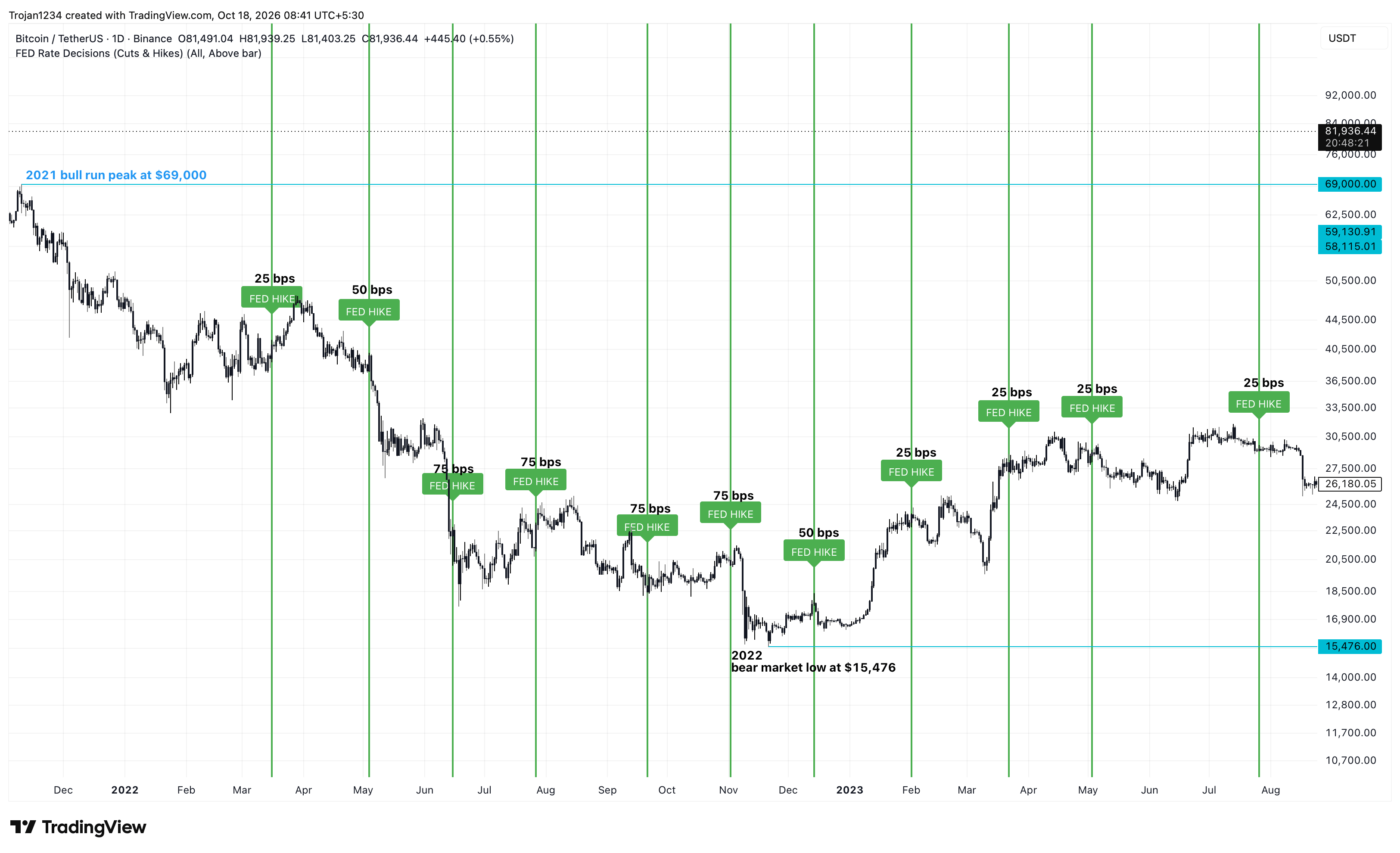
Bitcoin’s performance during the 2022-23 cycle illustrates why its relationship with rate increases is complex. As the Fed lifted rates from close to zero to 4.25%–4.50%, BTC lost nearly 78%, declining from around $69,000 in November 2021 to roughly $15,476 in November 2022.
Monetary tightening gathered pace in 2022 through four successive 75-basis-point increases, with three smaller hikes before and after that sequence. Those increases compounded selling pressure alongside the Terra ecosystem’s collapse, failures among crypto lenders and the FTX bankruptcy case.
Despite further, slower-paced Fed rate increases during 2023, Bitcoin staged a recovery. Rates ultimately reached 5.25%–5.50% in July, demonstrating that expectations, market positioning and demand can exert a greater influence than the immediate effect of rate hikes.
Can institutional demand counter inflation pressures?
Institutional demand now plays an important role in Bitcoin through spot Bitcoin Exchange-Traded Funds (ETFs) and corporate BTC treasuries, setting its 2026 market structure apart from the 2022 bear market. As FXStreet previously reported, Bitcoin’s four-year cycle points to a bullish reversal ahead in 2026.
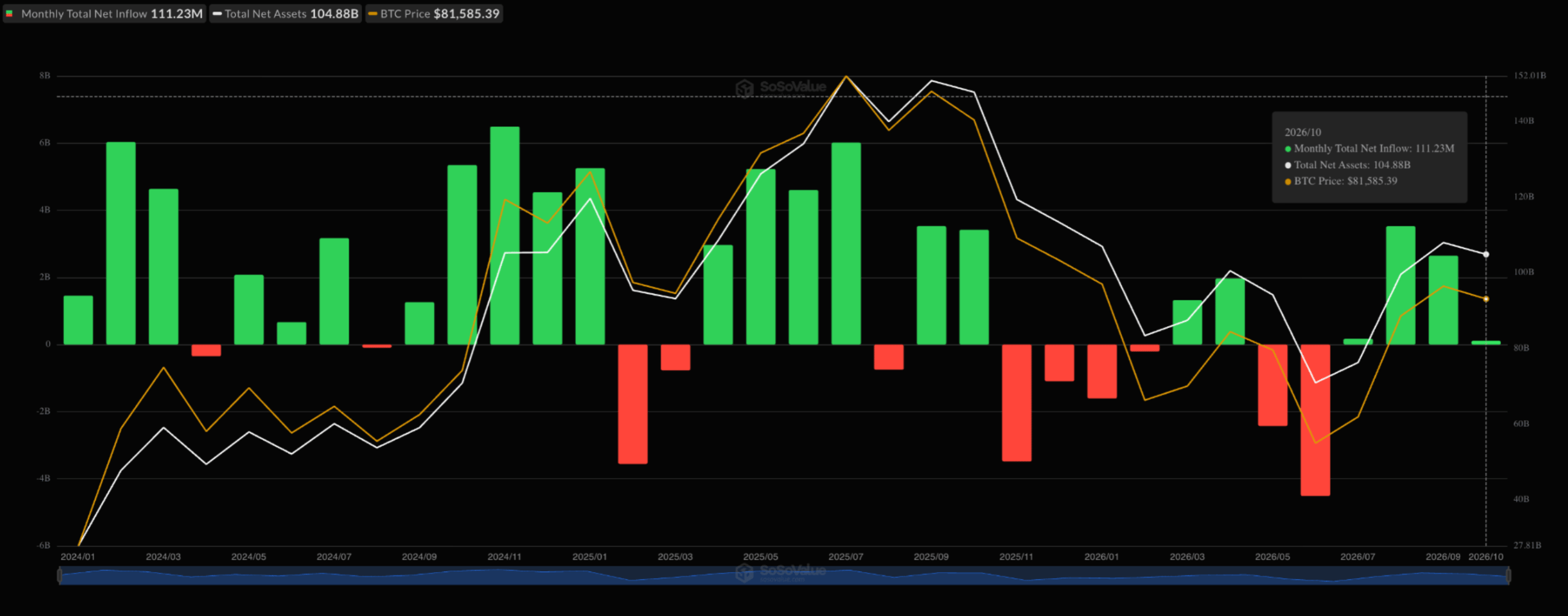
Since their January 2024 launch, US spot Bitcoin ETFs have registered 22 months of inflows and 11 months of outflows as of 28 October, taking total net flows to $104.9 billion. Bitcoin holdings at private companies stand at $103.7 billion, compared with $22.8 billion at public companies. Demand is supported by these sizeable ETF and corporate holdings, including purchases funded in some cases through equity issuance, debt or preferred securities.
A sustained Bitcoin correction could, however, weaken institutions’ ability to maintain their holdings. Strategy’s recent sale of some BTC to build cash reserves offers an example. Should another round of rate increases restrict their access to liquidity, accumulation could slow, or these holdings could even become a source of supply.

Expert perspective: Can Bitcoin withstand ETF and AI risks? WisdomTree’s Director of Digital Assets Research weighs in
With wider market conditions still uncertain, I asked WisdomTree’s Director of Digital Assets Research, Dovile Silenskyte, for his outlook on Bitcoin in an exclusive FXStreet interview.
- With Fed rates and geopolitical risks drawing attention, Bitcoin remains under downside pressure, even as its four-year cycle points to a possible end to the bear market in late 2026. Can spot Bitcoin exchange-traded funds (ETFs), corporate DATs and government-level holdings counter these macroeconomic risks?
The routes through which demand reaches Bitcoin distinguish this cycle from earlier ones. Investment portfolios with an established track record, corporate balance sheets and sovereign strategies now provide channels that could strengthen its ability to withstand macroeconomic pressures.
Through spot ETFs, investors can allocate to Bitcoin using market infrastructure they already know. Corporate treasuries may provide strategic demand over a longer horizon, and sovereign holdings could curb potential selling pressure if they are retained. Given Bitcoin’s constrained supply, continued purchases and retention through these channels could underpin prices, even while uncertainty over interest rates and geopolitical tensions dampen risk appetite.
That structural backing does not, however, eliminate cyclical risks. Corporate purchases still depend on financing conditions, while ETF flows can turn negative. A wider investor base creates additional potential sources of demand as sentiment recovers, rather than establishing a floor for prices.
Consequently, a bottom in late-2026 is still a possible scenario, not a reliable forecast. Institutional adoption [combined] with an improvement in global liquidity provides the stronger basis for a bullish argument. Lower real yields and easier monetary conditions could allow Bitcoin to gain from both structural demand and a more favourable macroeconomic environment.
- With AI-related debt issuance projected to reach $500 billion in 2026, pressure on bond and credit markets is becoming a concern. Might the AI investment boom make financial conditions tighter, draw capital away from speculative assets and put Bitcoin under pressure?
In the short term, Bitcoin could face competition for capital from AI investment, although growth in one does not necessarily exclude growth in the other. Financing the AI buildout need not prevent investors from also expanding their Bitcoin exposure.
Financing conditions represent the most immediate risk. If the supply of debt exceeds investor demand, substantial borrowing for AI infrastructure could raise funding costs. Yet an increase in issuance does not in itself imply tighter financial conditions: the money raised finances investment and flows through the economy. The decisive questions are whether markets have the capacity to absorb that debt and whether project returns justify the borrowing.
Stronger productivity presents the more meaningful longer-term opportunity. Efficiency improvements from AI that boost output and reduce inflationary pressures could make the investment environment more favourable, including for Bitcoin. Such an outcome is plausible, but it is not an assured benefit of AI expenditure.
There is also a different foundation to Bitcoin’s investment proposition. Exposure is to a scarce digital asset, not to company earnings or an issuer’s capacity to repay debt. As a result, its appeal is not confined to the technology spending cycle.
Key takeaways: Can Bitcoin weather another liquidity shock?
Bitcoin’s resilience offers a counterpoint to an entirely bearish assessment: despite uncertainty across markets, it continues to hold above key support levels. Institutional demand is the main distinction for Bitcoin in a potential new rate-hike cycle, and it could underpin the next sustained advance.
Nevertheless, with markets expecting a further 25-basis-point increase before the end of 2026, these funds may struggle to provide support through a prolonged period of rate hikes.
The central test, then, is whether Bitcoin’s institutionalisation enables it to absorb the next liquidity shock without suffering the extreme drawdowns seen in earlier cycles.
POPULAR ARTICLES
1British Pound remains almost steady against Japanese Yen after BoJ’s dovish hold2Following BoJ rate decision, Australian Dollar remains lower against Japanese Yen3Hot CPI inflation and hawkish RBA bolster rate hike bets, nudging Australian Dollar higher4US-Iran hopes temper safe-haven demand as United States Dollar Index edges lower5Silver Price Forecast: XAG/USD Slides to Near $51.00, Its Lowest Since November6Canadian Dollar gains even as oil pressure eases7Euro regains 1.1200 against weak USD as post-ECB rebound from YTD low continues8How are a hawkish BoE outlook and a subdued US Dollar driving British Pound gains?9If the Federal Reserve holds rates higher for longer, can Bitcoin still rally?


Get Started!
Sign up and access the Global Markets in less than 3 minutes

Connect With Us









Contacts
Phone: +61 2 8036 8388
Fax: +61 2 8036 8388
Email: support@tmgm.com



The information provided on this website is of a general nature only and does not constitute personal financial advice. Before acting on any information on this website, you should consider the suitability of the information in relation to your objectives, financial situation and needs. Investing in CFDs and FX Margin Contracts carries significant risks and is not suitable for all investors. You may lose more than your initial deposit. You do not own, or have, any interest in the underlying asset. We recommend that you seek independent advice and ensure you fully understand the risks involved before trading. It is important that you read and consider the disclosure document before you acquire any product listed on the website. The information and advertisements offered on this website are not intended for use by any person in any country or jurisdiction where such use would be contrary to local laws and regulations. The Products and Services offered on this website are not intended for residents of the United States, Malaysia and Thailand.
TMGM is authorized and regulated in various jurisdictions.
Trademax Australia Limited, trading as TMGM, is regulated by the Australian Securities and Investments Commission (ASIC), AFSL no. 436416 and is located at Level 28, One International Tower, 100 Barangaroo Avenue, 2000 Sydney, NSW Australia.
Email: support@tmgm.com.au
Trademax Global Limited, trading as TMGM, is authorized and regulated by the Vanuatu Financial Services Commission (VFSC), registration number 40356 and registered at 1276, Kumul Highway, Port Vila, Vanuatu, Republic of Vanuatu.
Email: support@tmgm.com
Trademax Global Markets (SE) Limited, trading as TMGM, is authorized and regulated by the Financial Services Authority (FSA) of Seychelles, with license number SD224. The company is registered at Office No 13, Providence Estate ABIS Centre, Mahe, Seychelles.
Email: support@tmgm.com
Trademax Global Markets (International) Pty Ltd, trading as TMGM, is authorized and regulated by the Financial Services Commission, Mauritius (FSC) with license no. GB22201012, and registered at 33, Edith Cavell Street C/o IQ EQ Fund Services (Mauritius) Ltd Port Louis, 11324 Mauritius.
Email: support@tmgm.com
Copyright © TMGM. All rights reserved