

Trading
Explore a wide range of markets with competitive pricing, deep liquidity, and advanced trading tools.
Learn More 
Platform
Trade seamlessly with TMGM's powerful platform, built for speed, precision, and a superior trading experience.
Learn More Trading Platform
Academy
Learn the fundamentals of trading with beginner-friendly resources, including guides, webinars, and market insights.
Learn More News & Analysis
Get real-time market updates and expert analysis to stay ahead of trading opportunities
Learn More News & Analysis
About
Learn what sets TMGM apart — our global presence, regulatory strength, and commitment to innovation in trading.
Learn More Why Choose TMGM
Sponsorship
Crypto Today: Reversal of post-midterm elections rally deepens losses in Bitcoin, Ethereum and XRP
- Selling pressure pushes Bitcoin sharply lower to below $76,000, as the prospect of Democrats taking control of the US Congress in January fuels concern.
- With its technical structure limiting the upside, Ethereum trades close to support at $2,200.
- Weakening momentum indicators drag XRP beneath $1.20.
Selling pressure is spreading across cryptocurrencies on Friday, leaving Bitcoin (BTC) below $76,000. As sellers strengthen their hold, Ethereum (ETH) slips towards the psychological demand zone at $2,200. The weakness extends to Ripple (XRP), which has retreated below $1.20.
How are the US midterms weighing on crypto?
Concerns over the outlook for crypto have intensified after the Democratic Party narrowly defeated Republicans in the United States (US) midterm elections to secure control of Congress. Democrats will command majorities in the House of Representatives and the Senate from January. Many believe this could obstruct crucial crypto regulations and hamper the progress of Artificial Intelligence (AI) in the world’s largest economy.
According to a Wall Street Journal report, Senator Elizabeth Warren is expected to take over as chair of the US Senate Banking Committee in early 2027. A prominent critic of crypto and a longstanding supporter of tougher rules, she is likely to bring crypto regulations into sharper focus.
Among Warren’s possible early priorities, the report identifies investigations into alleged insider trading in prediction markets, scrutiny of consumer protection practices at crypto entities, and an assessment of alleged conflicts of interest involving US President Donald Trump and his family. Her appointment as Senate Banking Committee Chair remains unconfirmed, although observers see little chance of an alternative candidate.
Writing in an opinion piece in Time on Thursday, Senator Warren said: “Democrats won this election by claiming we are on the side of working people, and working people are counting on us to deliver,”
A procedural vote on September 15 left the US CLARITY Act stuck in the Senate. The motion to bring the bill to the Senate floor failed 49-50, far short of the 60-vote threshold required for it to proceed. Democrats have faced criticism for obstructing its passage. With the party now holding a congressional majority, many worry that crypto regulations could be sidelined or that the gains made since Trump took office in 2024 could be reversed.
Discussions within the Democratic Party include bringing back crypto investor-protection legislation that could be broadened into a comprehensive digital market structure bill, according to Crypto In America.
According to Crypto In America, “Additional ethics provisions are also expected, targeting crypto-related activities by President Trump and other federal officials,” with the report adding, “The issue was a major sticking point in negotiations over the Clarity Act and helped drive the legislation’s collapse in September, when all Senate Democrats voted against advancing it.”
Even so, congressional passage alone would not ensure that new bills become law. Trump will retain his veto power for the next two years, making enactment a separate and difficult hurdle. Republican backing would be needed to override a presidential veto.
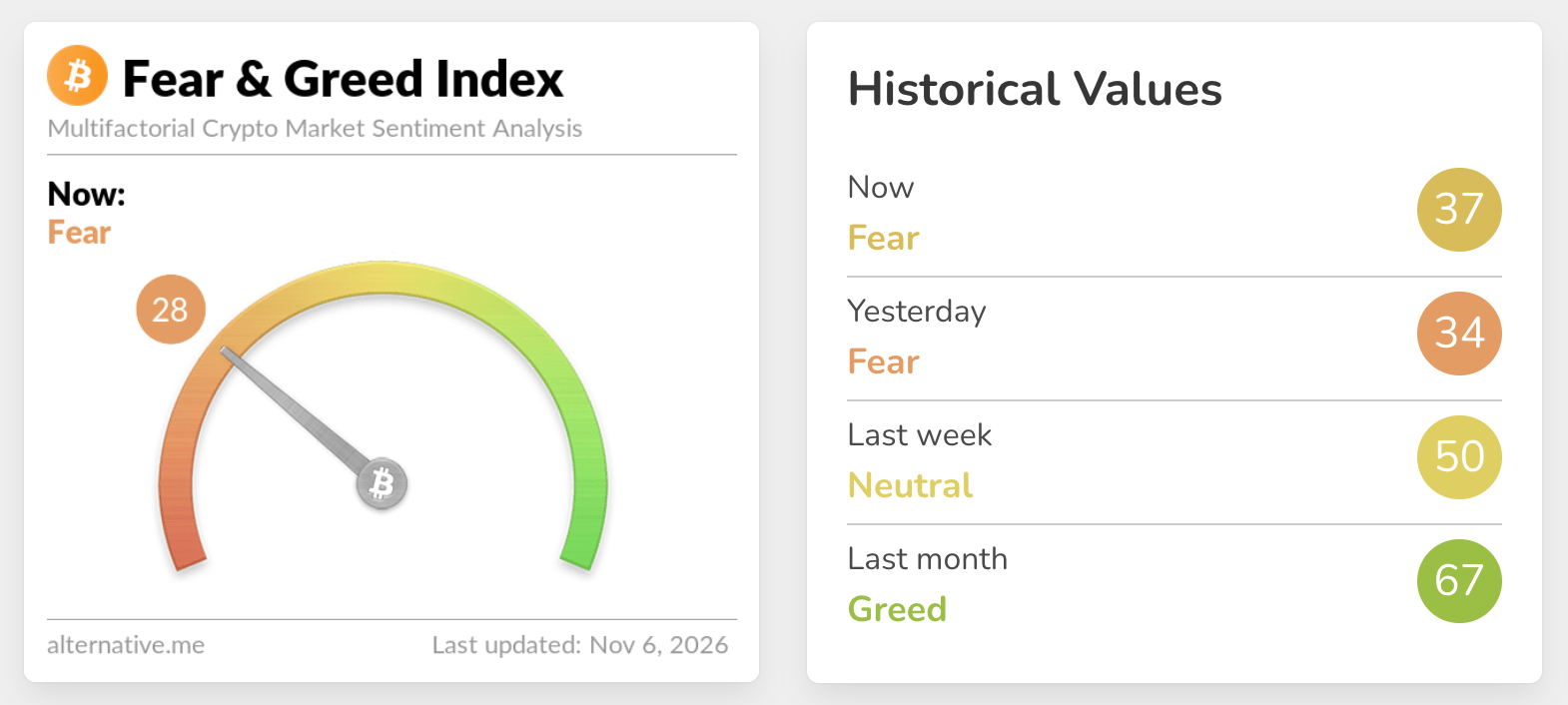
Sentiment across crypto markets is weakening further, as the Fear & Greed Index dropped from 37 a day earlier to 28 on Friday, remaining in Fear territory. Last month, the index averaged 67 in the Greed zone, a contrast that points to dwindling appetite for crypto-related digital investment products.
Bitcoin technical analysis: Can buyers loosen the bears’ grip?
A series of key moving averages is keeping Bitcoin under pressure at $75,712, leaving the near-term outlook bearish. Overhead supply is reinforced by the 200-day Exponential Moving Average (EMA) at $76,504, followed by the 100-day EMA at $77,770 and the 50-day EMA near $79,821, all above the current price.
The momentum picture also points to weakness. While the Relative Strength Index (RSI) sits around 38 in bearish territory, the Moving Average Convergence Divergence (MACD) line remains negative, indicating that recovery attempts are likely to encounter difficulty at resistance.
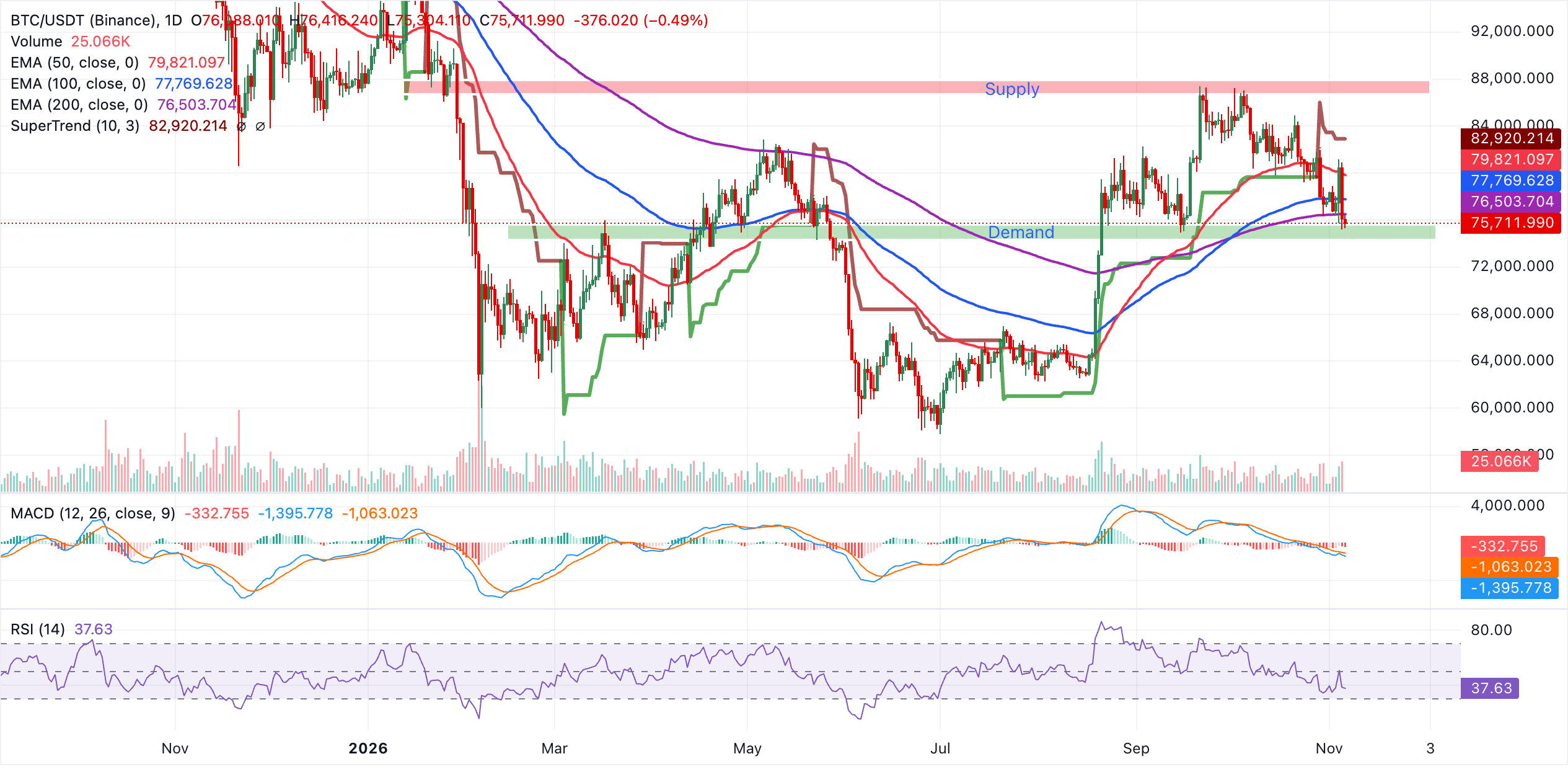
For buyers, the first requirement to relieve immediate pressure is a move back above the 200-day EMA at $76,504. The next obstacle would be the 100-day EMA at $77,770, followed by resistance at the 50-day EMA at $79,821. Further up, the SuperTrend line at $82,920 represents a more distant ceiling, unlikely to come under challenge without a substantial improvement in momentum.
Ethereum technical analysis: Can ETH defend crucial support?
Having surrendered the US midterm election gains that lifted the smart contract token above $2,400 earlier in the week, Ethereum is drifting lower around the critical $2,200 demand zone. The bearish bias remains strong, with the price below key EMAs grouped between $2,300 and $2,400. A daily-chart RSI reading of 38 and a MACD in negative territory underline the largely bearish momentum. Adding to the pressure on ETH’s technical structure is the SuperTrend line at $2,490, which suggests the path of least resistance remains lower.
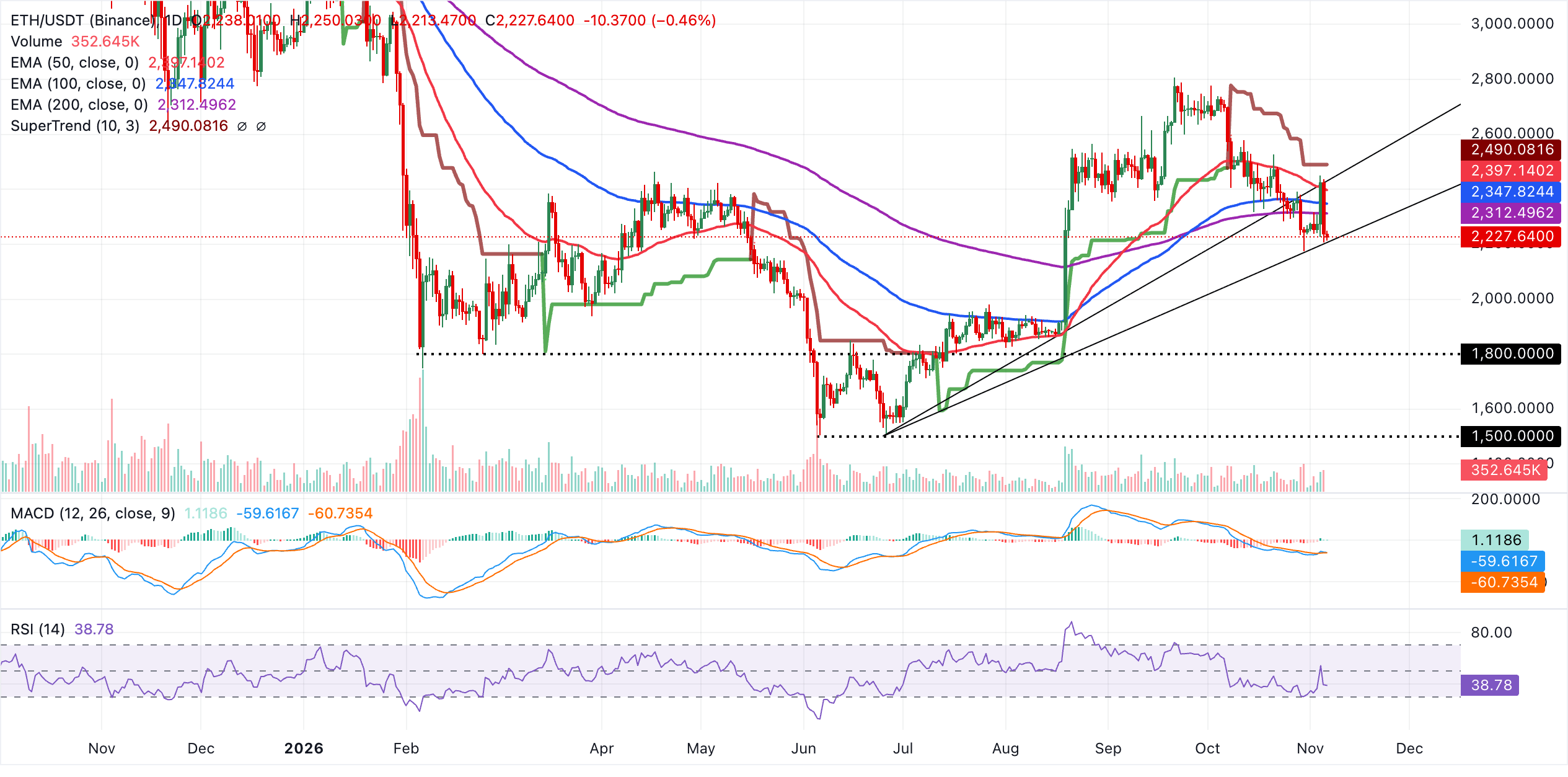
The concentration of buyers at $2,200 provides the first support zone. Once conditions settle, traders are likely to return there to position for another recovery attempt. A break below that level could force Ethereum to look for liquidity towards $2,000. Any rebound would face an initial short-term obstacle at the 200-day EMA of $2,312, then the 100-day EMA at $2,348 and the 50-day EMA at $2,397. Closing above this group of moving averages on a daily basis would point to a possible bullish reversal.
XRP technical analysis: Is the correction set to continue?
Trading beneath $1.20, XRP retains a bearish short-term outlook as it stays below major moving averages and in the lower half of the Bollinger Bands. Despite a modest improvement in recent sessions, the upside remains constrained by the 50-day, 100-day and 200-day EMAs. These averages are grouped roughly between $1.32 and $1.36, well above the spot price.
Although the sell-off is easing, momentum has yet to strengthen. The RSI is near 35, just above oversold territory, and the MACD line is slightly negative, with both readings suggesting that downward pressure remains in place.
For a corrective rebound, buyers would first have to overcome resistance at the lower Bollinger Band near $1.20, before confronting the middle band around $1.29. Higher up, a concentrated supply zone formed by the 100-day EMA at $1.32 and the 50-day EMA at $1.33 precedes the 200-day EMA near $1.36 and the upper Bollinger Band around $1.37. With little nearby chart-based support beneath current prices, a decisive break of $1.20 would leave XRP exposed to additional losses.
(An AI tool assisted in writing the technical analysis in this article. Learn more.)
Bitcoin, altcoins and stablecoins: Common questions
Ranked as the largest cryptocurrency by market capitalisation, Bitcoin is a virtual currency created to function as money. No single individual, group or entity can control this payment method, removing the need for third-party involvement in financial transactions.
The term altcoin covers cryptocurrencies other than Bitcoin. Some also exclude Ethereum, however, on the grounds that these two cryptocurrencies are the origins of forks. Under that interpretation, Litecoin would be the first altcoin: it was forked from the Bitcoin protocol and is therefore an “improved” version of it.
To maintain a stable price, stablecoins are structured as cryptocurrencies backed by reserves of the assets they represent. Each stablecoin’s value is pegged to a commodity or financial instrument, such as the US Dollar (USD), while an algorithm or demand regulates its supply. Their principal purpose is to offer investors a route into and out of cryptocurrency trading and investment. They can also serve as a store of value, given the volatility generally associated with cryptocurrencies.
By comparing Bitcoin’s market capitalisation with the combined market capitalisation of all cryptocurrencies, Bitcoin dominance indicates the level of investor interest in Bitcoin. BTC dominance is typically high ahead of and during a bull run, when investors favour a relatively stable cryptocurrency with a large market capitalisation, such as Bitcoin. Declining BTC dominance generally indicates that investors are shifting capital and/or profits into altcoins in pursuit of better returns, often setting off a surge in altcoin rallies.
POPULAR ARTICLES
1Asian FX: How are elections and oil shifts driving divergent moves? – OCBC2India FX Reserves, USD above expectations ($0B) in October 26: Actual ($717.06B)3US NFP data ahead: Australian Dollar tumbles against US Dollar4Euro: Why is the shift into Dollar cash capping gains against US Dollar? – ING5Can Gold overcome pressure below $4,100 as US Nonfarm Payrolls moves into focus?6Why is the Euro slipping as weak Eurozone data and BoJ tightening bets support the Japanese Yen?7Pi Network Price Forecast: How is the market sell-off after US midterm elections weighing on PI?8Crypto Today: Reversal of post-midterm elections rally deepens losses in Bitcoin, Ethereum and XRP9How does a Democratic Congress affect Bitcoin and crypto
regulation?

Get Started!
Sign up and access the Global Markets in less than 3 minutes

Connect With Us









Contacts
Phone: +61 2 8036 8388
Fax: +61 2 8036 8388
Email: support@tmgm.com



The information provided on this website is of a general nature only and does not constitute personal financial advice. Before acting on any information on this website, you should consider the suitability of the information in relation to your objectives, financial situation and needs. Investing in CFDs and FX Margin Contracts carries significant risks and is not suitable for all investors. You may lose more than your initial deposit. You do not own, or have, any interest in the underlying asset. We recommend that you seek independent advice and ensure you fully understand the risks involved before trading. It is important that you read and consider the disclosure document before you acquire any product listed on the website. The information and advertisements offered on this website are not intended for use by any person in any country or jurisdiction where such use would be contrary to local laws and regulations. The Products and Services offered on this website are not intended for residents of the United States, Malaysia and Thailand.
TMGM is authorized and regulated in various jurisdictions.
Trademax Australia Limited, trading as TMGM, is regulated by the Australian Securities and Investments Commission (ASIC), AFSL no. 436416 and is located at Level 28, One International Tower, 100 Barangaroo Avenue, 2000 Sydney, NSW Australia.
Email: support@tmgm.com.au
Trademax Global Limited, trading as TMGM, is authorized and regulated by the Vanuatu Financial Services Commission (VFSC), registration number 40356 and registered at 1276, Kumul Highway, Port Vila, Vanuatu, Republic of Vanuatu.
Email: support@tmgm.com
Trademax Global Markets (SE) Limited, trading as TMGM, is authorized and regulated by the Financial Services Authority (FSA) of Seychelles, with license number SD224. The company is registered at Office No 13, Providence Estate ABIS Centre, Mahe, Seychelles.
Email: support@tmgm.com
Trademax Global Markets (International) Pty Ltd, trading as TMGM, is authorized and regulated by the Financial Services Commission, Mauritius (FSC) with license no. GB22201012, and registered at 33, Edith Cavell Street C/o IQ EQ Fund Services (Mauritius) Ltd Port Louis, 11324 Mauritius.
Email: support@tmgm.com
Copyright © TMGM. All rights reserved