

Trading
Explore a wide range of markets with competitive pricing, deep liquidity, and advanced trading tools.
Learn More 
Platform
Trade seamlessly with TMGM's powerful platform, built for speed, precision, and a superior trading experience.
Learn More Trading Platform
Academy
Learn the fundamentals of trading with beginner-friendly resources, including guides, webinars, and market insights.
Learn More News & Analysis
Get real-time market updates and expert analysis to stay ahead of trading opportunities
Learn More News & Analysis
About
Learn what sets TMGM apart — our global presence, regulatory strength, and commitment to innovation in trading.
Learn More Why Choose TMGM
Sponsorship
Dow Jones Industrial Average recovers lost ground even as AI stocks retreat
- DJIA reclaims 50,000 for a third session after sliding towards 48,900.
- IBM, Salesforce and Sherwin-Williams support the index despite a nearly 5% decline in Nvidia.
- A Thursday closure and Friday's shortened session await US markets before Fed officials enter their quiet period.
A recovery outside artificial intelligence (AI) shares has put the Dow Jones Industrial Average on course for a third consecutive session of gains, even as a second day of AI selling spilled into the broader market. Having slipped below Tuesday's low to around 48,900, the Dow has regained 50,000. Other indices remain in negative territory: at their session lows, the Nasdaq Composite had lost 4.6% and the S&P 500 had shed 3.2%.

Losses remain concentrated in AI-linked shares, with Nvidia (NVDA) nearly 5% lower and Micron (MU) and Oracle (ORCL) down 4%-5%. Investors instead bought the S&P 500's materials, energy and real estate shares, with each sector gaining more than 1%. The Dow is drawing support from IBM (IBM), Salesforce (CRM) and Sherwin-Williams (SHW). According to traders, thin holiday volumes partly explain the recovery, alongside investor Michael Burry's decision to close his bets against the NASDAQ 100 and become a buyer for now.
Expectations of a December Fed rate increase remain priced at close to 94% after October's core Personal Consumption Expenditures Price Index (PCE) increased 3.3% year on year, exceeding the 3.2% forecast. Separately, the White House proposed tariffs on 14 trading partners, including an additional 20% on China. With third-quarter Gross Domestic Product (GDP) growth reaching 4.3% against expectations of 3.4%, interest rates and tariffs weighed on the Dow rather than an economic slowdown.
What lies ahead on the calendar?
Thanksgiving will keep US stock markets closed on Thursday, followed by a shortened Friday session ending at 18:00 GMT rather than 21:00 GMT. Friday also marks the final opportunity for Fed officials to comment before the policy decision, as the quiet period for the December 8-9 Federal Open Market Committee (FOMC) meeting begins on Saturday. Traders have linked the AI sell-off that spread to the Dow on Wednesday to borrowing costs: a December 9 hike would lift the Fed's rate to 4.00%-4.25%.
What do the charts indicate?
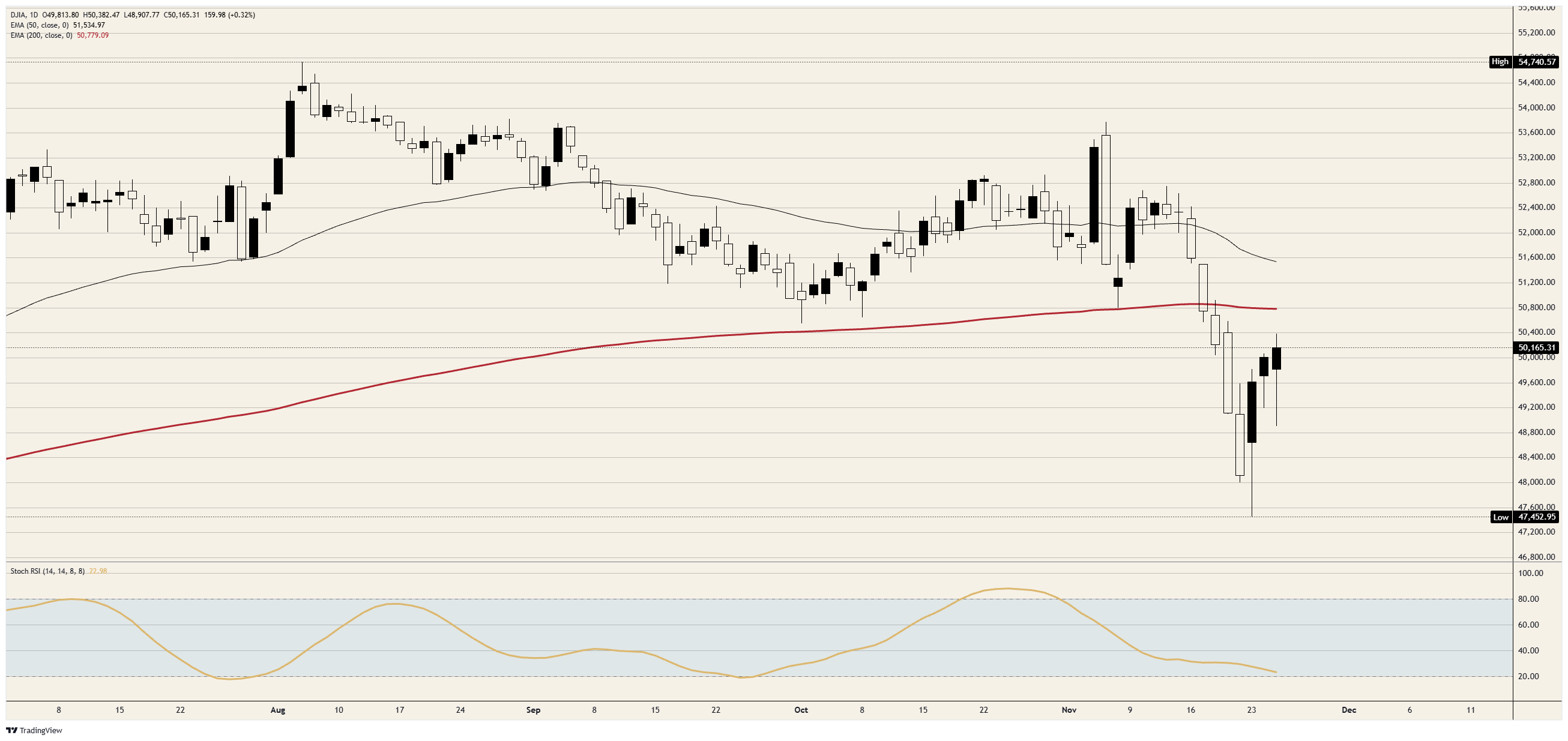
About two-fifths of the decline from the November 5 high near 53,800 has been retraced during three sessions of gains from Monday's low around 47,500. Still overhead is the 200-day Exponential Moving Average (EMA), just below 50,800, which the index broke beneath on November 17. The 50-day EMA stands near 51,500. Despite the three-session advance, daily momentum continues to weaken and is close to oversold territory.
Daily chart of the Dow Jones
Dow Jones: common questions
Among the world's oldest stock market indices, the Dow Jones Industrial Average comprises the 30 most actively traded US stocks. Rather than using market capitalisation, it assigns weights according to share prices. Its value is obtained by adding the constituent share prices and dividing the total by a factor that currently stands at 0.152. Charles Dow, who also established the Wall Street Journal, founded the index. More recently, critics have questioned how adequately it represents the wider market, given that it follows only 30 conglomerates rather than the larger universe covered by indices such as the S&P 500.
The combined performance of its constituent companies, as reported in quarterly earnings, is the principal driver of the Dow Jones Industrial Average (DJIA). Investor sentiment also responds to US and global macroeconomic releases, which in turn influence the index. Another important factor is the interest rate set by the Federal Reserve (Fed), since it determines the cost of borrowing for corporations that depend heavily on credit. Inflation and other indicators shaping Fed decisions can therefore have a substantial influence on the DJIA.
Developed by Charles Dow, Dow Theory seeks to establish the stock market's primary trend. It compares the direction of the Dow Jones Industrial Average (DJIA) with that of the Dow Jones Transportation Average (DJTA), following a trend only when both indices move the same way. Trading volume serves as confirmation, while analysis of peaks and troughs also forms part of the method. The theory describes three phases: accumulation, as smart money begins buying or selling; public participation, as the broader public enters; and distribution, as smart money withdraws.
Investors can access the DJIA through several instruments. ETFs package exposure to the index into a single security, removing the need to purchase shares in each of its 30 constituent companies. The SPDR Dow Jones Industrial Average ETF (DIA) is a prominent example. Futures contracts allow traders to speculate on the DJIA's future value, while options confer the right, without any obligation, to buy or sell the index at an agreed price at a future date. Mutual funds offer another route: purchasing a share in a diversified portfolio of DJIA stocks provides exposure to the index as a whole.
POPULAR ARTICLES
1New Zealand Dollar rebounds from 2009 low ahead of confidence data2Pound holds steady ahead of BoE stability report following rate hearing3Euro above 19-month low: What next as ECB meeting accounts loom?4Dow Jones Industrial Average recovers lost ground even as AI stocks retreat5FX Today: Why is the US Dollar weakening despite strong US data? ECB minutes in focus6Why is gold tumbling despite lower US yields as core PCE reaches 3.3%?7Chinese Yuan: Is Its Role in Global Portfolios Growing? – DBS8Australian Dollar recovers even as risk appetite stays weak and Fed outlook remains hawkish9LatAm FX: Regional currencies weaken as carry trades unwind – ING


Get Started!
Sign up and access the Global Markets in less than 3 minutes

Connect With Us









Contacts
Phone: +61 2 8036 8388
Fax: +61 2 8036 8388
Email: support@tmgm.com



The information provided on this website is of a general nature only and does not constitute personal financial advice. Before acting on any information on this website, you should consider the suitability of the information in relation to your objectives, financial situation and needs. Investing in CFDs and FX Margin Contracts carries significant risks and is not suitable for all investors. You may lose more than your initial deposit. You do not own, or have, any interest in the underlying asset. We recommend that you seek independent advice and ensure you fully understand the risks involved before trading. It is important that you read and consider the disclosure document before you acquire any product listed on the website. The information and advertisements offered on this website are not intended for use by any person in any country or jurisdiction where such use would be contrary to local laws and regulations. The Products and Services offered on this website are not intended for residents of the United States, Malaysia and Thailand.
TMGM is authorized and regulated in various jurisdictions.
Trademax Australia Limited, trading as TMGM, is regulated by the Australian Securities and Investments Commission (ASIC), AFSL no. 436416 and is located at Level 28, One International Tower, 100 Barangaroo Avenue, 2000 Sydney, NSW Australia.
Email: support@tmgm.com.au
Trademax Global Limited, trading as TMGM, is authorized and regulated by the Vanuatu Financial Services Commission (VFSC), registration number 40356 and registered at 1276, Kumul Highway, Port Vila, Vanuatu, Republic of Vanuatu.
Email: support@tmgm.com
Trademax Global Markets (SE) Limited, trading as TMGM, is authorized and regulated by the Financial Services Authority (FSA) of Seychelles, with license number SD224. The company is registered at Office No 13, Providence Estate ABIS Centre, Mahe, Seychelles.
Email: support@tmgm.com
Trademax Global Markets (International) Pty Ltd, trading as TMGM, is authorized and regulated by the Financial Services Commission, Mauritius (FSC) with license no. GB22201012, and registered at 33, Edith Cavell Street C/o IQ EQ Fund Services (Mauritius) Ltd Port Louis, 11324 Mauritius.
Email: support@tmgm.com
Copyright © TMGM. All rights reserved