

Trading
Explore a wide range of markets with competitive pricing, deep liquidity, and advanced trading tools.
Learn More 
Platform
Trade seamlessly with TMGM's powerful platform, built for speed, precision, and a superior trading experience.
Learn More Trading Platform
Academy
Learn the fundamentals of trading with beginner-friendly resources, including guides, webinars, and market insights.
Learn More News & Analysis
Get real-time market updates and expert analysis to stay ahead of trading opportunities
Learn More News & Analysis
About
Learn what sets TMGM apart — our global presence, regulatory strength, and commitment to innovation in trading.
Learn More Why Choose TMGM
Sponsorship
Gold regains $4,060 ahead of pivotal Fed decision; Oil pulls back
- Gold rebounds more than 1% to $4,061 following a test of $3,989.
- Energy-led inflation concerns ease as WTI slips towards $100.
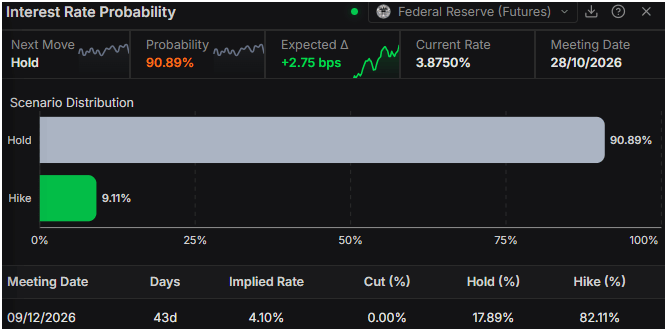
- Ahead of Warsh's remarks, markets price in an 83% probability of a December Fed rate hike.
Gold's recovery gathers pace on Tuesday, with the metal gaining over 1% despite a firmer US Dollar and higher US Treasury yields. After touching an intraday low of $3,989, XAU/USD is trading at $4,061. Lower Oil prices are supporting the precious metal as investors prepare for Wednesday's interest rate decision from the Federal Reserve (Fed).

Can lower Oil prices sustain XAU/USD's rebound despite higher US yields?
Gold reversed its opening losses to trade higher, although today's US economic releases offered little clarity on its direction. Geopolitical developments remain the main influence on prices, with West Texas Intermediate (WTI), the US Oil benchmark, declining more than 1% to $100.05 per barrel.
A quick resolution to the Middle East conflict appears unlikely, with negotiations between the US and Iran seemingly at a standstill. Recent reports suggest that the US and Israel are likely to renew their attack on Tehran after elections in Israel and the US midterm elections. This prospect drove WTI above $100.00 on Monday.
Market participants largely looked past weaker-than-expected US housing figures. Separately, the Conference Board reported that Consumer Confidence climbed to 91.7 in October from 84.2, reflecting greater optimism among Americans about employment and business conditions. Inflation expectations, however, held steady at the previous reading of 5.8%.
Business spending remained robust as AI infrastructure expanded, helping Durable Goods Orders grow 1.8% in September, compared with 0.1% previously. By contrast, the 4-week average for ADP Employment Change slipped from 18.5K to 16.8K, pointing to a modest cooling in the labour market.
Attention remains centred on the Fed, although its monetary policy statement is unlikely to be the main focus unless it takes an aggressively hawkish stance. Money markets assign a 9% probability to a rate hike, which would come as a surprise ahead of the US midterm elections. Traders will instead scrutinise Fed Chair Kevin Warsh's speech for indications of the next policy move at the December meeting.
Beyond the Fed, two other central banks are expected to raise rates amid concerns that energy prices will keep climbing. Thursday brings the European Central Bank (ECB) decision, with the Bank of Japan (BoJ) following on Friday. The ECB is expected to keep rates on hold on Thursday.
The probability of a 25-basis-point Fed rate hike in December stands at 83%, according to Prime Terminal data. While the odds remain positive, they have continued to decline from last week's 90%.
Thursday's releases of US Gross Domestic Product (GDP) data and the core Personal Consumption Expenditures (PCE) Price Index, the Fed's preferred inflation measure, are also on traders' radar.
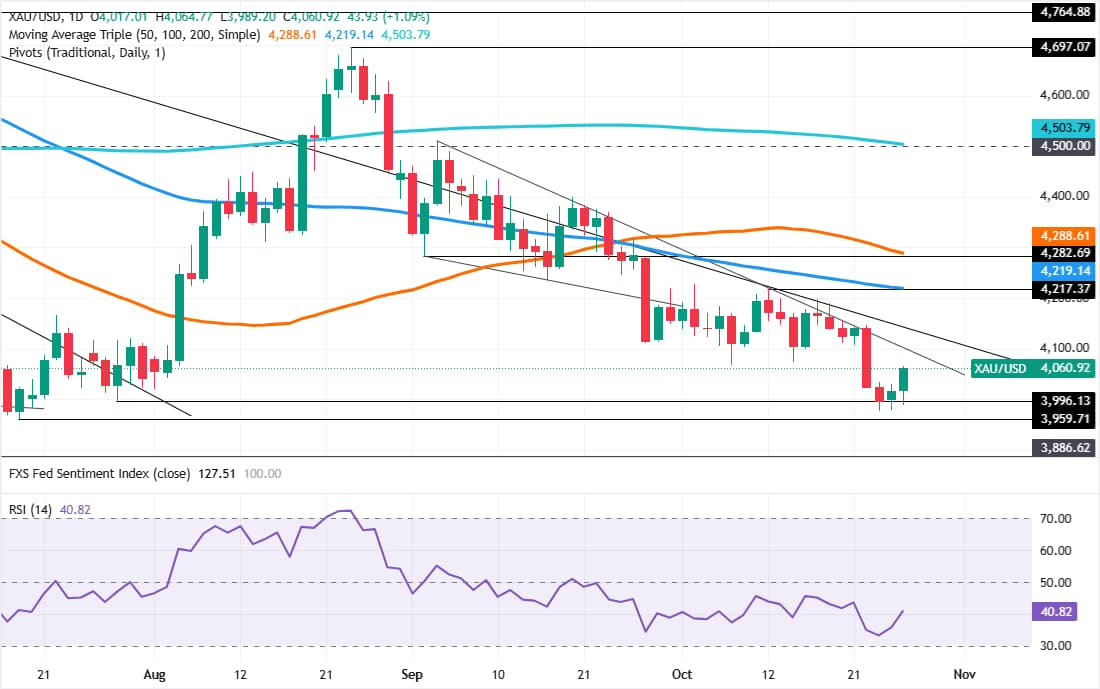
XAU/USD technical analysis: Can Gold target $4,100 as buyers protect $4,000?
Gold's move above October's 23-day high of $4,034 today confirms the "bullish harami" candlestick pattern formed by XAU/USD. Near-term momentum favours buyers, but the bearish Relative Strength Index (RSI) calls for caution.
A resistance trendline drawn from around the September highs, near $4,100, is the next upside level to watch. Breaking above it would bring $4,200 into view. Beyond that, key resistance lies at the 100-day Simple Moving Average (SMA) of $4,219, followed by the 50-day SMA of $4,288.
A fall below $4,000 would leave XAU/USD vulnerable to a test of last Friday's $3,975 low. Further support is located at the 17 July low of $3,959 and then the year-to-date (YTD) low of $3,941.
Common questions about Gold
Throughout human history, Gold has served extensively as both a store of value and a means of exchange. Today, its appeal extends beyond its lustre and use in jewellery: the precious metal is widely regarded as a safe-haven asset and, therefore, a good investment during periods of turbulence. Because it is not dependent on any particular issuer or government, Gold is also commonly viewed as a hedge against inflation and currency depreciation.
The largest holders of Gold are central banks. To support their currencies during turbulent periods, they typically diversify reserves and purchase Gold, reinforcing perceptions of strength in both the economy and the currency. Substantial Gold reserves can bolster confidence in a country's solvency. According to the World Gold Council, central banks increased their reserves by 1,136 tonnes of Gold, valued at around $70 billion, in 2022. That marked the largest annual purchase since records began. Emerging-economy central banks, including those in China, India and Turkey, are expanding their Gold reserves rapidly.
The US Dollar and US Treasuries, both leading reserve and safe-haven assets, have an inverse relationship with Gold. A weaker Dollar generally supports a rise in Gold, allowing investors and central banks to diversify their holdings during unsettled periods. Risk assets also tend to move in the opposite direction to Gold: stock market gains usually weigh on the metal, whereas selling in riskier markets generally supports it.
A broad range of influences can move Gold prices. Its safe-haven appeal means geopolitical unrest or concerns about a deep recession can trigger a rapid rise. Since Gold offers no yield, lower interest rates generally support it, while a higher cost of borrowing usually puts pressure on the precious metal. Nevertheless, the US Dollar (USD) drives most price moves because Gold is quoted in dollars (XAU/USD). Dollar strength tends to restrain Gold prices, while a softer Dollar is likely to lift them.
POPULAR ARTICLES
1South Korea: How is the AI cycle bolstering the GDP outlook? – DBS2British Pound: Why is Budget risk limiting the Pound’s recovery? – Scotiabank3USD/CHF Price Forecast: Is 0.8400 within reach after bullish engulfing?4Can the Australian Dollar stay near one-month highs as CPI and Fed take centre stage?5US Dollar: Risks tilt further to the downside ahead of FOMC – Scotiabank6Gold regains $4,060 ahead of pivotal Fed decision; Oil pulls back7Chilean Peso: Could dovish repricing emerge as central bank expected to stay on hold? – BBH8Brazilian Real: Fiscal Doubts Accompany Post-Election Sell-Off – Commerzbank9Euro: Will key support at 1.1113 hold against US Dollar? – Scotiabank
LIVE QUOTES

ALL ABOUT GOLD & PRECIOUS METALS
Gold ETF Taxation: What Is the Tax on Gold ETF in India?
How Much Gold Is Allowed From Dubai to India?
How much is the Tax on Gold in India?
Gold Market Open Time: XAUUSD Trading Hours & Best Time to Trade
How to Trade Gold
Top 10 Most Traded Commodities in India & The Best Commodity to Trade
Gold Price Chart India 10 Years: An Overview
Why Invest in Gold: The Advantages of Trading Gold CFDs
4 Strategies for Investing in Gold for Beginners in 2025
Get Started!
Sign up and access the Global Markets in less than 3 minutes

Connect With Us









Contacts
Phone: +61 2 8036 8388
Fax: +61 2 8036 8388
Email: support@tmgm.com



The information provided on this website is of a general nature only and does not constitute personal financial advice. Before acting on any information on this website, you should consider the suitability of the information in relation to your objectives, financial situation and needs. Investing in CFDs and FX Margin Contracts carries significant risks and is not suitable for all investors. You may lose more than your initial deposit. You do not own, or have, any interest in the underlying asset. We recommend that you seek independent advice and ensure you fully understand the risks involved before trading. It is important that you read and consider the disclosure document before you acquire any product listed on the website. The information and advertisements offered on this website are not intended for use by any person in any country or jurisdiction where such use would be contrary to local laws and regulations. The Products and Services offered on this website are not intended for residents of the United States, Malaysia and Thailand.
TMGM is authorized and regulated in various jurisdictions.
Trademax Australia Limited, trading as TMGM, is regulated by the Australian Securities and Investments Commission (ASIC), AFSL no. 436416 and is located at Level 28, One International Tower, 100 Barangaroo Avenue, 2000 Sydney, NSW Australia.
Email: support@tmgm.com.au
Trademax Global Limited, trading as TMGM, is authorized and regulated by the Vanuatu Financial Services Commission (VFSC), registration number 40356 and registered at 1276, Kumul Highway, Port Vila, Vanuatu, Republic of Vanuatu.
Email: support@tmgm.com
Trademax Global Markets (SE) Limited, trading as TMGM, is authorized and regulated by the Financial Services Authority (FSA) of Seychelles, with license number SD224. The company is registered at Office No 13, Providence Estate ABIS Centre, Mahe, Seychelles.
Email: support@tmgm.com
Trademax Global Markets (International) Pty Ltd, trading as TMGM, is authorized and regulated by the Financial Services Commission, Mauritius (FSC) with license no. GB22201012, and registered at 33, Edith Cavell Street C/o IQ EQ Fund Services (Mauritius) Ltd Port Louis, 11324 Mauritius.
Email: support@tmgm.com
Copyright © TMGM. All rights reserved