

Trading
Explore a wide range of markets with competitive pricing, deep liquidity, and advanced trading tools.
Learn More 
Platform
Trade seamlessly with TMGM's powerful platform, built for speed, precision, and a superior trading experience.
Learn More Trading Platform
Academy
Learn the fundamentals of trading with beginner-friendly resources, including guides, webinars, and market insights.
Learn More News & Analysis
Get real-time market updates and expert analysis to stay ahead of trading opportunities
Learn More News & Analysis
About
Learn what sets TMGM apart — our global presence, regulatory strength, and commitment to innovation in trading.
Learn More Why Choose TMGM
Sponsorship
NZD/USD Price Forecast: Is Further Downside Likely Below 0.5560?
- NZD/USD slips towards 0.5620, pressured by the US Dollar’s partial recovery from early losses.
- With US midterm elections approaching, investors prepare for volatility.
- For this year’s third quarter, New Zealand’s Unemployment Rate is expected to decline to 5.5%.
Selling pressure weighs on the New Zealand Dollar (NZD) against the US Dollar (USD), leaving NZD/USD near 0.5620 in Monday’s European session. A partial reversal of the US Dollar’s early losses is dragging the Kiwi pair lower. The Greenback, however, remains under pressure ahead of Tuesday’s United States (US) midterm elections.

How Is the New Zealand Dollar Performing Today?
Among the major currencies listed below, the Swiss Franc was the New Zealand Dollar’s weakest counterpart today. The table sets out the New Zealand Dollar’s (NZD) percentage moves against each currency.
| USD | EUR | GBP | JPY | CAD | AUD | NZD | CHF | |
|---|---|---|---|---|---|---|---|---|
| USD | -0.44% | -0.18% | 0.25% | 0.02% | 0.33% | 0.15% | -0.60% | |
| EUR | 0.44% | 0.27% | 0.67% | 0.45% | 0.77% | 0.59% | -0.13% | |
| GBP | 0.18% | -0.27% | 0.45% | 0.19% | 0.50% | 0.33% | -0.39% | |
| JPY | -0.25% | -0.67% | -0.45% | -0.22% | 0.08% | -0.11% | -0.84% | |
| CAD | -0.02% | -0.45% | -0.19% | 0.22% | 0.32% | 0.12% | -0.58% | |
| AUD | -0.33% | -0.77% | -0.50% | -0.08% | -0.32% | -0.18% | -0.90% | |
| NZD | -0.15% | -0.59% | -0.33% | 0.11% | -0.12% | 0.18% | -0.71% | |
| CHF | 0.60% | 0.13% | 0.39% | 0.84% | 0.58% | 0.90% | 0.71% |
Percentage movements between major currencies are displayed in the heat map. Select the base currency in the left-hand column and the quote currency in the top row. Selecting the New Zealand Dollar on the left and following its row across to the US Dollar, for instance, gives the percentage change for NZD (base)/USD (quote) in the corresponding cell.
Despite rebounding from an intraday trough of 101.43, the US Dollar Index (DXY) remains 0.3% lower near 101.70 at the time of writing. The index tracks the Greenback against six major currencies.
Could a Democrat sweep in US midterms weigh on the Dollar outlook?
For FX markets this week, ING’s Chris Turner identifies the US midterm elections as the principal event risk. Betting markets, he notes, now assign the Democrats a “70-72% chance of taking both the House and the Senate.” In his view, “one could make the case that the Dollar should come lower on such an outcome,” since a Democrat clean sweep would likely “lead to gridlock on the debt ceiling, a prolonged government shutdown next year and could encourage President Trump to pursue an even more activist foreign policy agenda.” Turner therefore suggests that investors will assess these political risks alongside factors that continue to support the Dollar and DXY around 102.00: robust US growth, inflation above target and continued Fed tightening.
Due at 15:00 GMT later in the day, October’s US ISM Manufacturing PMI figures will be in focus for investors.
Meanwhile, Wednesday’s Q3 labour market release is awaited in New Zealand (NZ). Expectations are for the Unemployment Rate to ease from the previous 5.6% to 5.5%.
NZD/USD Technical Analysis: Can the Pair Shake Off Its Bearish Bias?
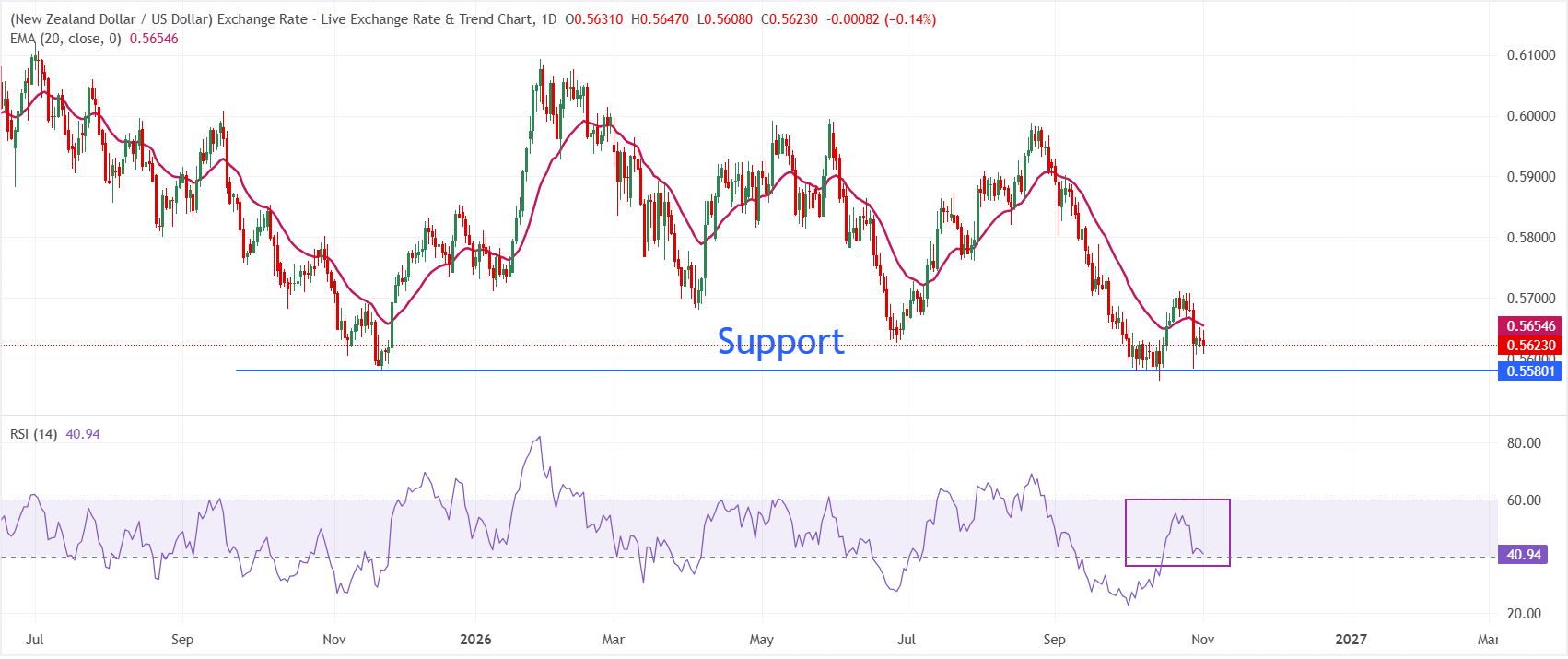
Trading at 0.5623 on the daily chart, NZD/USD retains a bearish short-term bias below its 20-day Exponential Moving Average (EMA) of 0.5655. The brief mid-October rebound failed to hold, and the pair has since continued to edge lower. Its inability to move above the short-term EMA points to sustained selling pressure.
At around 41, the 14-day Relative Strength Index (RSI) sits below the neutral 50 mark. This indicates weak upward momentum, rather than outright oversold conditions.
For the bearish tone to ease and a more substantial corrective rebound to become possible, a daily close above the immediate resistance at the 20-day EMA near 0.5655 would be required. On the downside, the low of 14 October at 0.5564 provides critical support. A break beneath it could set off another leg lower.
(The technical analysis of this story was written with the help of an AI tool. Know more.)
Which Economic Indicator Is in Focus?
What Does the Unemployment Rate Measure?
Published by Statistics New Zealand, the Unemployment Rate measures unemployed workers as a percentage of the total civilian labour force. A rise signals that New Zealand’s labour market is not expanding and that the economy is weak. A lower reading is generally regarded as bullish for the New Zealand Dollar (NZD); conversely, a higher reading is considered bearish.
Find out more.Next scheduled release: Tue 03 Nov 2026 21:45
Release frequency: Quarterly
Consensus estimate: 5.5%
Previous reading: 5.6%
Data source: Stats NZ
The NZD could gain support from a better-than-expected employment reading. Published quarterly by Statistics New Zealand, the data provide insights into the country’s labour market, covering employment and unemployment rates, labour demand, and movements in wages and salaries. These indicators tend to influence inflation in New Zealand and the interest rate decision of the Reserve Bank of New Zealand (RBNZ), ultimately affecting the NZD.
POPULAR ARTICLES
1Equities: How do AI themes underpin a selective overweight? – HSBC2CEE FX: Are rate hikes on the horizon? – Societe Generale3Bitcoin Price Forecast: Can BTC Regain $78,000 as ETF Outflows Weigh?4Euro: How does Fitch’s move limit rebound potential against the US Dollar? – ING5US Dollar heads into elections on a softer footing – MUFG6EUR/GBP Price Forecast: Can Euro Clear Resistance at 0.8360 as Pound Momentum Fades?7NZD/USD Price Forecast: Is Further Downside Likely Below 0.5560?8Brent: Price outlook points to higher levels for longer – OCBC9Oil’s retreat offers Gold some respite as traders await key US economic data


Get Started!
Sign up and access the Global Markets in less than 3 minutes

Connect With Us









Contacts
Phone: +61 2 8036 8388
Fax: +61 2 8036 8388
Email: support@tmgm.com



The information provided on this website is of a general nature only and does not constitute personal financial advice. Before acting on any information on this website, you should consider the suitability of the information in relation to your objectives, financial situation and needs. Investing in CFDs and FX Margin Contracts carries significant risks and is not suitable for all investors. You may lose more than your initial deposit. You do not own, or have, any interest in the underlying asset. We recommend that you seek independent advice and ensure you fully understand the risks involved before trading. It is important that you read and consider the disclosure document before you acquire any product listed on the website. The information and advertisements offered on this website are not intended for use by any person in any country or jurisdiction where such use would be contrary to local laws and regulations. The Products and Services offered on this website are not intended for residents of the United States, Malaysia and Thailand.
TMGM is authorized and regulated in various jurisdictions.
Trademax Australia Limited, trading as TMGM, is regulated by the Australian Securities and Investments Commission (ASIC), AFSL no. 436416 and is located at Level 28, One International Tower, 100 Barangaroo Avenue, 2000 Sydney, NSW Australia.
Email: support@tmgm.com.au
Trademax Global Limited, trading as TMGM, is authorized and regulated by the Vanuatu Financial Services Commission (VFSC), registration number 40356 and registered at 1276, Kumul Highway, Port Vila, Vanuatu, Republic of Vanuatu.
Email: support@tmgm.com
Trademax Global Markets (SE) Limited, trading as TMGM, is authorized and regulated by the Financial Services Authority (FSA) of Seychelles, with license number SD224. The company is registered at Office No 13, Providence Estate ABIS Centre, Mahe, Seychelles.
Email: support@tmgm.com
Trademax Global Markets (International) Pty Ltd, trading as TMGM, is authorized and regulated by the Financial Services Commission, Mauritius (FSC) with license no. GB22201012, and registered at 33, Edith Cavell Street C/o IQ EQ Fund Services (Mauritius) Ltd Port Louis, 11324 Mauritius.
Email: support@tmgm.com
Copyright © TMGM. All rights reserved