

Trading
Explore a wide range of markets with competitive pricing, deep liquidity, and advanced trading tools.
Learn More 
Platform
Trade seamlessly with TMGM's powerful platform, built for speed, precision, and a superior trading experience.
Learn More Trading Platform
Academy
Learn the fundamentals of trading with beginner-friendly resources, including guides, webinars, and market insights.
Learn More News & Analysis
Get real-time market updates and expert analysis to stay ahead of trading opportunities
Learn More News & Analysis
About
Learn what sets TMGM apart — our global presence, regulatory strength, and commitment to innovation in trading.
Learn More Why Choose TMGM
Sponsorship
Ripple Price Forecast: Can XRP hold $1.30 support as protocol defers bug fix to November?
- Downside pressure nudges XRP towards $1.30, with the 100-day EMA turning into resistance alongside the 50-day and 200-day EMAs.
- A drop in validator support to 26 restarts the XRP Ledger’s bug-fix countdown, pushing the patch back to November.
- A fragile price structure hampers XRP’s recovery prospects, even as the weekly SuperTrend indicator offers support.
Sellers are gaining the upper hand in Ripple (XRP), which is retreating towards $1.30 on Thursday and surrendering gains made early in the week. Buyers have been left discouraged after attempts to extend the recovery towards $1.40 fell short. Downside remains the path of least resistance, with selling likely to gather pace if bulls surrender the $1.30 demand zone.

Can modest ETF inflows offset selling pressure?
Selling pressure persists across the cryptocurrency market despite money flowing into spot Exchange-Traded Funds (ETFs). Bitcoin (BTC) is leading the retreat with a slide below $82,000, while Ethereum (ETH) is correcting near $2,400.
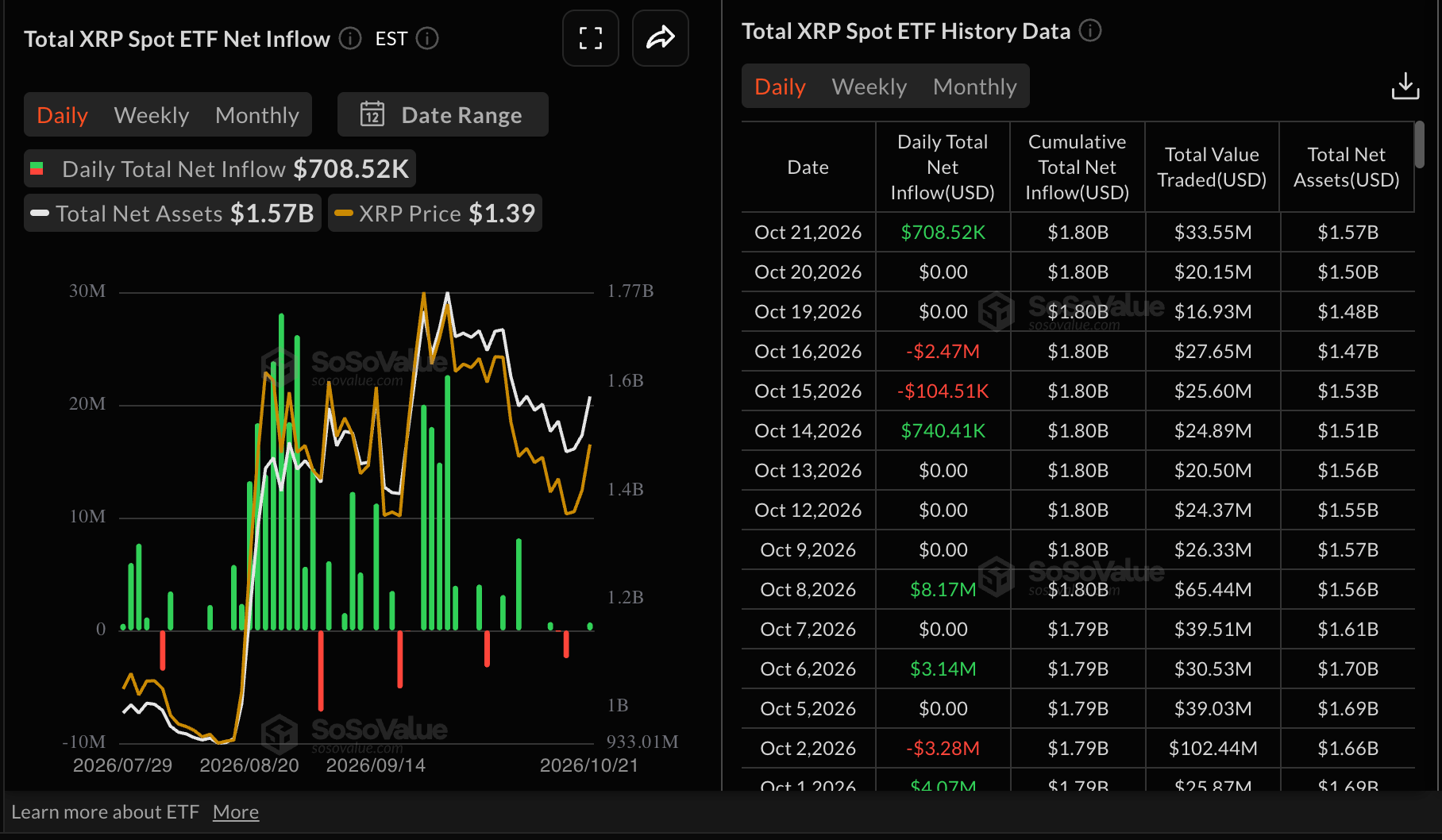
Wednesday brought roughly $709,000 in inflows to US-listed XRP spot ETFs, following two straight days of subdued activity. This modest interest over a single day may be insufficient to absorb selling pressure unless inflows continue in the weeks ahead. Nevertheless, cumulative inflows remain positive at $1.8 billion despite the volatility, while net assets stand at $1.6 billion. These figures suggest that long-term investor appetite for the underlying token remains intact.
Why has the XRP Ledger bug fix been postponed?
A decline in validator support from 35 to 26 has forced Ripple’s XRP Ledger (XRPL) to postpone a planned bug fix. The patch now faces another two-week wait, although CoinDesk has reported on X that support among validators has recovered to 31.
For an XRPL amendment to proceed, validator consensus must remain above 80%. Approval from at least 29 of 35 validators is required, with the network checking that threshold every 15 minutes for 14 days. This process ensures broad network backing before protocol changes are introduced, whether they close loopholes in token creation or refine the lending algorithm.
Technical analysis: Can XRP buyers regain control?
A cluster of key Exponential Moving Averages (EMAs) continues to keep XRP under pressure near $1.33, leaving its short-term outlook bearish. Closest overhead is the 100-day EMA at $1.34. The 50-day and 200-day EMAs converge just above $1.37, indicating that a substantial supply zone still caps the pair.
Weak momentum reinforces that picture: the Relative Strength Index (RSI) is near 43 and the Moving Average Convergence Divergence (MACD) indicator is marginally negative. Together, these readings suggest that recovery attempts are likely to attract selling for as long as prices remain below the overhead barriers.
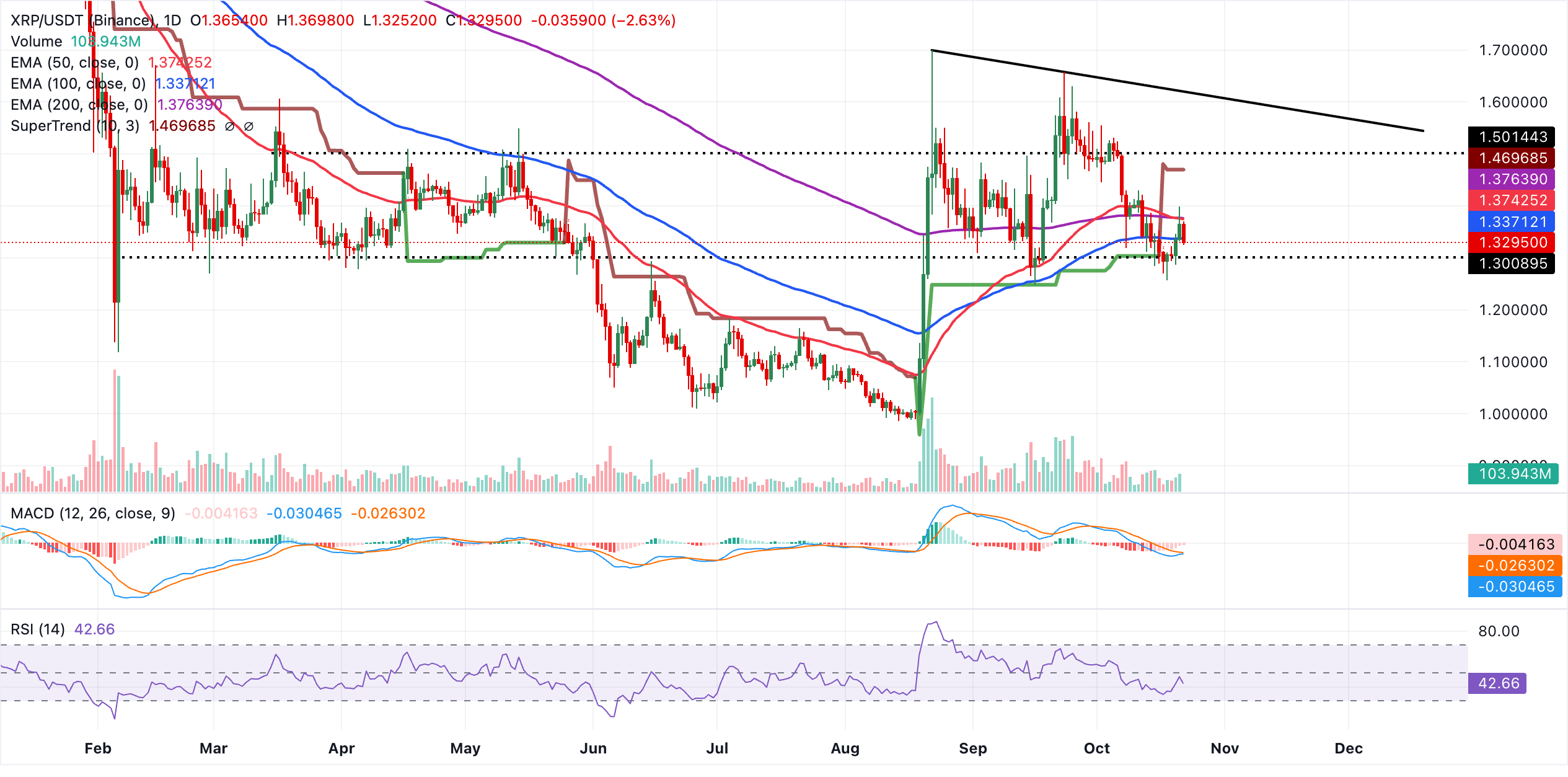
Any move higher would first encounter the 100-day EMA near $1.34, followed by the closely grouped 50-day EMA and 200-day EMA at $1.38. A sustained breakout above this confluence would bring the SuperTrend line near $1.47 into focus. Beyond it lies the broader downtrend barrier marked by the resistance trend line, with reference levels at $1.62 and $1.70. The daily chart offers no clear indicator-based support, leaving the pair exposed to further declines unless buyers reclaim at least the 100-day EMA.
The weekly chart, meanwhile, presents mixed momentum readings rather than a firm directional signal. Although positive, the MACD histogram has eased from earlier highs, and the RSI is hovering near 48. This combination points more towards consolidation than a sustained bullish push.
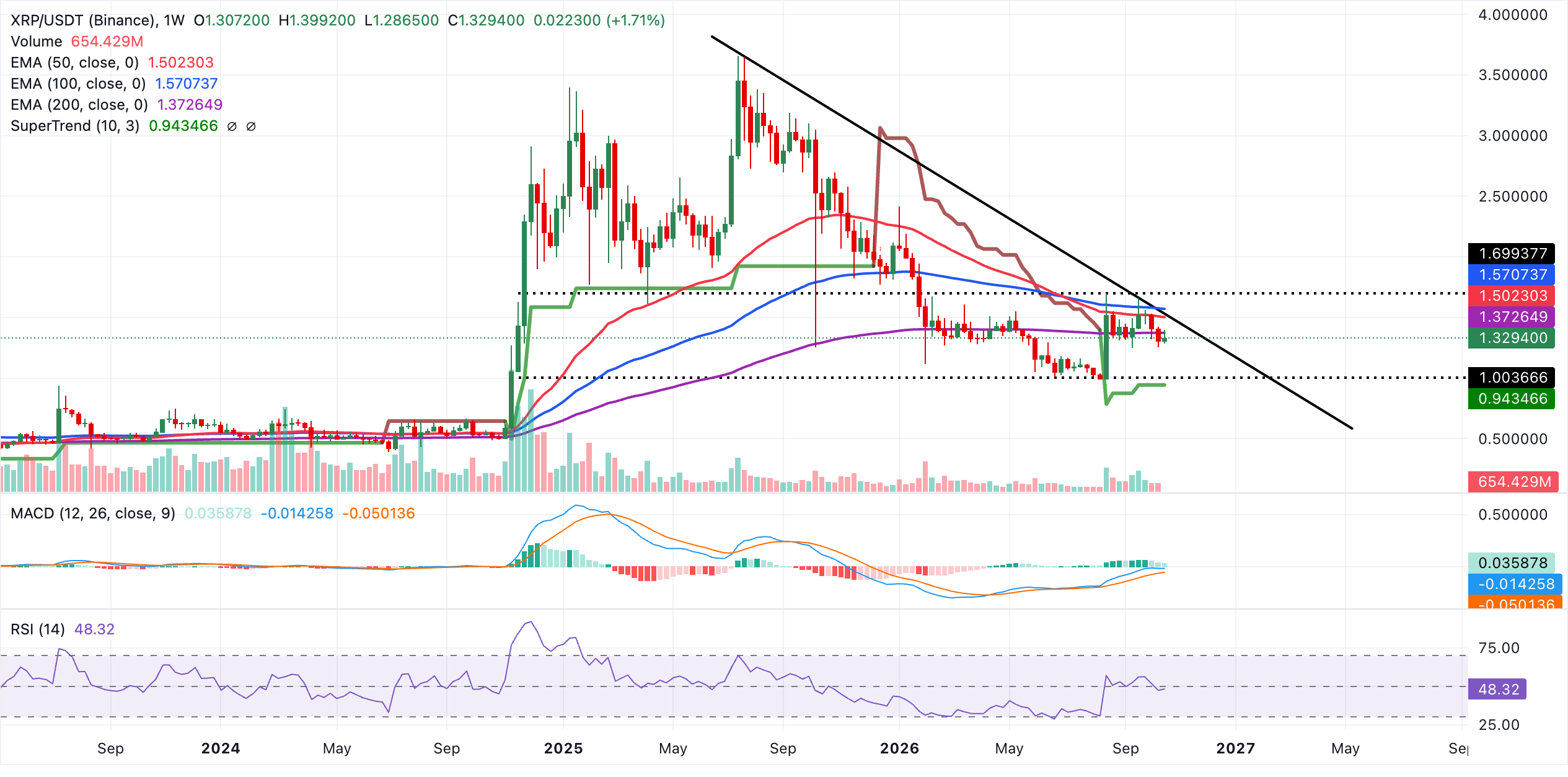
The next significant demand zone lies considerably lower, around $0.94, where the SuperTrend indicator provides structural support and buyers previously returned. A weekly close back towards this area would open the door to a broader correction. Holding above present levels, by contrast, would leave XRP range-bound below the dense band of overhead resistance.
(The technical analysis of this story was written with the help of an AI tool. Know more.)
Common questions about Ripple
Specialising in cross-border remittances, Ripple is a payments company that uses blockchain technology to deliver its services. Ripple Labs Inc. created RippleNet as a payment transfer network accessible to financial institutions across the world. The company also uses the XRP token.
As the native token of the decentralised XRPLedger blockchain, XRP enables transactions that Ripple Labs facilitates on the network, allowing financial institutions to transfer value across borders. By enabling instant, trustless payments on the XRPLedger chain, XRP helps financial firms reduce the cost of worldwide transactions.
Built on distributed ledger technology and blockchain, XRPLedger uses XRP to power transactions. Unlike other blockchains, it incorporates an inflammatory protocol designed to counter spam and distributed denial-of-service (DDOS) attacks. Maintenance of XRPL is handled by a peer-to-peer network called the global XRP Ledger community.
The interledger standard used by XRP is a blockchain protocol that enables payments between different networks. XRP’s blockchain can, for example, link the ledgers of two or more banks, effectively eliminating intermediaries and the need for centralisation within the system. Jed McCaleb, Arthur Britto and David Schwartz engineered the XRPLedger blockchain, for which XRP serves as the native token.
POPULAR ARTICLES
1South African Rand: SAGBs find support in fiscal discipline – Societe Generale2Canadian Dollar holds steady as US Dollar rebound caps further gains3Why is Bitcoin's quantum countdown accelerating as estimates continue to fall?4Mexican Peso: How are Banxico risks pressuring MXN against the US Dollar? - Commerzbank5Euro: Could French spreads drive losses against US Dollar? – BBH6European Central Bank: Communication focus as French spreads widen – Nordea7Last week’s US Initial Jobless Claims fell to 194K8Swiss Franc: Do safe-haven risks threaten its funding role? - Societe Generale9WTI Oil Price Forecast: Can buyers drive a breakout above $100 as upward pressure mounts?
LIVE QUOTES


ALL ABOUT TECHNICAL
What Is an Order Block in Trading and How Can You Trade It?
Average True Range (ATR) Indicator: What Is the Formula, and How Do You Read and Use It?
What Is a Judas Swing? ICT Trading Strategy Explained With Examples
The Real Interest Rate: Are Your Savings Actually Earning Anything?
Butterfly Pattern Trading: How to Identify and Trade the Butterfly Harmonic Pattern
What Is a Rising Wedge Pattern and How Do You Trade It?
What Is a Descending Triangle Pattern and How Do You Trade It?
Accumulation, Manipulation and Distribution (AMD): ICT Power of 3 Trading Guide
How to Read the CPI Report Before You Trade It: A Trader's Guide to Headline and Core
Get Started!
Sign up and access the Global Markets in less than 3 minutes

Connect With Us









Contacts
Phone: +61 2 8036 8388
Fax: +61 2 8036 8388
Email: support@tmgm.com



The information provided on this website is of a general nature only and does not constitute personal financial advice. Before acting on any information on this website, you should consider the suitability of the information in relation to your objectives, financial situation and needs. Investing in CFDs and FX Margin Contracts carries significant risks and is not suitable for all investors. You may lose more than your initial deposit. You do not own, or have, any interest in the underlying asset. We recommend that you seek independent advice and ensure you fully understand the risks involved before trading. It is important that you read and consider the disclosure document before you acquire any product listed on the website. The information and advertisements offered on this website are not intended for use by any person in any country or jurisdiction where such use would be contrary to local laws and regulations. The Products and Services offered on this website are not intended for residents of the United States, Malaysia and Thailand.
TMGM is authorized and regulated in various jurisdictions.
Trademax Australia Limited, trading as TMGM, is regulated by the Australian Securities and Investments Commission (ASIC), AFSL no. 436416 and is located at Level 28, One International Tower, 100 Barangaroo Avenue, 2000 Sydney, NSW Australia.
Email: support@tmgm.com.au
Trademax Global Limited, trading as TMGM, is authorized and regulated by the Vanuatu Financial Services Commission (VFSC), registration number 40356 and registered at 1276, Kumul Highway, Port Vila, Vanuatu, Republic of Vanuatu.
Email: support@tmgm.com
Trademax Global Markets (SE) Limited, trading as TMGM, is authorized and regulated by the Financial Services Authority (FSA) of Seychelles, with license number SD224. The company is registered at Office No 13, Providence Estate ABIS Centre, Mahe, Seychelles.
Email: support@tmgm.com
Trademax Global Markets (International) Pty Ltd, trading as TMGM, is authorized and regulated by the Financial Services Commission, Mauritius (FSC) with license no. GB22201012, and registered at 33, Edith Cavell Street C/o IQ EQ Fund Services (Mauritius) Ltd Port Louis, 11324 Mauritius.
Email: support@tmgm.com
Copyright © TMGM. All rights reserved