

Trading
Explore a wide range of markets with competitive pricing, deep liquidity, and advanced trading tools.
Learn More 
Platform
Trade seamlessly with TMGM's powerful platform, built for speed, precision, and a superior trading experience.
Learn More Trading Platform
Academy
Learn the fundamentals of trading with beginner-friendly resources, including guides, webinars, and market insights.
Learn More News & Analysis
Get real-time market updates and expert analysis to stay ahead of trading opportunities
Learn More News & Analysis
About
Learn what sets TMGM apart — our global presence, regulatory strength, and commitment to innovation in trading.
Learn More Why Choose TMGM
Sponsorship
Why is the British Pound under pressure from softer inflation and slower pay growth ahead of PMI week?
- GBP/USD slips below 1.3100 to a 12-month low as expectations of a BoE rate rise weaken.
- Below-forecast UK readings put inflation at 3.6% and wage growth at 3.5%.
- Monday brings UK PMIs and remarks from BoE Chief Economist Pill; US core PCE follows on Wednesday.
The Pound has weakened on developments that offer relief to British households: UK inflation and wage growth both undershot forecasts. With declines in eight of the past nine sessions, GBP/USD is trading just below 1.3100, a 12-month low. Each data miss reduced expectations of a second Bank of England (BoE) rate rise on December 17. Over the same five days, Fed officials debated how large their own increase should be.

Why is relief for households weighing on the Pound?
Wage growth excluding bonuses slowed to 3.5% in the three months to September, Tuesday's labour data showed, compared with a 3.6% forecast and the previous 3.7%. The claimant count increased by 33.2K, exceeding expectations of 28.1K. However, unemployment dropped to 4.6% against a projected 4.7%, indicating that job losses are not behind the wage slowdown. On Wednesday, the Consumer Price Index (CPI) showed a 3.6% YoY increase, below the 3.7% forecast, while core inflation held at 2.8%.
For Sterling, the two readings give the BoE grounds to hold off: wage growth and inflation were each a tenth below expectations. Following the inflation release, traders lowered the probability of a December rate rise from 90% to about 80%. In its November report, which set out the rationale for the November 5 increase, the BoE had projected inflation at about 5% by mid-2027. Governor Bailey said on Wednesday that the peak would probably be lower.
Only Friday's retail sales release surpassed expectations, recording a 0.7% rise in October against a forecast of no change. The resulting recovery failed to reach 1.3150, leaving the pair back at its low.
How long can Sterling retain its rate advantage?
Sterling retains a modest yield advantage over the Dollar, with the UK's Bank Rate at 4% against the Fed's 3.75%-4.00%. That comparison faces a test on December 9, when the Fed meets ahead of the BoE. Minutes from the Fed's October meeting indicated that almost all officials anticipated further increases, while Fed Governor Waller called for a half-point rise on Wednesday. BoE Deputy Governor Lombardelli, meanwhile, has said she would neither rule out nor commit to December or February.
Even Friday's sell-off in US equities, which prompted traders to stop pricing in the Fed's December increase in full, did not prevent the Pound from setting a 12-month low. Sterling declined as UK data weakened the case for BoE tightening, then lost ground again as doubts emerged over a Fed rise. That leaves bulls with few potential sources of support.
Will US inflation outweigh Monday's UK PMIs?
The UK's November Purchasing Managers Index (PMI) surveys from S&P Global are due on Monday at 09:30 GMT, after October's composite reading of 52.9 and services reading of 52.8. BoE Chief Economist Pill follows at 13:00 GMT. In a November 14 interview with the Financial Times, he argued that the BoE had delayed too long and would have to raise rates again in 2027. That gives him the strongest publicly stated case among officials for a December increase.
The more consequential release arrives on Wednesday at 13:30 GMT: October US core Personal Consumption Expenditures (PCE) inflation. Forecasts point to 0.3% MoM and 3.2% YoY, with the annual rate up from 3.1%. A reading that meets or exceeds expectations would restore full pricing of a December Fed rise and could push GBP/USD towards 1.3000. A weaker figure would allow Sterling to respond to its own PMI readings for a session or two.
Thursday's BoE Financial Stability Report is scheduled for 10:30 GMT. With US markets closed for Thanksgiving, many of those who would normally trade the release will be away from their desks. Ahead of these events, the Finance Bill implementing the October 28 budget reaches its second reading in the Commons on Monday. The gilt market received that budget calmly, and Sterling has paid it little attention since.
Which technical levels matter for GBP/USD?
Resistance: The first barrier is 1.3150, October's low and the support breached on Thursday; Friday's recovery failed to reach it. Further up, the 1.3200 area marks the point at which Tuesday's advance stalled.
Support: Just below 1.3100, Friday's low marks the weakest traded level in 12 months. Beneath that, the daily chart offers no support until the November 2025 low, slightly above 1.3000.
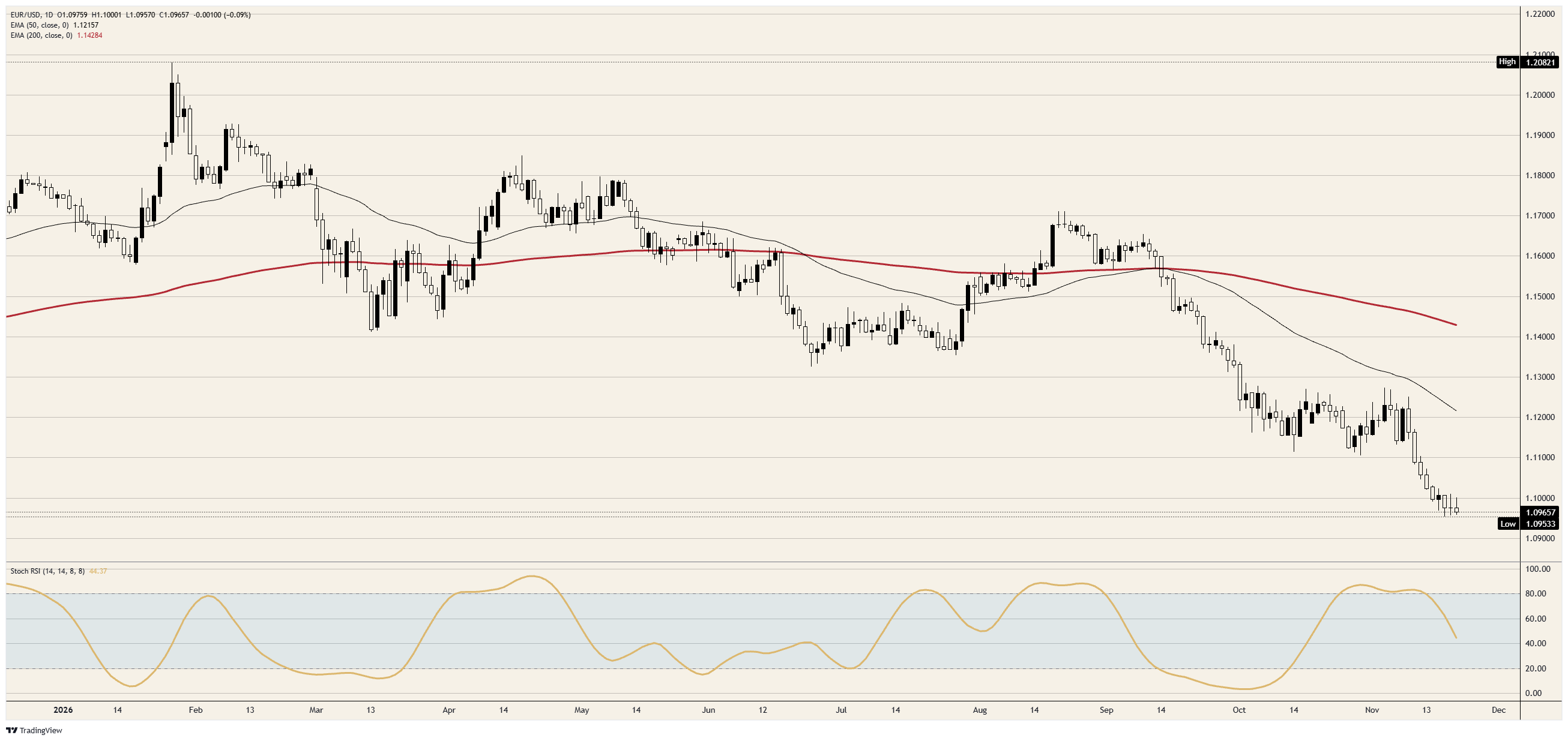
Bias: Below 1.3150, the outlook remains tilted towards short positions, targeting 1.3050 first and 1.3000 next. With the daily Stochastic Relative Strength Index (Stoch RSI) close to 20 and continuing to decline, a rebound towards 1.3150 remains possible without altering that view. A daily close above 1.3200, however, would invalidate the break below October's low and remove the short bias.
Daily price chart: GBP/USD
Pound Sterling: common questions
Issued by the Bank of England (BoE), the Pound Sterling (GBP) is the United Kingdom's official currency and the world's oldest, dating to 886 AD. According to 2022 data, it ranks fourth among currencies traded in the global foreign exchange (FX) market, representing 12% of all transactions and an average daily value of $630 billion. Among its principal pairs, GBP/USD, known as ‘Cable’, accounts for 11% of FX trading. GBP/JPY, referred to by traders as the ‘Dragon’, represents 3%, while EUR/GBP accounts for 2%.
Monetary policy set by the Bank of England is the most important influence on Sterling's value. Decisions centre on whether the BoE is meeting its main objective of “price stability” – keeping inflation steady at around 2%. Adjusting interest rates is its principal means of doing so. To curb excessive inflation, the BoE raises rates, increasing borrowing costs for households and businesses. GBP generally benefits because higher rates make the UK a more appealing destination for international investors' funds. Inflation that is too low, by contrast, signals slowing economic growth. The BoE will then consider cutting rates to make credit cheaper, encouraging businesses to borrow more for investment in projects that generate growth.
Sterling can respond to economic releases because they indicate how well the economy is performing. GDP, Manufacturing and Services PMIs, and employment figures can each shape GBP's direction. Economic strength supports Sterling by drawing in more overseas investment and potentially encouraging the BoE to raise rates, which directly strengthens GBP. Weak economic readings, on the other hand, are likely to push Pound Sterling lower.
The Trade Balance is another important release for Pound Sterling, showing the gap between a country's export earnings and its spending on imports during a specified period. Strong overseas demand for a country's exports creates additional demand for its currency as foreign buyers seek to purchase those goods. As a result, a positive net Trade Balance supports the currency, while a negative balance has the opposite effect.
POPULAR ARTICLES
1The Euro faces a week dominated by US inflation with a rate hike already priced in2Why is the British Pound under pressure from softer inflation and slower pay growth ahead of PMI week?3Dow Jones Industrial Average extends losses to a fifth day amid broader AI sell-off4Chinese Yuan: Controls Triggered by Short-Lived Fall Against US Dollar - Commerzbank5Malaysian Ringgit: How are chip export curbs and yields weighing on MYR against US Dollar? – OCBC6Chinese Yuan: Gradual gains amid tight management – BNY7Why does the Australian Dollar remain under pressure amid diverging Fed and RBA outlooks?8Malaysian Ringgit: Why does range-bound trading persist as growth outpaces FX? – Commerzbank9Indonesian Rupiah: Losses against US Dollar limited by BI measures - OCBC

Get Started!
Sign up and access the Global Markets in less than 3 minutes

Connect With Us









Contacts
Phone: +61 2 8036 8388
Fax: +61 2 8036 8388
Email: support@tmgm.com



The information provided on this website is of a general nature only and does not constitute personal financial advice. Before acting on any information on this website, you should consider the suitability of the information in relation to your objectives, financial situation and needs. Investing in CFDs and FX Margin Contracts carries significant risks and is not suitable for all investors. You may lose more than your initial deposit. You do not own, or have, any interest in the underlying asset. We recommend that you seek independent advice and ensure you fully understand the risks involved before trading. It is important that you read and consider the disclosure document before you acquire any product listed on the website. The information and advertisements offered on this website are not intended for use by any person in any country or jurisdiction where such use would be contrary to local laws and regulations. The Products and Services offered on this website are not intended for residents of the United States, Malaysia and Thailand.
TMGM is authorized and regulated in various jurisdictions.
Trademax Australia Limited, trading as TMGM, is regulated by the Australian Securities and Investments Commission (ASIC), AFSL no. 436416 and is located at Level 28, One International Tower, 100 Barangaroo Avenue, 2000 Sydney, NSW Australia.
Email: support@tmgm.com.au
Trademax Global Limited, trading as TMGM, is authorized and regulated by the Vanuatu Financial Services Commission (VFSC), registration number 40356 and registered at 1276, Kumul Highway, Port Vila, Vanuatu, Republic of Vanuatu.
Email: support@tmgm.com
Trademax Global Markets (SE) Limited, trading as TMGM, is authorized and regulated by the Financial Services Authority (FSA) of Seychelles, with license number SD224. The company is registered at Office No 13, Providence Estate ABIS Centre, Mahe, Seychelles.
Email: support@tmgm.com
Trademax Global Markets (International) Pty Ltd, trading as TMGM, is authorized and regulated by the Financial Services Commission, Mauritius (FSC) with license no. GB22201012, and registered at 33, Edith Cavell Street C/o IQ EQ Fund Services (Mauritius) Ltd Port Louis, 11324 Mauritius.
Email: support@tmgm.com
Copyright © TMGM. All rights reserved