

Trading
Explore a wide range of markets with competitive pricing, deep liquidity, and advanced trading tools.
Learn More 
Platform
Trade seamlessly with TMGM's powerful platform, built for speed, precision, and a superior trading experience.
Learn More Trading Platform
Academy
Learn the fundamentals of trading with beginner-friendly resources, including guides, webinars, and market insights.
Learn More News & Analysis
Get real-time market updates and expert analysis to stay ahead of trading opportunities
Learn More News & Analysis
About
Learn what sets TMGM apart — our global presence, regulatory strength, and commitment to innovation in trading.
Learn More Why Choose TMGM
Sponsorship
$84K in Focus: Bitcoin vs Gold Forecast as BTC gathers pace and XAU jumps above $4,100
- $83,000 is Bitcoin’s next target as it moves higher. Bulls firmly defended support near $80,000 during a correction driven by macroeconomic factors.
- $4,100 remains beneath Gold as it posts a modest gain, although major moving averages overhead appear to constrain its recovery.
- 85% is the probability of the Fed leaving interest rates unchanged next week, despite continuing macroeconomic uncertainty.
$80,000 recently held as support for Bitcoin (BTC). The largest cryptocurrency by market capitalisation is edging up on Wednesday, with buyers appearing to increase their risk exposure. Its recent test confirmed support near that level as investors rebalanced portfolios against higher United States (US) inflation and ongoing geopolitical pressures.

A modest daily gain keeps Gold (XAU/USD) above $4,100. However, the broader trend remains bearish, and structural levels appear to restrict the metal’s recovery prospects.
October Fed decision: Rate pause bets stay high
An unchanged interest rate is the outcome markets strongly favour at next week’s Federal Reserve Open Market Committee (FOMC) meeting. According to CME Group’s FedWatch Tool, the probability of the Federal Reserve (Fed) holding rates at 3.75%-4.00% on 28 October is 85%. A 25-basis-point increase to 4.00-4.25% carries roughly a 15% probability.
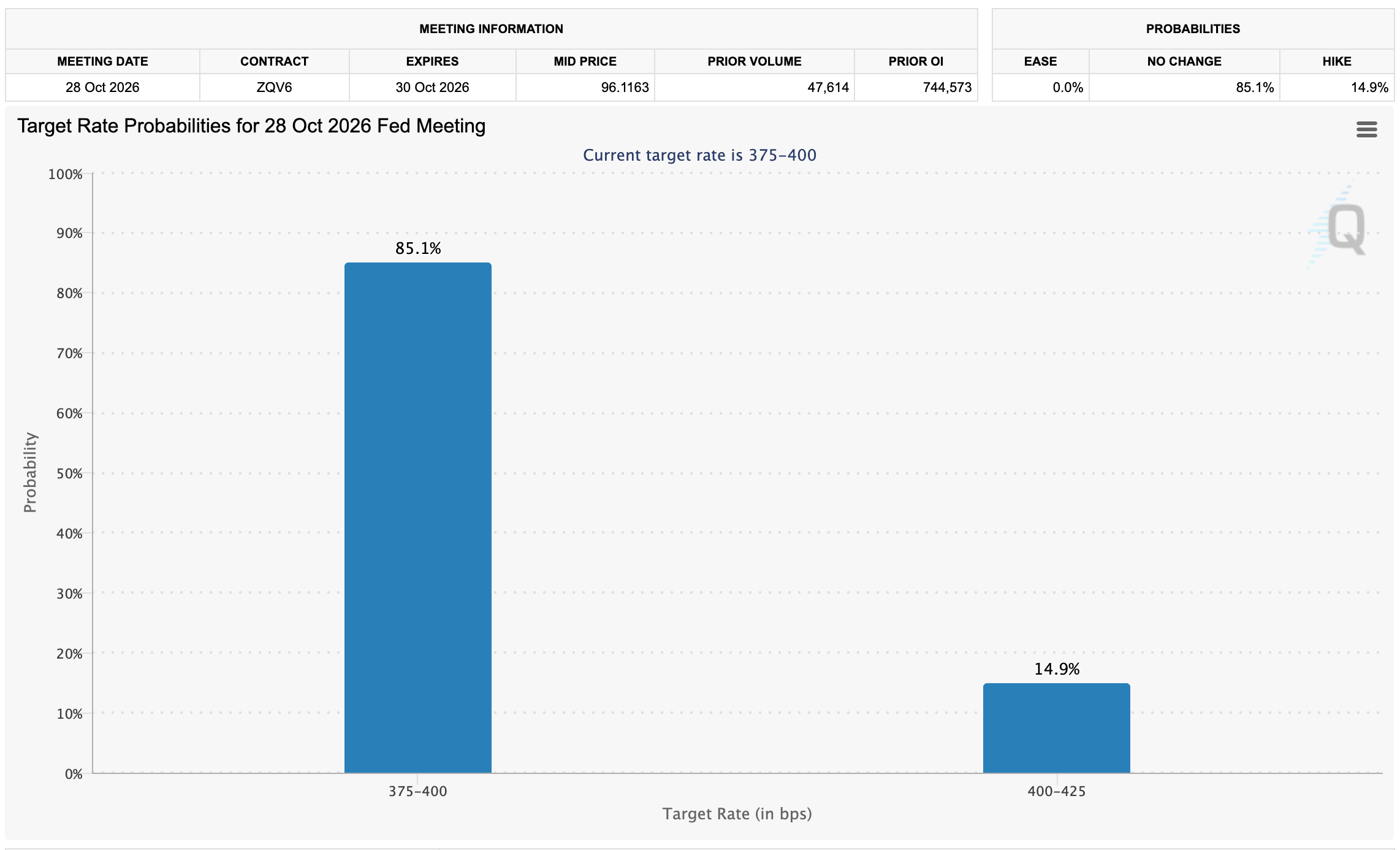
Last week’s Consumer Price Index (CPI) report highlighted persistent US inflation, providing the backdrop to strong expectations for unchanged rates. For December, interest rate traders are assigning a higher probability to a rate increase.
In an emailed analysis report, Crypto Finance said: “Markets currently assign approximately an 85% probability to unchanged rates at the October 28 meeting, although expectations for another rate hike in December remain elevated,”
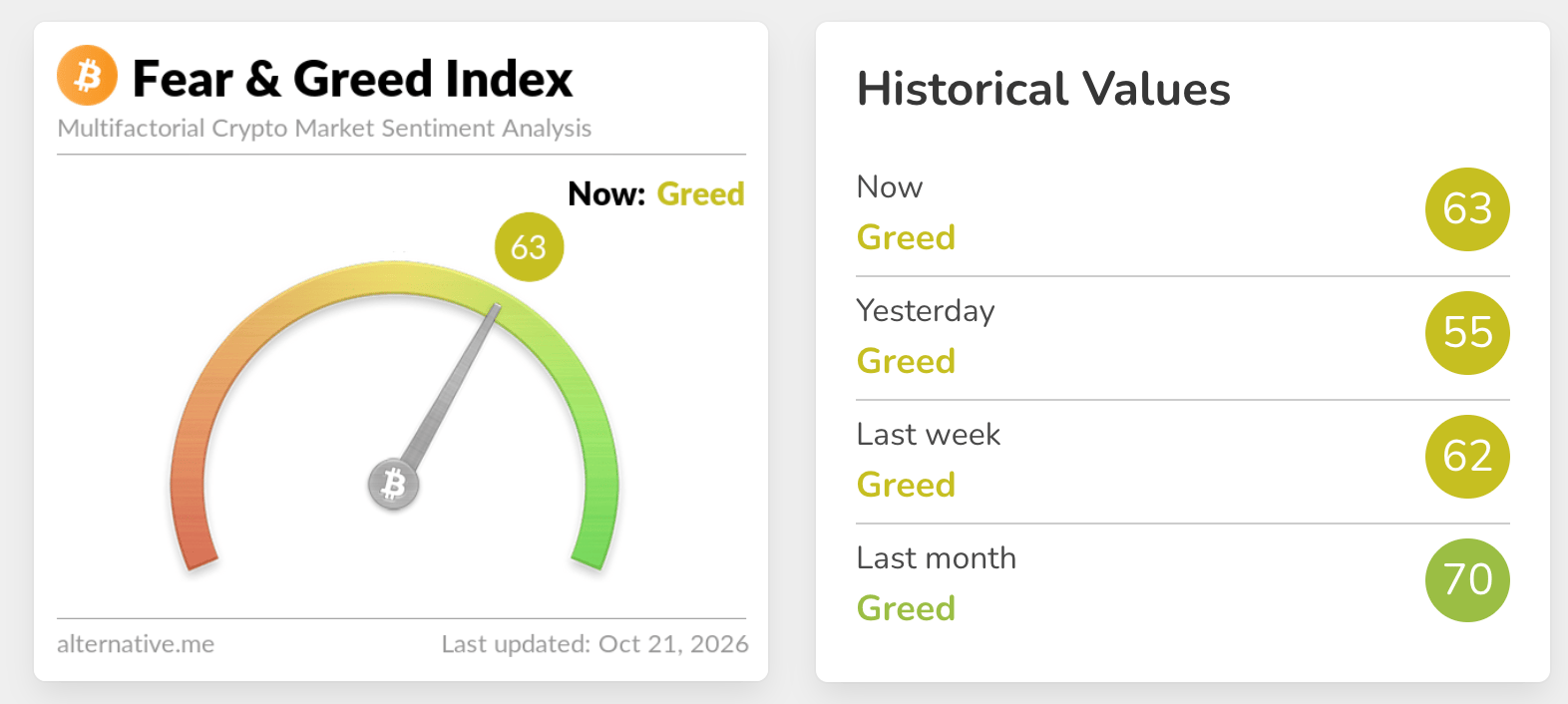
Macroeconomic conditions remain a key driver of cryptocurrency risk appetite. On Wednesday, the Fear & Greed Index stands at 63, placing it in Greed territory, compared with 55 a day earlier. Although sentiment is elevated, the Fed’s persistently restrictive monetary policy continues to temper conviction in aggressive gains.
Bitcoin technical outlook: Key support holds
At $83,564, Bitcoin retains a constructive bullish bias, trading comfortably above its short-, medium- and long-term Exponential Moving Averages (EMAs). An underlying demand zone is reinforced by the 50-day EMA at $80,795 and the SuperTrend baseline around $79,664. However, the Moving Average Convergence Divergence (MACD) remains negative, signalling that upward momentum may be fading.
A broadly neutral Relative Strength Index (RSI) reading near 55 points to consolidation within the wider uptrend, rather than a rally that has fully run out of momentum.
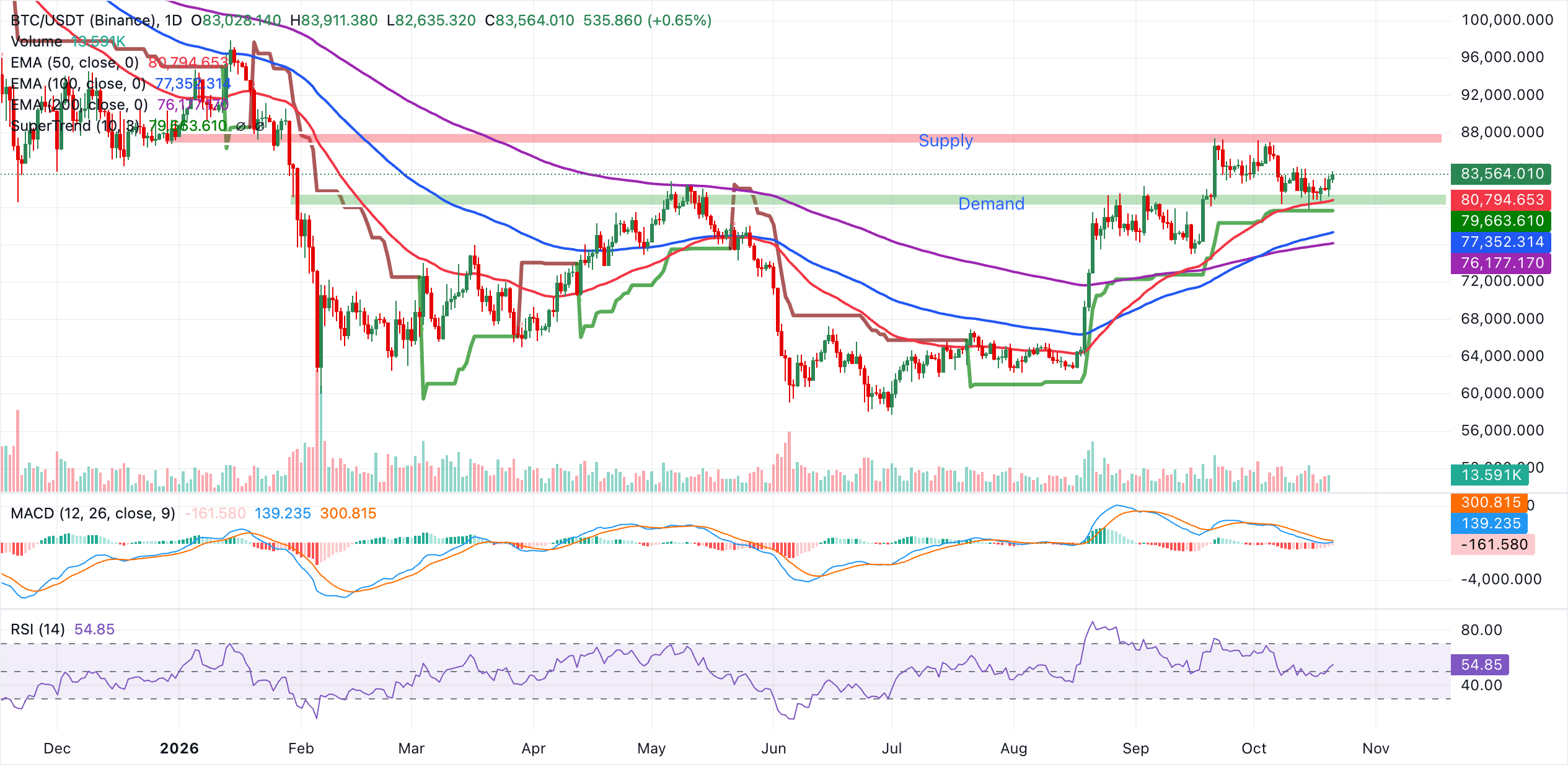
The first support level is the 50-day EMA at $80,794, ahead of the SuperTrend line at $79,664. A retreat towards these levels could see buyers try to regain control. Further down, the 100-day EMA at $77,352 and the 200-day EMA at $76,177 provide structural support. Provided these levels hold, they should sustain the broader bullish structure.
Gold technical outlook: XAU support holds, upside constrained
Trading at $4,134, Gold is attempting a recovery as bulls defend support above $4,100. That demand zone is encouraging investors to consider returning, but near-term pressure persists. The metal remains below its 50-day, 100-day and 200-day EMAs, with the nearest at $4,241 reinforcing the bearish bias despite a slightly positive MACD reading above zero. Around 43, the RSI remains neutral, indicating weak momentum rather than capitulation.
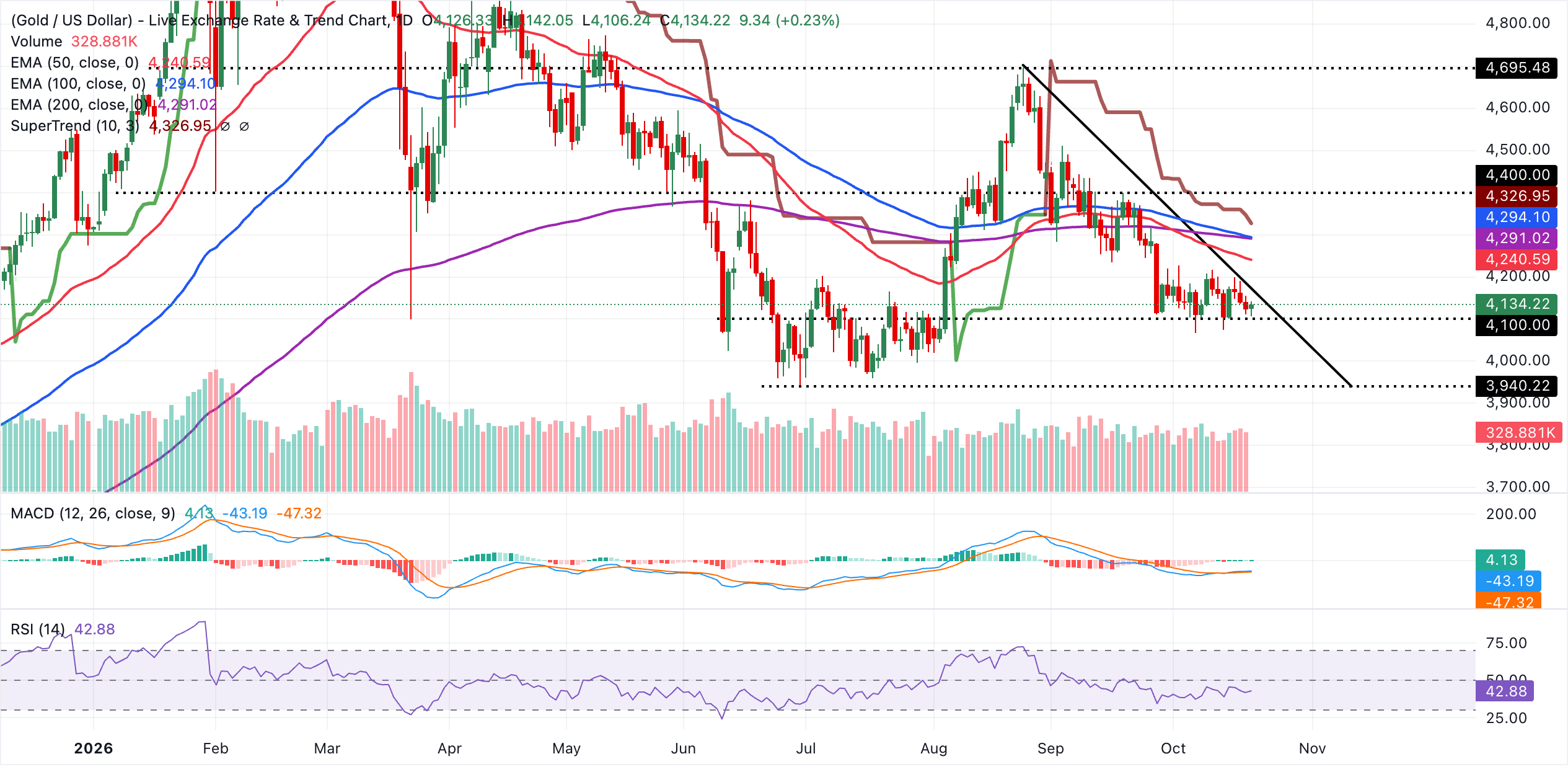
The 50-day EMA near $4,241 presents the first resistance hurdle. Beyond it sit the 200-day EMA at $4,291 and the 100-day EMA at $4,294, while the SuperTrend line at $4,327 marks a broader ceiling for any recovery. With no structural support levels on the daily chart, traders must instead look to psychological demand zones at $4,100 and $4,000. A sustained move back below this support range would likely pave the way for a deeper correction.
(The technical analysis of this story was written with the help of an AI tool. Know more.)
Bitcoin, altcoins and stablecoins: Key questions
The largest cryptocurrency by market capitalisation, Bitcoin is a virtual currency created to function as money. No single person, group or entity can control this payment method, removing the need for third-party involvement in financial transactions.
Any cryptocurrency other than Bitcoin is classified as an altcoin. Some also exclude Ethereum, however, because these two cryptocurrencies are the origins of forks. Under that definition, Litecoin is the first altcoin: it was forked from the Bitcoin protocol and is therefore an “improved” version of it.
Designed for price stability, stablecoins are cryptocurrencies backed by reserves of the assets they represent. Each stablecoin achieves this through a peg to a commodity or financial instrument, such as the US Dollar (USD), while an algorithm or demand regulates its supply. Their primary purpose is to offer investors a route into and out of cryptocurrency trading and investment. They also enable investors to store value, as cryptocurrencies generally experience volatility.
The ratio of Bitcoin’s market capitalisation to the combined market capitalisation of all cryptocurrencies is known as Bitcoin dominance. It illustrates the level of investor interest in Bitcoin. BTC dominance is typically high ahead of and during a bull run, when investors turn to relatively stable cryptocurrencies with large market capitalisations, such as Bitcoin. Falling BTC dominance generally signals that investors are shifting capital and/or profits into altcoins in pursuit of higher returns. That shift usually sparks a surge in altcoin rallies.
POPULAR ARTICLES
1One-month high for Australian Dollar as hawkish RBA lends support21.3400 remains out of reach as British Pound stalls despite hot UK CPI and BoE rate-hike bets3$84K in Focus: Bitcoin vs Gold Forecast as BTC gathers pace and XAU jumps above $4,1004United Kingdom inflation: The energy shock effect – ING5Poland: Bond positioning amid fiscal change – BNY6United States: Danske Bank on pre-election tail risks7United States EIA Heating Oil Stocks Change above expectations (0M) in October 16: Actual (0.652M)8United States EIA Gasoline Stocks Change below expectations (0M) in October 16: Actual (-2.952M)9United States EIA Distillate Stocks Change above expectations (0M) in October 16: Actual (1.675M)
LIVE QUOTES


ALL ABOUT GOLD & PRECIOUS METALS
Get Started!
Sign up and access the Global Markets in less than 3 minutes

Connect With Us









Contacts
Phone: +61 2 8036 8388
Fax: +61 2 8036 8388
Email: support@tmgm.com



The information provided on this website is of a general nature only and does not constitute personal financial advice. Before acting on any information on this website, you should consider the suitability of the information in relation to your objectives, financial situation and needs. Investing in CFDs and FX Margin Contracts carries significant risks and is not suitable for all investors. You may lose more than your initial deposit. You do not own, or have, any interest in the underlying asset. We recommend that you seek independent advice and ensure you fully understand the risks involved before trading. It is important that you read and consider the disclosure document before you acquire any product listed on the website. The information and advertisements offered on this website are not intended for use by any person in any country or jurisdiction where such use would be contrary to local laws and regulations. The Products and Services offered on this website are not intended for residents of the United States, Malaysia and Thailand.
TMGM is authorized and regulated in various jurisdictions.
Trademax Australia Limited, trading as TMGM, is regulated by the Australian Securities and Investments Commission (ASIC), AFSL no. 436416 and is located at Level 28, One International Tower, 100 Barangaroo Avenue, 2000 Sydney, NSW Australia.
Email: support@tmgm.com.au
Trademax Global Limited, trading as TMGM, is authorized and regulated by the Vanuatu Financial Services Commission (VFSC), registration number 40356 and registered at 1276, Kumul Highway, Port Vila, Vanuatu, Republic of Vanuatu.
Email: support@tmgm.com
Trademax Global Markets (SE) Limited, trading as TMGM, is authorized and regulated by the Financial Services Authority (FSA) of Seychelles, with license number SD224. The company is registered at Office No 13, Providence Estate ABIS Centre, Mahe, Seychelles.
Email: support@tmgm.com
Trademax Global Markets (International) Pty Ltd, trading as TMGM, is authorized and regulated by the Financial Services Commission, Mauritius (FSC) with license no. GB22201012, and registered at 33, Edith Cavell Street C/o IQ EQ Fund Services (Mauritius) Ltd Port Louis, 11324 Mauritius.
Email: support@tmgm.com
Copyright © TMGM. All rights reserved