

Trading
Explore a wide range of markets with competitive pricing, deep liquidity, and advanced trading tools.
Learn More 
Platform
Trade seamlessly with TMGM's powerful platform, built for speed, precision, and a superior trading experience.
Learn More Trading Platform
Academy
Learn the fundamentals of trading with beginner-friendly resources, including guides, webinars, and market insights.
Learn More News & Analysis
Get real-time market updates and expert analysis to stay ahead of trading opportunities
Learn More News & Analysis
About
Learn what sets TMGM apart — our global presence, regulatory strength, and commitment to innovation in trading.
Learn More Why Choose TMGM
Sponsorship
US-Iran deal hopes fail to prevent Yen losses against the Dollar
- 158.00 marks USD/JPY's highest level since 29 October. The pair remains close to that peak.
- An above-forecast ISM manufacturing reading helps USD/JPY recover from its low.
- Following September wage figures on Thursday, BoJ Governor Ueda addresses the IMF on Friday.
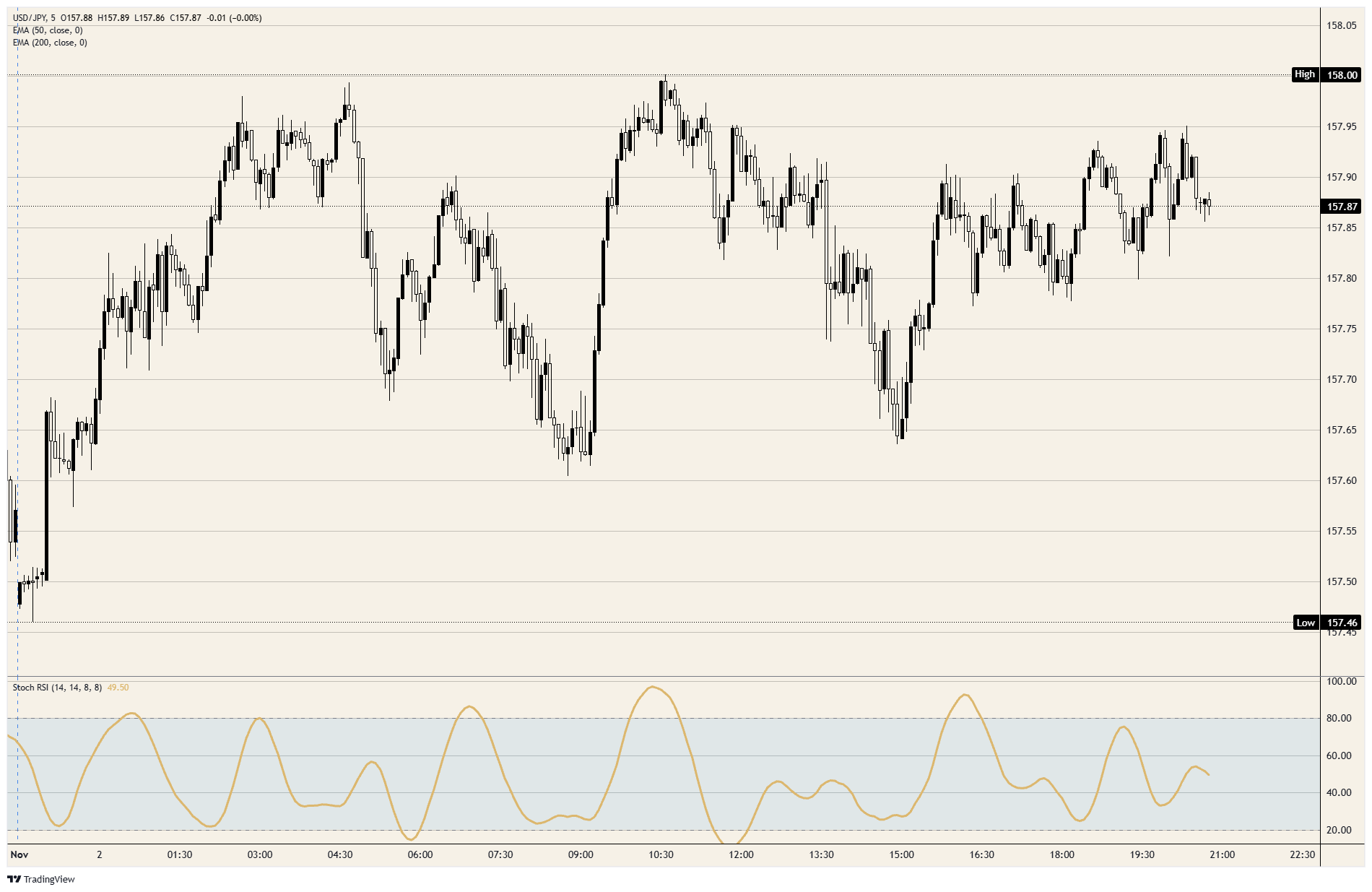
158.00 marked USD/JPY's highest level since 29 October. US-Iran diplomacy weakened the Dollar against the Euro and the Pound, but not against the Yen. As the Dollar's losses elsewhere reached their deepest point, the pair briefly retreated to just above 157.50 before advancing to the high. It now trades just below 158.00.

Lower Crude Oil prices following the US-Iran talks reduce Japan's import costs, as the country sources almost all of its oil overseas. Even so, the Yen lost ground. With the Bank of Japan (BoJ) not due to make its next policy decision until 17-18 December, no change on the Japanese side of USD/JPY's interest-rate differential is scheduled for more than six weeks.
S&P Global's final US manufacturing index declined from 56.0 to 54.9, with USD/JPY retreating to just above 157.50. The subsequent Institute for Supply Management (ISM) manufacturing survey climbed to 55.5, beating the 54.6 forecast. The pair then recovered to just below 158.00.
3.8% Wage Growth Forecast; BoJ and US Data Ahead
At 23:50 GMT on Wednesday, the BoJ releases its meeting minutes. September wage figures are due at 23:30 GMT on Thursday, with annual growth forecast to hold at 3.8% for a second month. At 16:00 GMT on Friday, BoJ Governor Ueda delivers a lecture at the International Monetary Fund (IMF). All three will inform the BoJ's December decision.
A reading of 54.8, down from 54.9, is forecast for Wednesday's ISM services index, scheduled for 15:00 GMT. Friday brings the October payrolls report at 13:30 GMT, with 65K expected after 29K. Both releases bear on USD/JPY's interest-rate differential, following the Fed's decision to leave rates at 3.75%-4.00% on 28 October.
156.00-159.00 Range Frames USD/JPY Trading
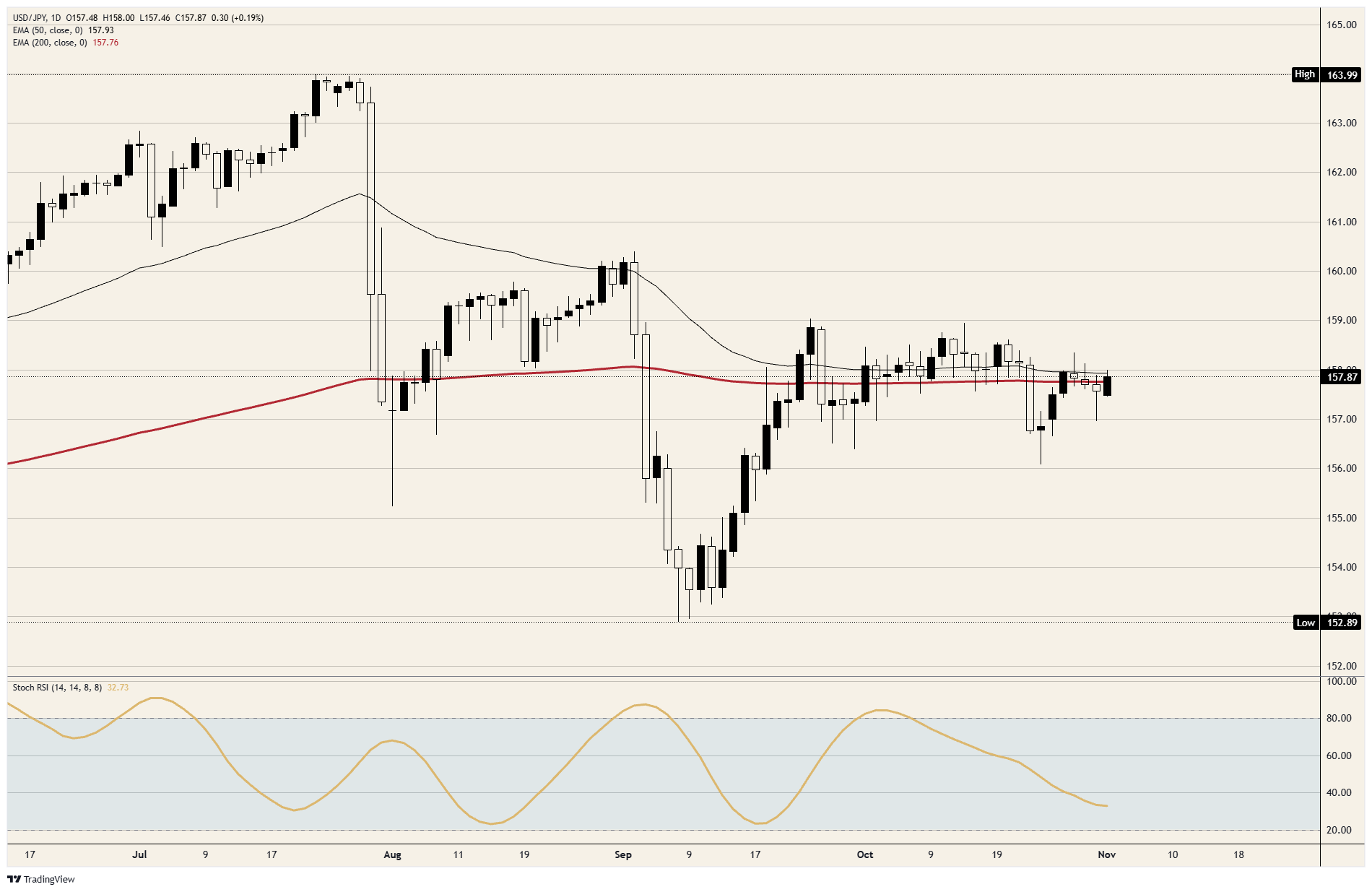
After recovering from a September trough just below 153.00, USD/JPY has traded from just above 156.00 to near 159.00 since late September. Within that band, the 50-day and 200-day Exponential Moving Averages (EMA) sit less than a fifth of a yen apart. Repeated crossings of both averages have characterised trading since early October.
5-Minute Chart: USD/JPY
Daily Chart: USD/JPY
Japanese Yen: Frequently Asked Questions
Among the world's most actively traded currencies, the Japanese Yen (JPY) draws its value broadly from Japan's economic performance. More specific influences include Bank of Japan policy, the gap between Japanese and US bond yields, and traders' appetite for risk, alongside other factors.
Currency control forms part of the Bank of Japan's mandate, making its actions important for the Yen. Direct intervention in foreign exchange markets has occasionally been used, typically to weaken the currency. Political concerns among Japan's main trading partners, however, discourage frequent intervention. Between 2013 and 2024, the BoJ's ultra-loose monetary policy drove Yen depreciation against major currency peers as its policy increasingly diverged from that of other leading central banks. More recently, a gradual withdrawal of this ultra-loose policy has provided some support for the Yen.
By maintaining ultra-loose monetary policy over the last decade, the BoJ widened its policy divergence with other central banks, especially the US Federal Reserve. That divergence helped widen the yield gap between 10-year US and Japanese bonds, favouring the US Dollar over the Japanese Yen. The gap is now narrowing as the BoJ implements its 2024 decision to move gradually away from ultra-loose policy and other major central banks cut interest rates.
Often regarded as a safe-haven investment, the Japanese Yen tends to attract investors during periods of market stress because of its perceived reliability and stability. In turbulent markets, the currency is therefore likely to appreciate against currencies considered riskier investments.
POPULAR ARTICLES
1$95.50 in focus: WTI recovers to near this level on hopes of Iran peace talks2No breakthrough as talks end; Iran says contacts to end war continue34.85%: RBA expected to lift interest rate4Near $3,950: Gold advances as traders prepare for US midterm election50.7000 test: Australian Dollar faces risk aversion as RBA rate hike approaches6US-Iran deal hopes fail to prevent Yen losses against the Dollar7RBNZ hold: New Zealand Dollar gives back Iran-talks gains8Half its gain erased: Euro pulls back on US-Iran diplomacy9Iran talks lift pound to highest level since mid-September


Get Started!
Sign up and access the Global Markets in less than 3 minutes

Connect With Us









Contacts
Phone: +61 2 8036 8388
Fax: +61 2 8036 8388
Email: support@tmgm.com



The information provided on this website is of a general nature only and does not constitute personal financial advice. Before acting on any information on this website, you should consider the suitability of the information in relation to your objectives, financial situation and needs. Investing in CFDs and FX Margin Contracts carries significant risks and is not suitable for all investors. You may lose more than your initial deposit. You do not own, or have, any interest in the underlying asset. We recommend that you seek independent advice and ensure you fully understand the risks involved before trading. It is important that you read and consider the disclosure document before you acquire any product listed on the website. The information and advertisements offered on this website are not intended for use by any person in any country or jurisdiction where such use would be contrary to local laws and regulations. The Products and Services offered on this website are not intended for residents of the United States, Malaysia and Thailand.
TMGM is authorized and regulated in various jurisdictions.
Trademax Australia Limited, trading as TMGM, is regulated by the Australian Securities and Investments Commission (ASIC), AFSL no. 436416 and is located at Level 28, One International Tower, 100 Barangaroo Avenue, 2000 Sydney, NSW Australia.
Email: support@tmgm.com.au
Trademax Global Limited, trading as TMGM, is authorized and regulated by the Vanuatu Financial Services Commission (VFSC), registration number 40356 and registered at 1276, Kumul Highway, Port Vila, Vanuatu, Republic of Vanuatu.
Email: support@tmgm.com
Trademax Global Markets (SE) Limited, trading as TMGM, is authorized and regulated by the Financial Services Authority (FSA) of Seychelles, with license number SD224. The company is registered at Office No 13, Providence Estate ABIS Centre, Mahe, Seychelles.
Email: support@tmgm.com
Trademax Global Markets (International) Pty Ltd, trading as TMGM, is authorized and regulated by the Financial Services Commission, Mauritius (FSC) with license no. GB22201012, and registered at 33, Edith Cavell Street C/o IQ EQ Fund Services (Mauritius) Ltd Port Louis, 11324 Mauritius.
Email: support@tmgm.com
Copyright © TMGM. All rights reserved