

Сауда
Бәсекеге қабілетті бағалар, жоғары өтімділік және озық сауда құралдары арқылы нарықтардың кең ауқымын зерттеңіз.
Толығырақ 
Платформа
TMGM-нің жылдамдыққа, дәлдікке және жоғары деңгейлі сауда тәжірибесіне арналған қуатты платформасымен сауданы кедергісіз жүргізіңіз.
Толығырақ Сауда платформасы
Академия
Бастауыштарға арналған нұсқаулықтар, вебинарлар және нарық талдаулары сияқты ресурстар арқылы сауданың негіздерін үйреніңіз.
Толығырақ TMGM Академиясы
Жаңалықтар және талдау
Сауда мүмкіндіктерінен алда болу үшін нақты уақыттағы нарық жаңартулары мен сараптамалық талдауды алыңыз
Толығырақ Жаңалықтар және талдау
Туралы
TMGM-ді ерекшелендіретін жайттарды біліңіз — біздің жаһандық ауқымымыз, реттеушілік беріктігіміз және трейдингтегі инновацияларға деген адалдығымыз.
Толығырақ Неліктен TMGM-ді таңдау керек
WTI Price Forecast: Extends correction below $100
- The Oil price slides below $100 as fears of US resuming attacks on Iran have diminished.
- US Secretary of State Rubio said that President Trump prefers a diplomatic resolution.
- Iran signals that talks with the US through Qatari mediators are still going on.
West Texas Intermediate (WTI), futures, on NYMEX, is down 2.25% to near $99.80 during the European trade on Monday. The oil price extends its correction that started after failing to progress the rally above $104.03, the five-month high posted on Friday.

The WTI price comes under pressure as fears of prolonged energy supply risks have diminished, following signals from the United States (US) that it would prioritize diplomatic resolution with Iran over resuming military action.
Over the weekend, US Secretary of State Marco Rubio said that Washington hasn’t made any decision to renews strikes on Tehran and that President Donald Trump prefers a diplomatic resolution. However, Rubio kept fears of military action alive, stating that the US retains the capabilities to achieve whatever military objective Trump decides to pursue.
Separately, the comments from Iran that talks are ongoing with Qatari mediators on a plan to reopen the Strait of Hormuz within two days if the US cooperates have also eased energy supply fears, Al Jazeera reported.
Meanwhile, lower oil prices suggest that financial markets are ignoring claims from US media personality and political commentator Tucker Carlso that Israeli Prime Minister (PM) Benjamin Netanyahu is pressing US President Donald Trump to launch a nuclear strike on Iran, alleging that Washington could take a decision on the use of nuclear weapons within days, The Times of India (ToI) reported.
WTI Technical Analysis
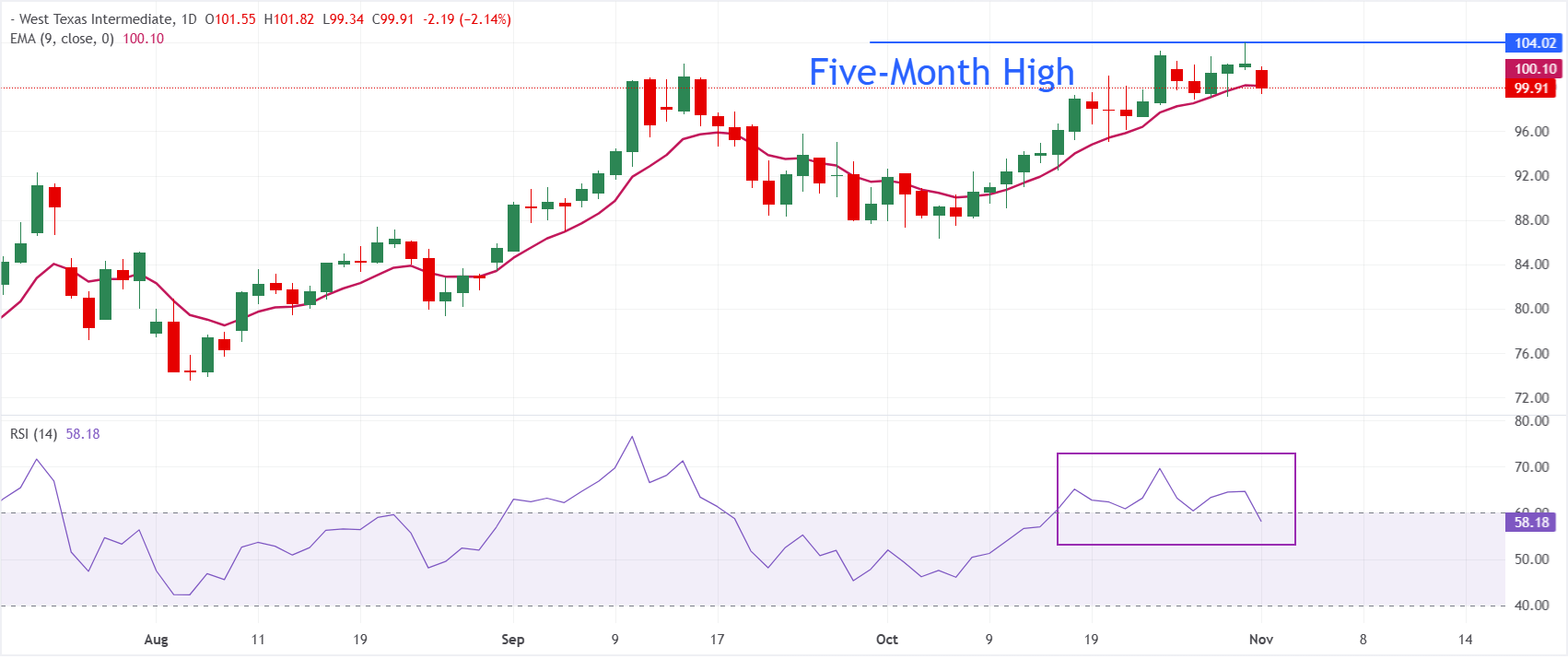
In the daily chart, WTI US Oil trades below $100, holding just under the 9-day exponential moving average (EMA) at $100.09, which caps the topside and keeps the near-term bias mildly bearish despite the strong rally from the mid-$80s.
Price action sitting below this short-term EMA suggests that bulls are losing traction, while the Relative Strength Index (14) around 58 stays in positive territory, hinting at still constructive momentum that has yet to translate into a clear bullish break above immediate resistance.
On the topside, the five-month high at $104.03 is the critical hurdle for oil prices. On the downside, the October 20 low at $95.05 might act as key support level.
(The technical analysis of this story was written with the help of an AI tool. Know more.)
WTI Oil FAQs
WTI Oil is a type of Crude Oil sold on international markets. The WTI stands for West Texas Intermediate, one of three major types including Brent and Dubai Crude. WTI is also referred to as “light” and “sweet” because of its relatively low gravity and sulfur content respectively. It is considered a high quality Oil that is easily refined. It is sourced in the United States and distributed via the Cushing hub, which is considered “The Pipeline Crossroads of the World”. It is a benchmark for the Oil market and WTI price is frequently quoted in the media.
Like all assets, supply and demand are the key drivers of WTI Oil price. As such, global growth can be a driver of increased demand and vice versa for weak global growth. Political instability, wars, and sanctions can disrupt supply and impact prices. The decisions of OPEC, a group of major Oil-producing countries, is another key driver of price. The value of the US Dollar influences the price of WTI Crude Oil, since Oil is predominantly traded in US Dollars, thus a weaker US Dollar can make Oil more affordable and vice versa.
The weekly Oil inventory reports published by the American Petroleum Institute (API) and the Energy Information Agency (EIA) impact the price of WTI Oil. Changes in inventories reflect fluctuating supply and demand. If the data shows a drop in inventories it can indicate increased demand, pushing up Oil price. Higher inventories can reflect increased supply, pushing down prices. API’s report is published every Tuesday and EIA’s the day after. Their results are usually similar, falling within 1% of each other 75% of the time. The EIA data is considered more reliable, since it is a government agency.
OPEC (Organization of the Petroleum Exporting Countries) is a group of 12 Oil-producing nations who collectively decide production quotas for member countries at twice-yearly meetings. Their decisions often impact WTI Oil prices. When OPEC decides to lower quotas, it can tighten supply, pushing up Oil prices. When OPEC increases production, it has the opposite effect. OPEC+ refers to an expanded group that includes ten extra non-OPEC members, the most notable of which is Russia.
Үздік мақалалар
1Iran’s Baghaei: Chances of US-Iran diplomacy in next few days exits2US Dollar Index Price Forecast: DXY slides to 101.75; seems vulnerable below 100-hour SMA3Pi Network Price Forecast: PI tests long-term resistance breakout as selling pressure wanes4Euro holds gains, as lower Oil prices offset weak German Retail Sales figures5British Pound: Resistance at 1.3435 caps upside against US Dollar – UOB6Forex Today: US Dollar edges lower as mood improves ahead of midterm elections7Euro pares gains against British Pound after Germany’s Retail Sales unexpectedly fall in September8Germany’s Retail Sales falls by 2.0% in September, vs. 0.4% expected9Gold: Recovery toward 2027 despite near-term pressure - OCBC

Бастау!
Тіркеліп, 3 минуттан аз уақытта жаһандық нарықтарға қол жеткізіңіз

Бізбен байланысыңыз









Байланыстар
Телефон: +61 2 8036 8388
Факс: +61 2 8036 8388
Эл. пошта: support@tmgm.com



Осы веб-сайтта берілген ақпарат тек жалпы сипатта ғана ұсынылады және жеке қаржылық кеңес болып табылмайды. Осы веб-сайттағы кез келген ақпаратқа сүйенбес бұрын, оның сіздің мақсаттарыңызға, қаржылық жағдайыңызға және қажеттіліктеріңізге сәйкестігін бағалауыңыз керек. CFD және FX Margin Contracts-қа инвестиция салу елеулі тәуекелдермен байланысты және барлық инвесторлар үшін қолайлы емес. Сіз бастапқы салымыңыздан артық қаражат жоғалтуыңыз мүмкін. Сіз базалық активке ешқандай меншік құқығына немесе үлеске ие болмайсыз. Сауда жасамас бұрын тәуелсіз кеңес алуды және тәуекелдерді толық түсінуді ұсынамыз. Веб-сайтта көрсетілген кез келген өнімді сатып алмас бұрын, ақпараттық құжатты оқып, оны мұқият қарастыру маңызды. Осы веб-сайтта ұсынылған ақпарат пен жарнамалар жергілікті заңдар мен ережелерге қайшы келетін кез келген елде немесе юрисдикцияда тұратын адамдардың пайдалануына арналмаған. Осы веб-сайтта ұсынылатын Өнімдер мен Қызметтер Америка Құрама Штаттары, Малайзия және Таиланд тұрғындарына арналмаған.
TMGM әртүрлі юрисдикцияларда уәкілетті және реттеледі.
Trademax Australia Limited, TMGM атауымен жұмыс істейді, Австралияның Бағалы қағаздар және инвестициялар жөніндегі комиссиясымен (ASIC) реттеледі, AFSL № 436416 және мына мекенжайда орналасқан: Level 28, One International Tower, 100 Barangaroo Avenue, 2000 Sydney, NSW Australia.
Электрондық пошта: support@tmgm.com.au
Trademax Global Limited, TMGM атауымен жұмыс істейді, Вануату Қаржылық қызметтер комиссиясымен (VFSC) уәкілетті және реттеледі, тіркеу нөмірі 40356, тіркелген мекенжайы: 1276, Kumul Highway, Port Vila, Vanuatu, Republic of Vanuatu.
Электрондық пошта: support@tmgm.com
Trademax Global Markets (SE) Limited, TMGM атауымен жұмыс істейді, Сейшел аралдарының Қаржылық қызметтер басқармасы (FSA) тарапынан уәкілетті және реттеледі, лицензия нөмірі SD224. Компания мына мекенжайда тіркелген: Office No 13, Providence Estate ABIS Centre, Mahe, Seychelles.
Электрондық пошта: support@tmgm.com
Trademax Global Markets (International) Pty Ltd, TMGM атауымен жұмыс істейді, Mauritius Қаржылық қызметтер комиссиясымен (FSC) № GB22201012 лицензиясы бойынша уәкілетті және реттеледі, тіркелген мекенжайы: 33, Edith Cavell Street C/o IQ EQ Fund Services (Mauritius) Ltd Port Louis, 11324 Mauritius.
Электрондық пошта: support@tmgm.com
Авторлық құқық © TMGM. Барлық құқықтар қорғалған