

Giao dịch
Khám phá đa dạng thị trường với mức giá cạnh tranh, thanh khoản sâu và các công cụ giao dịch tiên tiến.
Tìm hiểu thêm 
Nền tảng
Giao dịch mượt mà với nền tảng mạnh mẽ của TMGM, được xây dựng để đảm bảo tốc độ, độ chính xác và trải nghiệm giao dịch vượt trội.
Tìm hiểu thêm Nền tảng Giao dịch
Công cụ Giao dịch
Học viện
Học các kiến thức cơ bản về giao dịch với các tài nguyên thân thiện cho người mới bắt đầu, bao gồm hướng dẫn, hội thảo trực tuyến và nhận định thị trường.
Tìm hiểu thêm Học viện TMGM
Tin tức & Phân tích
Nhận cập nhật thị trường theo thời gian thực và phân tích chuyên gia để luôn dẫn đầu các cơ hội giao dịch
Tìm hiểu thêm Tin tức & Phân tích
Giới thiệu
Tìm hiểu điều gì làm nên sự khác biệt của TMGM — sự hiện diện toàn cầu, sức mạnh quy định và cam kết đổi mới trong giao dịch.
Tìm hiểu thêm Tại sao chọn TMGM
Crypto Today: Bitcoin, Ethereum and XRP pare losses amid fading institutional support
- Bitcoin holds above $82,000 amid very mild ETF inflows and broader crypto market consolidation.
- Ethereum bulls focus on retaining trend control despite capital outflows via spot ETFs.
- XRP gains traction, positioning for a decisive breakout above the 100-day EMA and a move toward the key $1.40 resistance level.
Bitcoin (BTC) holds above $82,000 on Friday, buoyed by key structural support levels and a psychological demand area around $80,000. The Crypto King shows signs of consolidation, allowing bulls to build strength ahead of attempts to recover toward $84,000 in the short to medium term.

Ethereum (ETH) has steadied above $2,400, despite upside appearing capped by a short-term moving average. Momentum indicators are sending mixed signals, suggesting the tug-of-war between bulls and bears may continue until there is a decisive breach of the $2,500 supply range or the immediate $2,400 support on the downside.
Ripple (XRP), meanwhile, is exchanging hands at $1.34 as bulls push to reclaim the medium-term moving average as support. Still, traders should temper expectations due to structural limitations.
Bitcoin ETFs attract mild inflows amid broader capital outflows
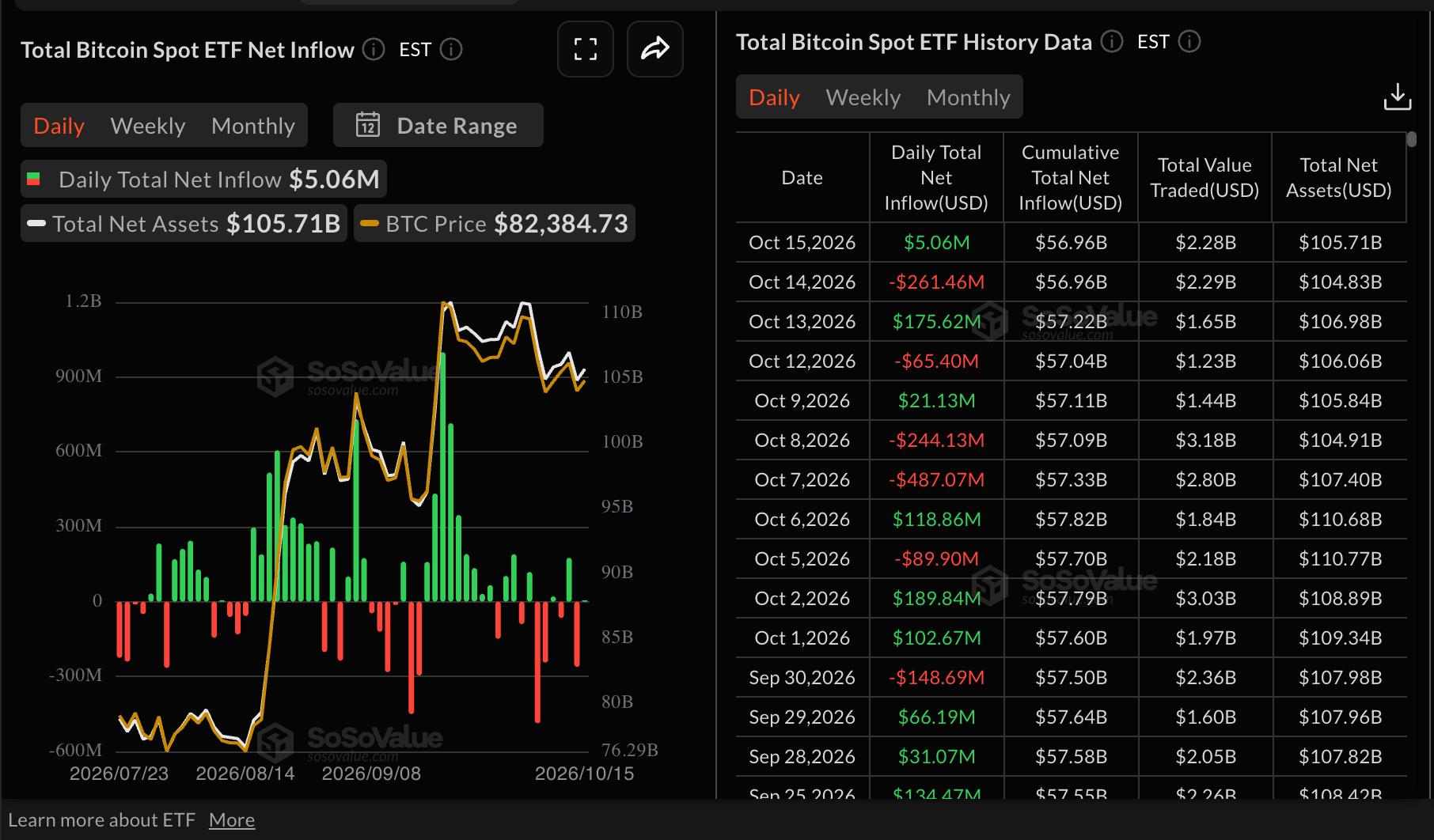
Appetite for digital assets remains on the back seat as investors appear to reassess their positioning and risk exposure. Bitcoin spot Exchange-Traded Funds (ETFs) recorded very mild inflows of $5 million on Thursday after logging $261 million in outflows the day before. If the crypto market outlook improves in the short term, a rebound in investor sentiment could boost ETF uptake and cushion against prevailing headwinds.
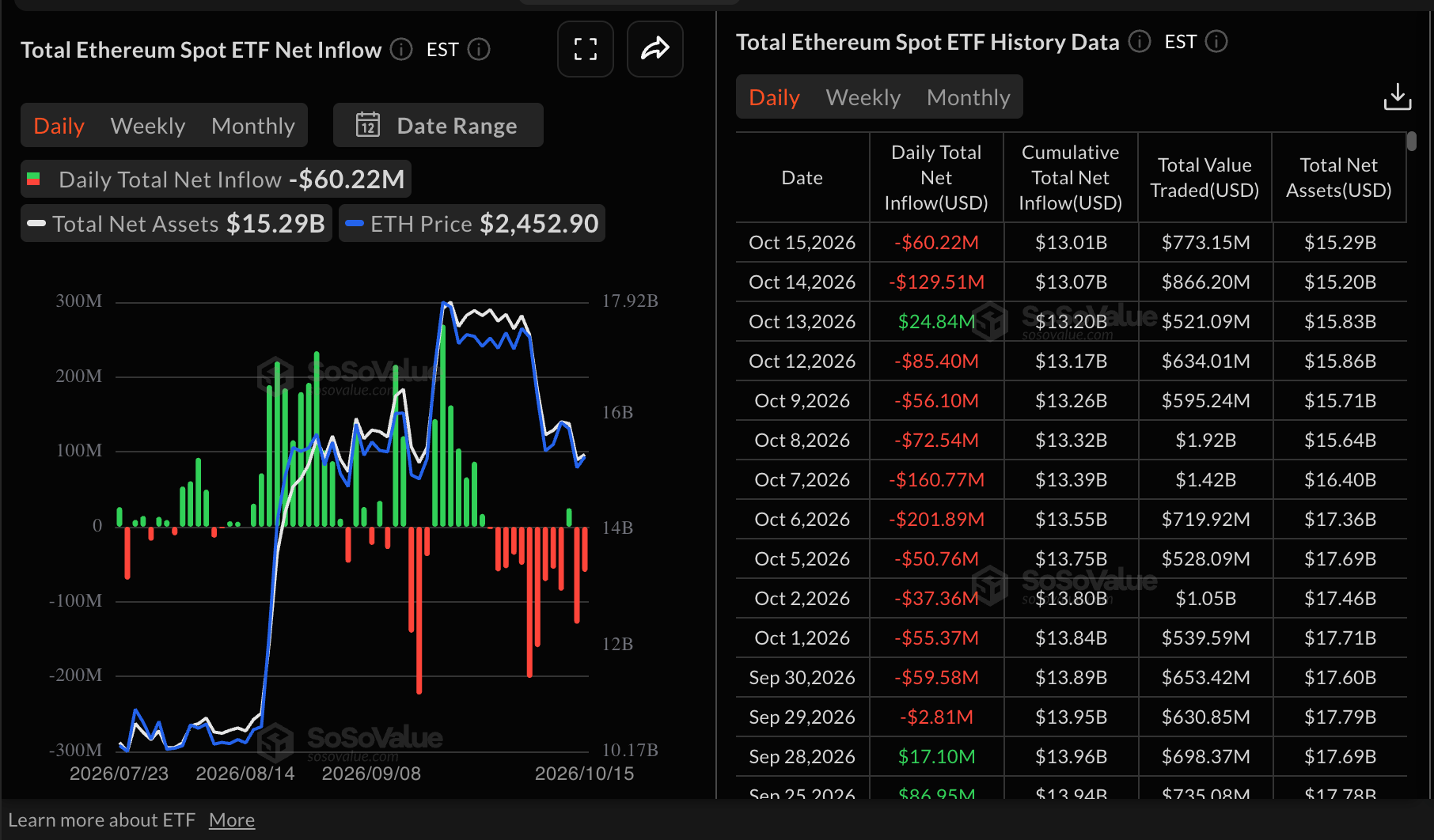
Ethereum spot ETFs extended the bearish streak for the second consecutive day, recording $60 million in outflows on Thursday and $129 million the previous day. Aside from Tuesday’s $25 million inflow outlier, ETH ETFs have persistently faced outflows since September 29. This suggests institutional interest remains low, weighing on price action.
XRP ETFs also recorded outflows, though very mild, at $105,000 on Thursday. This subtle return in inflows follows $740,000 in mild inflows, posted on Wednesday, according to SoSoValue. Moreover, broader activity has remained muted since last Friday, undermining institutional demand.
Technical analysis: Bitcoin bulls defend support
Bitcoin trades at $82,186, maintaining a bullish near-term bias as price extends above the 50-day, 100-day, and 200-day Exponential Moving Average (EMA) lines, with the 50-day EMA at $80,446 as the nearest dynamic floor. The SuperTrend indicator at $79,663 also sits below spot, reinforcing an underlying demand zone, while the Relative Strength Index (RSI) around 49 suggests neutral momentum and the Moving Average Convergence Divergence (MACD) remains slightly negative, hinting that upside progress may be more of a grind than a surge.
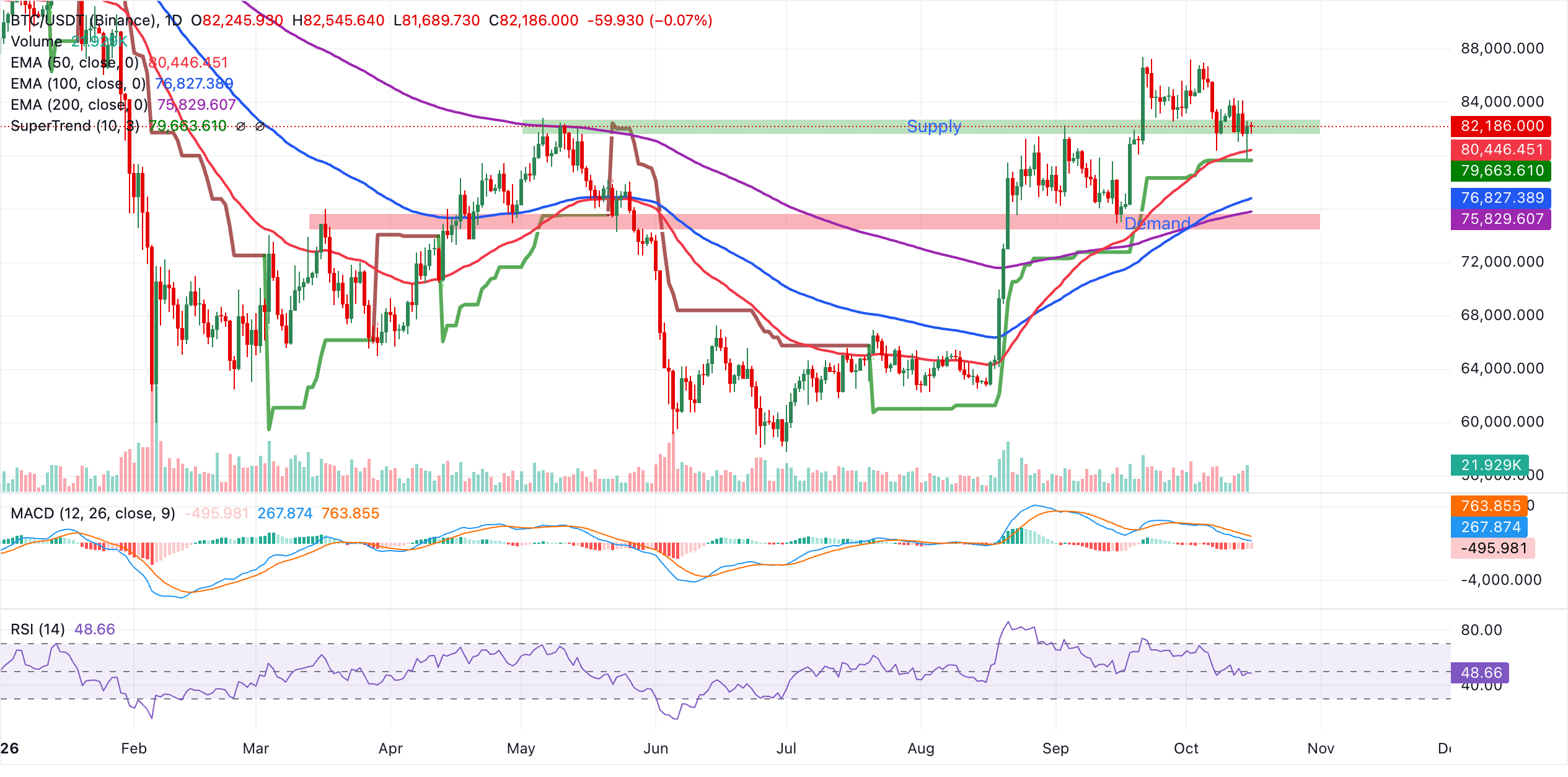
Initial support is seen at the 50-day EMA at $80,446, followed by the SuperTrend line at $79,664, which together define the first technical cushion in any pullback. Deeper declines would expose the 100-day EMA near $76,827 and then the longer-term 200-day EMA at $75,830, levels that should act as broader trend supports as long as BTC continues to trade above them on a closing basis.
Altcoins technical outlook: Ethereum and XRP eye short-term recovery
Ethereum trades at $2,455, consolidating between nearby trend supports and overhead resistance. Price holds above the 100-day and 200-day EMAs at $2,358 and $2,304, suggesting underlying demand still cushions the recent pullback, yet it remains below the 50-day EMA at $2,494 and the SuperTrend line at $2,693, capping topside for now.
The MACD stays in negative territory with a subdued histogram, while the RSI around 41 hints at soft momentum rather than aggressive selling, reinforcing a neutral, range-bound near-term bias.
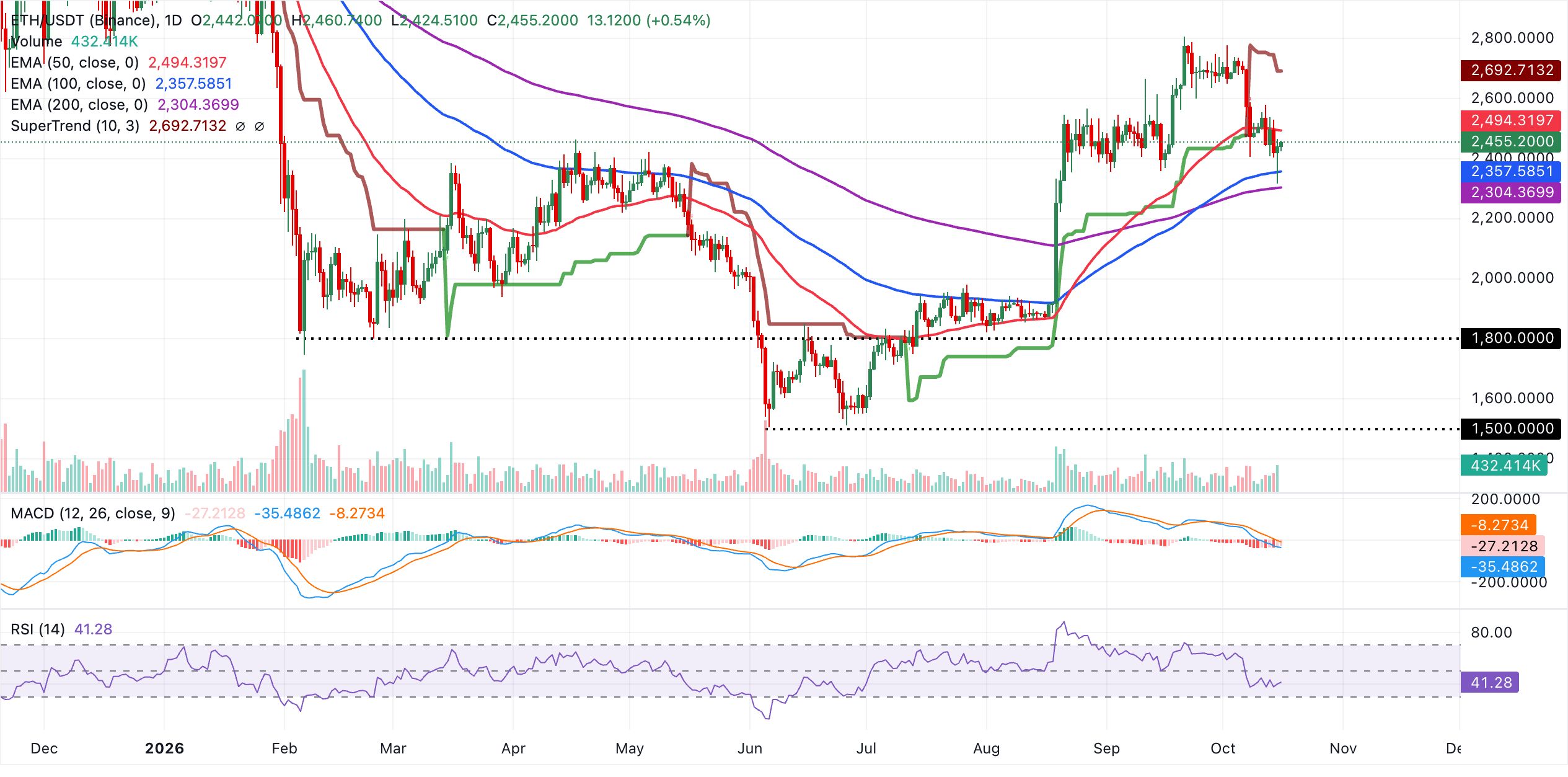
Immediate resistance emerges at the 50-day EMA near $2,494, where a sustained break would open the way toward the SuperTrend barrier at $2,693 as the next objective. On the downside, initial support is at the 100-day EMA at $2,358, followed by the 200-day EMA at $2,304. A daily close below this latter floor would considerably weaken the broader structure and tilt the bias more decisively toward sellers.
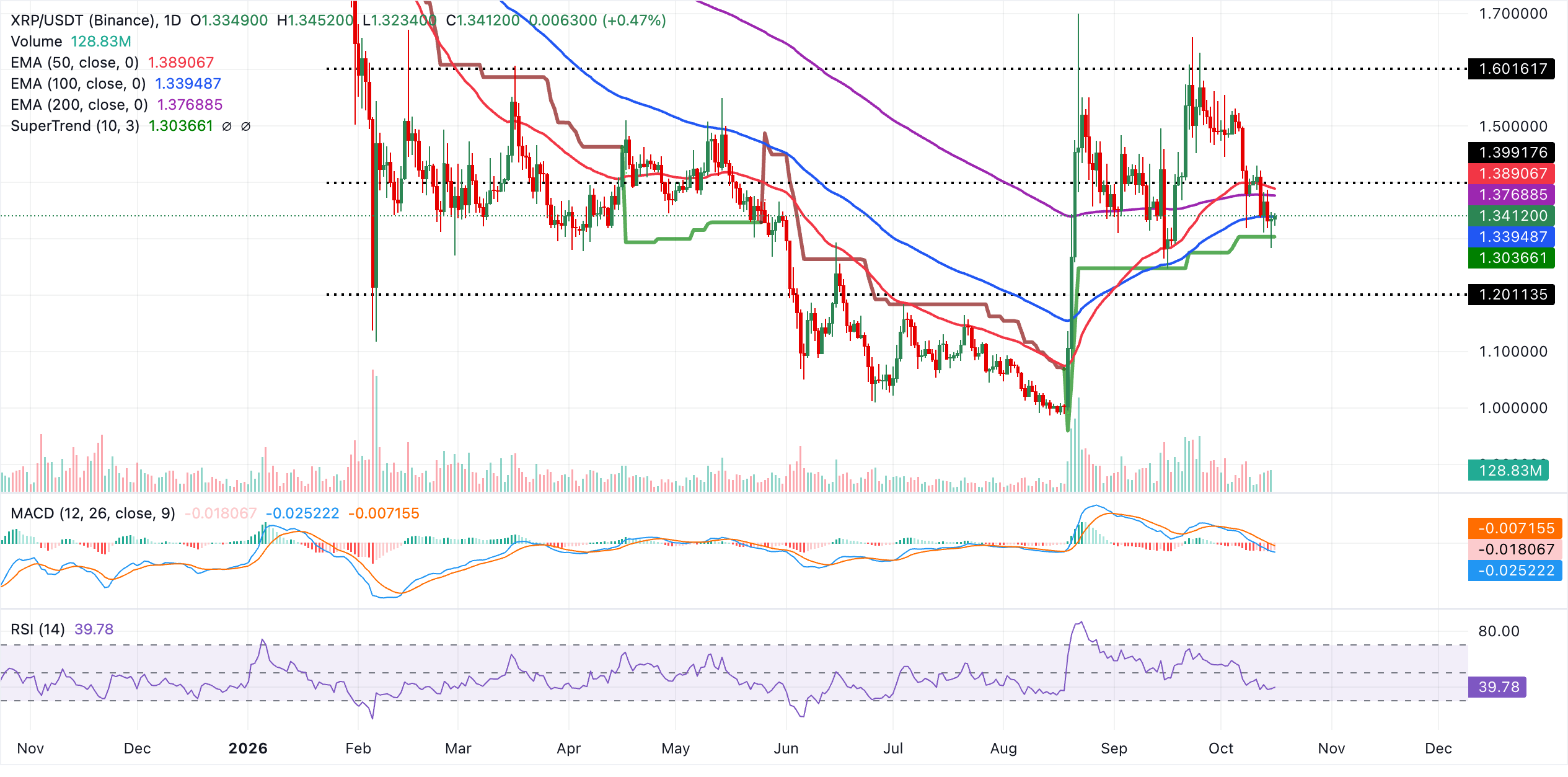
XRP, meanwhile, trades at $1.34, maintaining a mildly bearish near-term tone as price holds just above the 100-day EMA at $1.34 but remains capped by a dense band of longer-term overhead resistance. The 200-day EMA at $1.38 and the 50-day EMA at $1.39 sit well above spot, suggesting the broader trend remains vulnerable to downside risk, while the MACD stays below zero and the RSI stays near 40, both reinforcing waning bullish momentum.
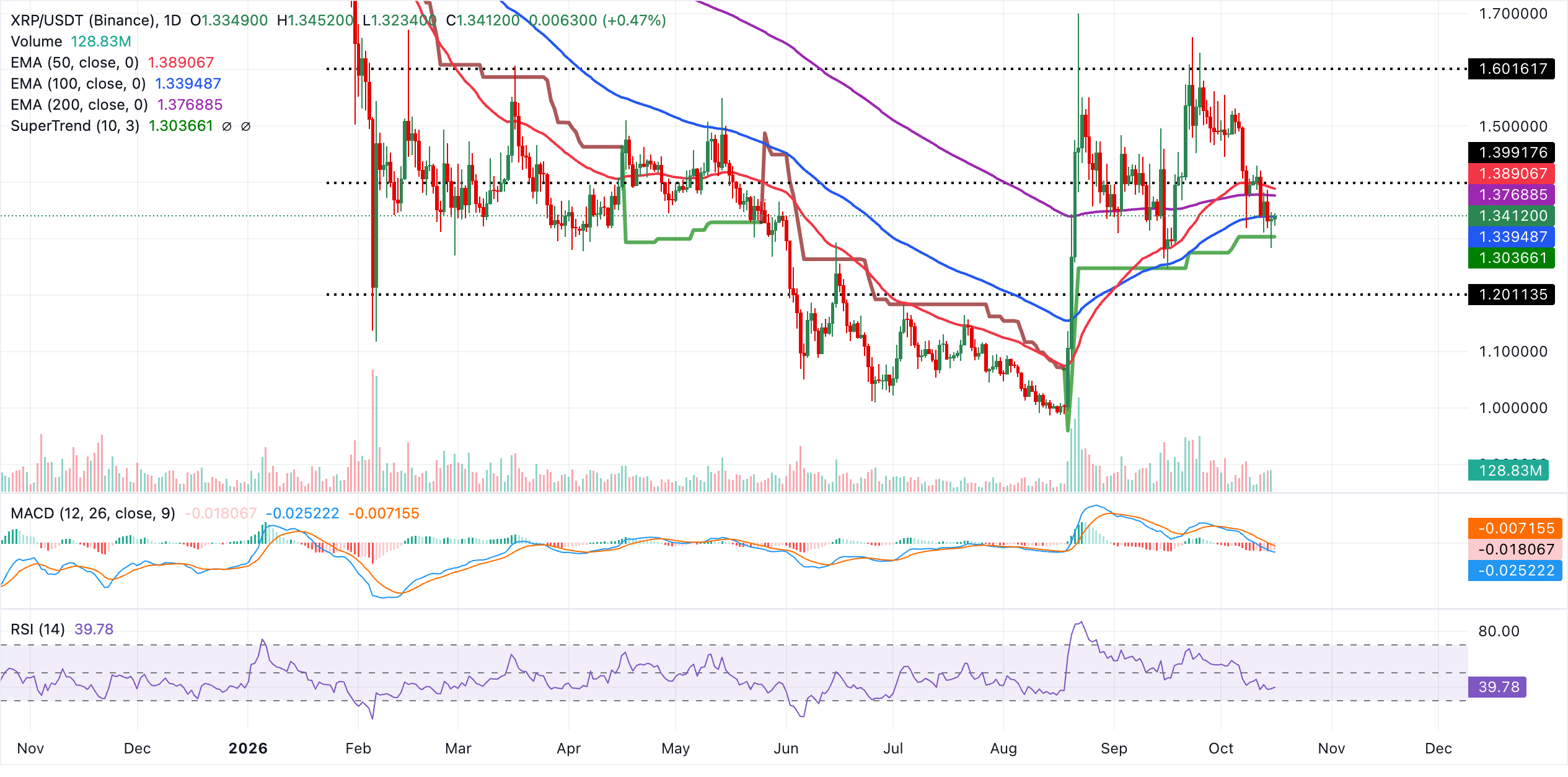
Immediate support is the 100-day EMA at $1.34, and a sustained break back below this floor would likely trigger further retracement toward lower daily levels not yet highlighted by the current indicator set. On the topside, XRP would need to reclaim the 200-day EMA at $1.38 first, with the 50-day EMA at $1.39 poised as the next significant barrier, and only a daily close above this cluster would start to ease the prevailing bearish bias.
(The technical analysis of this story was written with the help of an AI tool. Know more.)
Crypto ETF FAQs
An Exchange-Traded Fund (ETF) is an investment vehicle or an index that tracks the price of an underlying asset. ETFs can not only track a single asset, but a group of assets and sectors. For example, a Bitcoin ETF tracks Bitcoin’s price. ETF is a tool used by investors to gain exposure to a certain asset.
Yes. The first Bitcoin futures ETF in the US was approved by the US Securities & Exchange Commission in October 2021. A total of seven Bitcoin futures ETFs have been approved, with more than 20 still waiting for the regulator’s permission. The SEC says that the cryptocurrency industry is new and subject to manipulation, which is why it has been delaying crypto-related futures ETFs for the last few years.
Yes. The SEC approved in January 2024 the listing and trading of several Bitcoin spot Exchange-Traded Funds, opening the door to institutional capital and mainstream investors to trade the main crypto currency. The decision was hailed by the industry as a game changer.
The main advantage of crypto ETFs is the possibility of gaining exposure to a cryptocurrency without ownership, reducing the risk and cost of holding the asset. Other pros are a lower learning curve and higher security for investors since ETFs take charge of securing the underlying asset holdings. As for the main drawbacks, the main one is that as an investor you can’t have direct ownership of the asset, or, as they say in crypto, “not your keys, not your coins.” Other disadvantages are higher costs associated with holding crypto since ETFs charge fees for active management. Finally, even though investing in ETFs reduces the risk of holding an asset, price swings in the underlying cryptocurrency are likely to be reflected in the investment vehicle too.
BÀI VIẾT PHỔ BIẾN
1Bitcoin Weekly Forecast: Macroeconomic headwinds, cooling demand cap BTC gains2Euro: Dollar drivers stay dominant on price movement – Nordea3WTI holds weekly gains near $96 amid risk premium to oil prices4Oil: Gradual price decline with dark transit support – Commerzbank5US Dollar: Flatter curve supports currency – ING6Experts agree: US Dollar might have reached a top with the AI bubble teetering7Gold holds firm but struggles to build momentum as Fed rate-hike risks linger8Crypto Today: Bitcoin, Ethereum and XRP pare losses amid fading institutional support9Indian Rupee: Policy support and yield reversal – Societe Generale
GIÁ TRỰC TIẾP


Bắt đầu ngay!
Đăng ký và truy cập Thị trường Toàn cầu trong vòng chưa đầy 3 phút

Kết nối với chúng tôi









Liên hệ
Điện thoại: +61 2 8036 8388
Fax: +61 2 8036 8388
Email: support@tmgm.com
Website: https://www.tmg-max.com



Thông tin được cung cấp trên trang web này chỉ mang tính chất chung và không cấu thành lời khuyên tài chính cá nhân. Trước khi hành động dựa trên bất kỳ thông tin nào trên trang web này, bạn nên cân nhắc mức độ phù hợp của thông tin đó với mục tiêu, tình hình tài chính và nhu cầu của mình. Đầu tư vào CFD và Hợp đồng Ký quỹ FX tiềm ẩn rủi ro đáng kể và không phù hợp với tất cả nhà đầu tư. Bạn có thể mất nhiều hơn khoản tiền nạp ban đầu của mình. Bạn không sở hữu hoặc có bất kỳ quyền lợi nào đối với tài sản cơ sở. Chúng tôi khuyến nghị bạn tìm kiếm tư vấn độc lập và đảm bảo rằng bạn hiểu đầy đủ các rủi ro liên quan trước khi giao dịch. Điều quan trọng là bạn phải đọc và cân nhắc tài liệu công bố thông tin trước khi mua bất kỳ sản phẩm nào được liệt kê trên trang web. Thông tin và quảng cáo được cung cấp trên trang web này không nhằm mục đích sử dụng bởi bất kỳ cá nhân nào tại bất kỳ quốc gia hoặc khu vực pháp lý nào mà việc sử dụng đó sẽ trái với luật pháp và quy định địa phương. Các Sản phẩm và Dịch vụ được cung cấp trên trang web này không dành cho cư dân Hoa Kỳ, Malaysia và Thái Lan.
TMGM được ủy quyền và quản lý tại nhiều khu vực pháp lý khác nhau.
Trademax Australia Limited, giao dịch dưới tên TMGM, được quản lý bởi Ủy ban Chứng khoán và Đầu tư Úc (ASIC), AFSL số 436416 và có trụ sở tại Tầng 28, One International Tower, 100 Barangaroo Avenue, 2000 Sydney, NSW Australia.
Email: support@tmgm.com.au
Trademax Global Limited, giao dịch dưới tên TMGM, được ủy quyền và quản lý bởi Ủy ban Dịch vụ Tài chính Vanuatu (VFSC), số đăng ký 40356 và được đăng ký tại 1276, Kumul Highway, Port Vila, Vanuatu, Cộng hòa Vanuatu.
Email: support@tmgm.com
Trademax Global Markets (SE) Limited, hoạt động dưới tên TMGM, được ủy quyền và điều chỉnh bởi Cơ quan Dịch vụ Tài chính (FSA) của Seychelles, với số giấy phép SD224. Công ty đăng ký tại Văn phòng số 13, Providence Estate ABIS Centre, Mahe, Seychelles.
Email: support@tmgm.com
Trademax Global Markets (International) Pty Ltd, giao dịch dưới tên TMGM, được ủy quyền và quản lý bởi Ủy ban Dịch vụ Tài chính, Mauritius (FSC) với giấy phép số GB22201012, và được đăng ký tại 33, Edith Cavell Street C/o IQ EQ Fund Services (Mauritius) Ltd Port Louis, 11324 Mauritius.
Email: support@tmgm.com
Bản quyền © TMGM. Tất cả quyền được bảo lưu