
News & AnalysisCareer

Above $81,000 again on Wednesday, Bitcoin (BTC) is extending its advance and bolstering sentiment across cryptocurrencies as markets await the Federal Reserve’s (Fed) next interest rate decision.
Following Bitcoin higher, Ethereum (ETH) is approaching $2,400, with bullish investors appearing to add to their exposure. Improving momentum indicators are also supporting Ripple (XRP), which is inching higher above $1.33.

Against a backdrop of heightened inflation worries and high oil and energy prices, the Federal Open Market Committee (FOMC) is due to deliver its interest rate decision later on Wednesday. Persistent geopolitical tensions in the Middle East remain part of that backdrop.
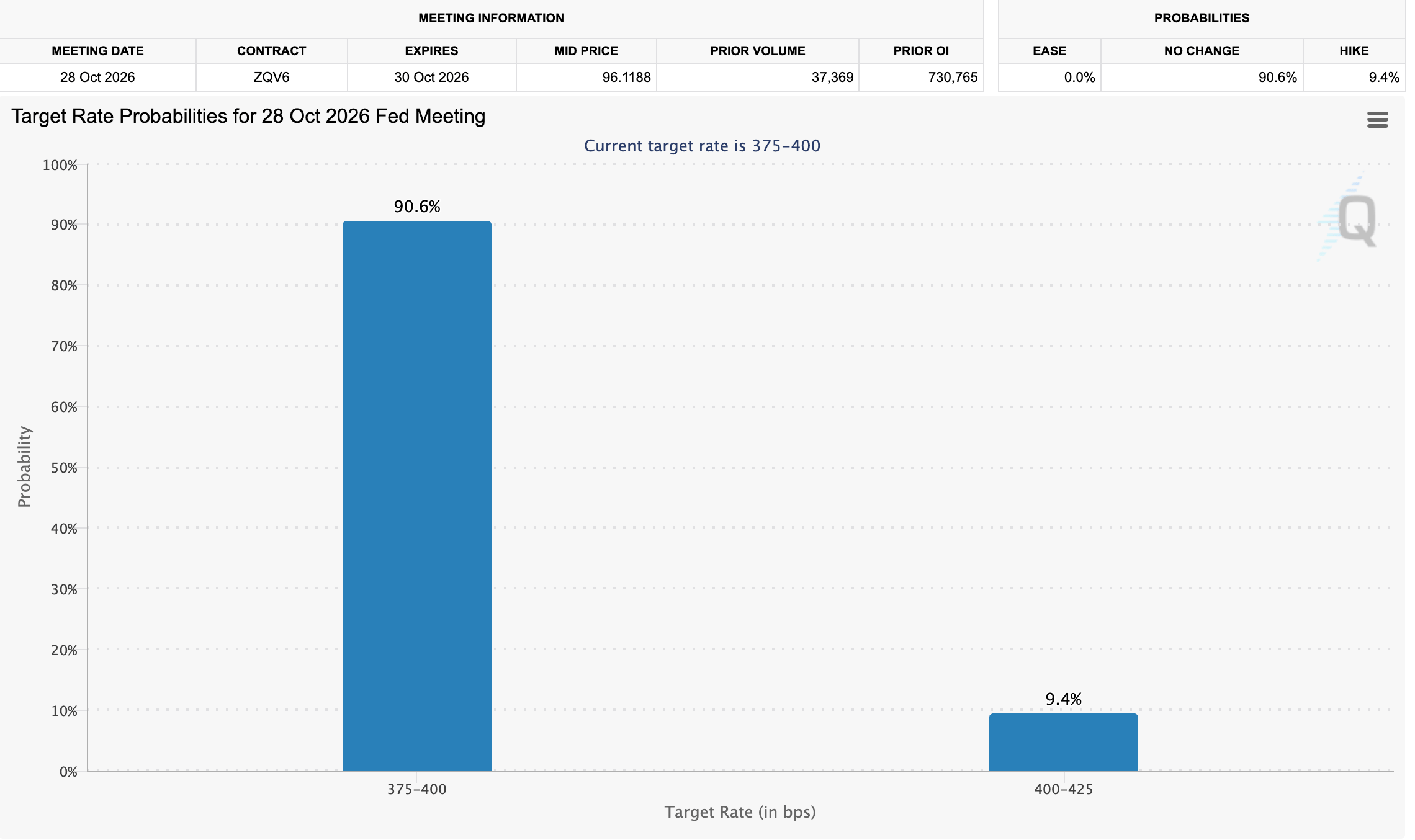
CME’s FedWatch Tool puts the probability of unchanged interest rates at 91%, in line with widespread expectations of a hold. Attention will therefore centre on Fed Chair Kevin Warsh's press conference after the meeting, where traders will look for indications of the policy outlook.
Inflation remains above the 2% long-term target, leaving persistent price pressures among the Fed’s main challenges. Warsh has repeatedly stressed the regulator’s resolve to lower inflation, although the US economy continues to show resilience.
In emailed commentary, Ian Weisberger, Co-founder and CEO of CoinRoutes, said: “This is a nervy week for crypto. In the space of three days, traders face a Fed rate decision, results from the biggest tech companies in the world, and around $12 billion worth of bitcoin bets expiring on Friday,” adding, “Then the US midterms land next Tuesday.”
At $81,494, Bitcoin is consolidating within the upper half of its recent Bollinger Bands envelope, leaving the short-term outlook broadly neutral. Underlying support comes from the 50-day Exponential Moving Average (EMA) at $80,831, above which the price is holding. However, trading just below the Bollinger middle band at $81,941 points to only tentative upward momentum.
Bullish pressure has yet to take the upper hand: the Relative Strength Index (RSI) stands near its neutral line at 48, and the Moving Average Convergence Divergence (MACD) remains below zero.
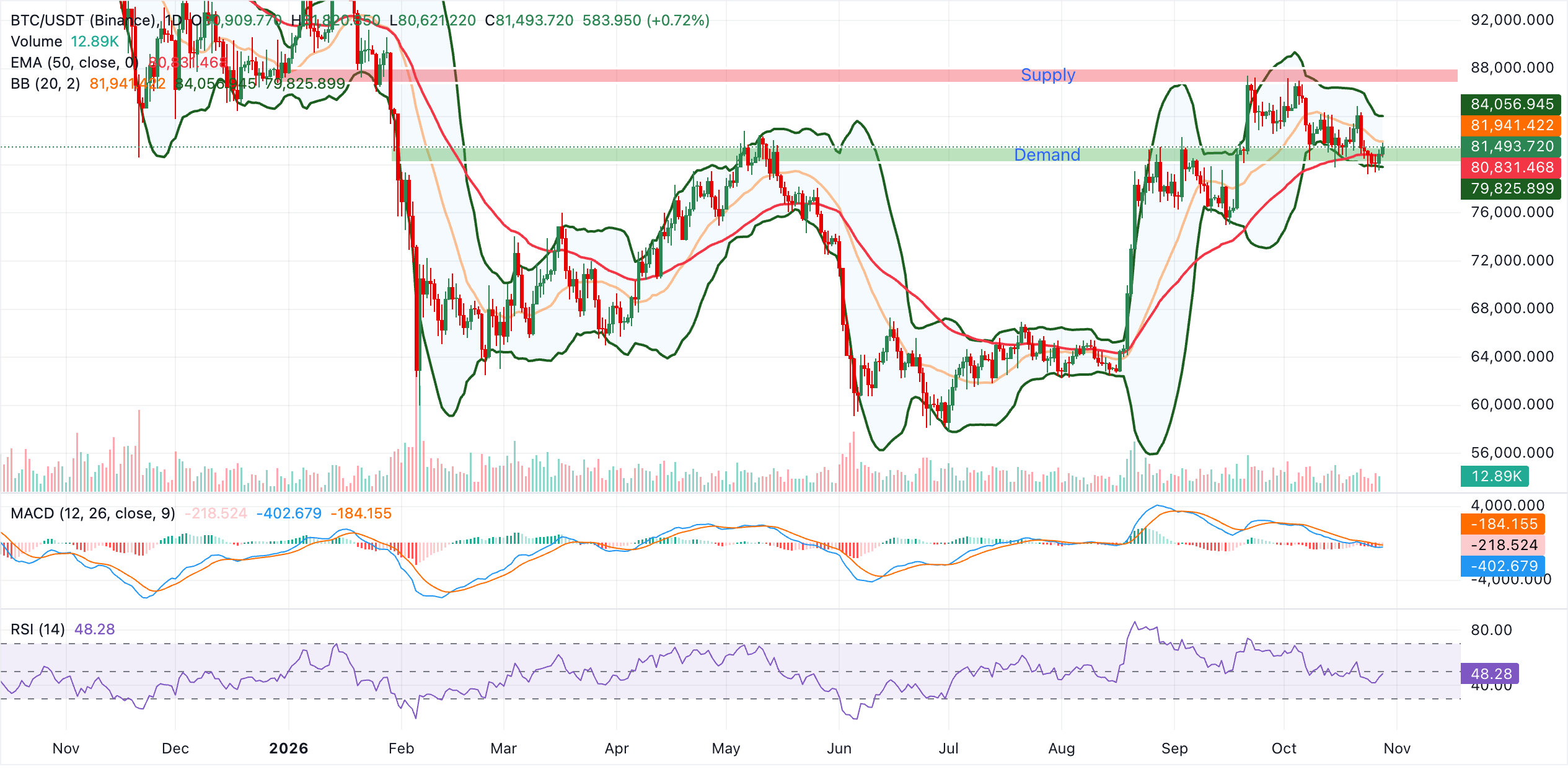
Around $81,941, the Bollinger middle band provides the first resistance level. A sustained move above it would bring the upper Bollinger band near $84,056 into focus as the next obstacle. Support is initially provided by the 50-day EMA around $80,831. Should the pullback deepen, attention would turn to the lower Bollinger band near $79,826, where buyers would be expected to show firmer interest if the consolidation gives way to a downward move.
A second successive day of gains has taken Ethereum to $2,374, though the bias remains cautiously bearish. Its spot price is still beneath both the Bollinger middle band around $2,421 and the 50-day EMA near $2,452.
Despite that broader weakness, sellers have not secured full control. The pair remains just above a rising support trendline near $2,369 and clear of the lower Bollinger Band at roughly $2,305.
With the RSI near 41, bullish conviction remains limited. The MACD is still negative, but its narrowing negative readings indicate that bearish momentum is beginning to ease rather than gather pace.
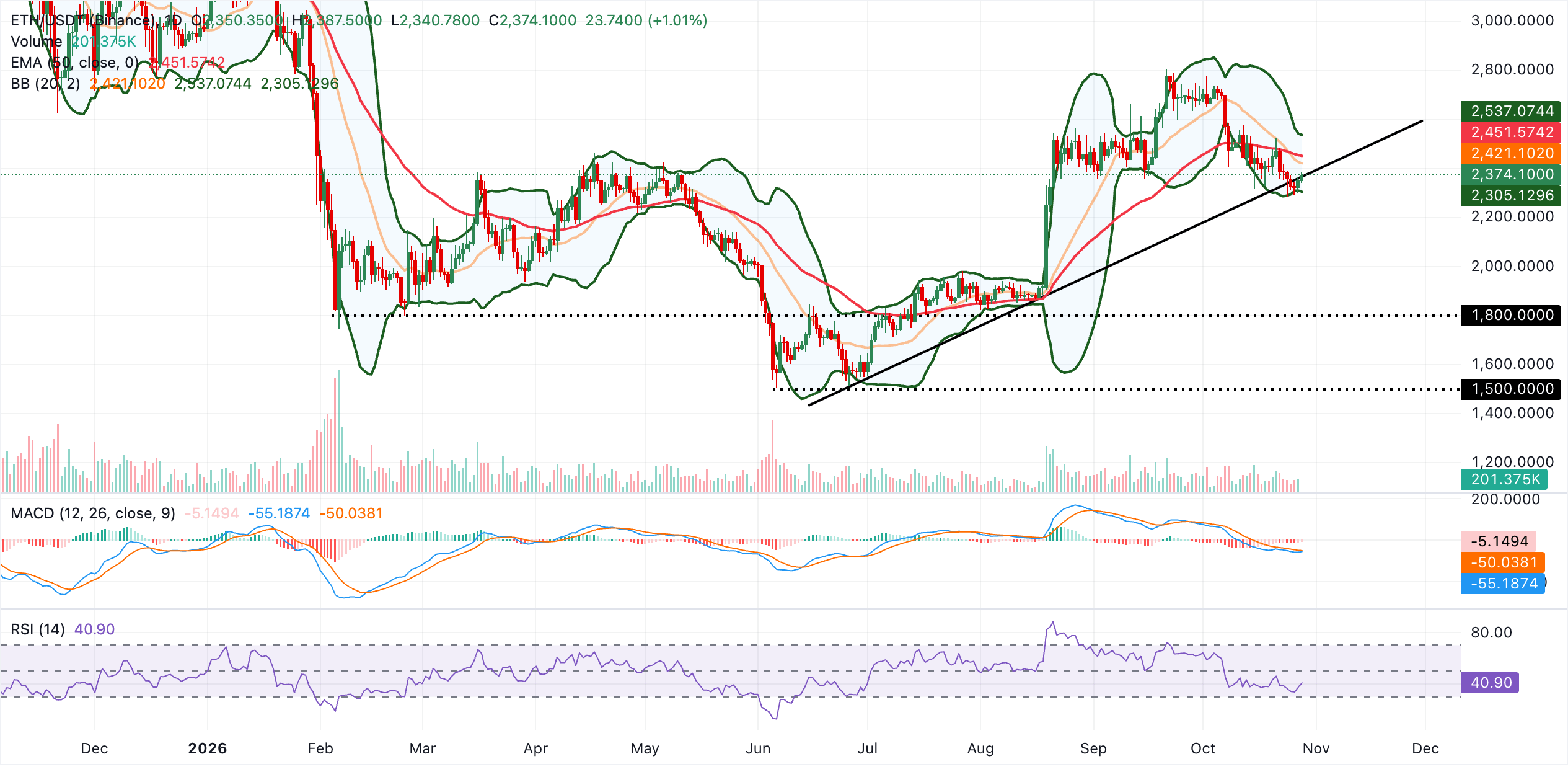
The Bollinger Band middle line around $2,421 presents the first resistance, and only a sustained break above it would clear a path towards the 50-day EMA near $2,452. Further up, rallies could run into a more demanding hurdle at the upper Bollinger Band around $2,537. Initial support sits in the reclaimed trendline area near $2,369, followed by the lower Bollinger Band around $2,305. A daily close beneath that latter support would likely leave ETH vulnerable to a deeper correction.
Trading above $1.33, XRP is seeing bulls strengthen their position in an effort to regain control of the trend. Near-term progress is nevertheless constrained: the price remains just beneath the 20-day Bollinger middle band around $1.33 and below the 50-day EMA near $1.36. As a result, the broader bias is still mildly bearish, even with a slightly positive MACD reading.
At around 46, the RSI points to momentum lacking a clear direction, favouring consolidation over a forceful breakout. Meanwhile, the established descending resistance trendline, projected from above $1.70, remains the dominant feature of the medium-term structure.
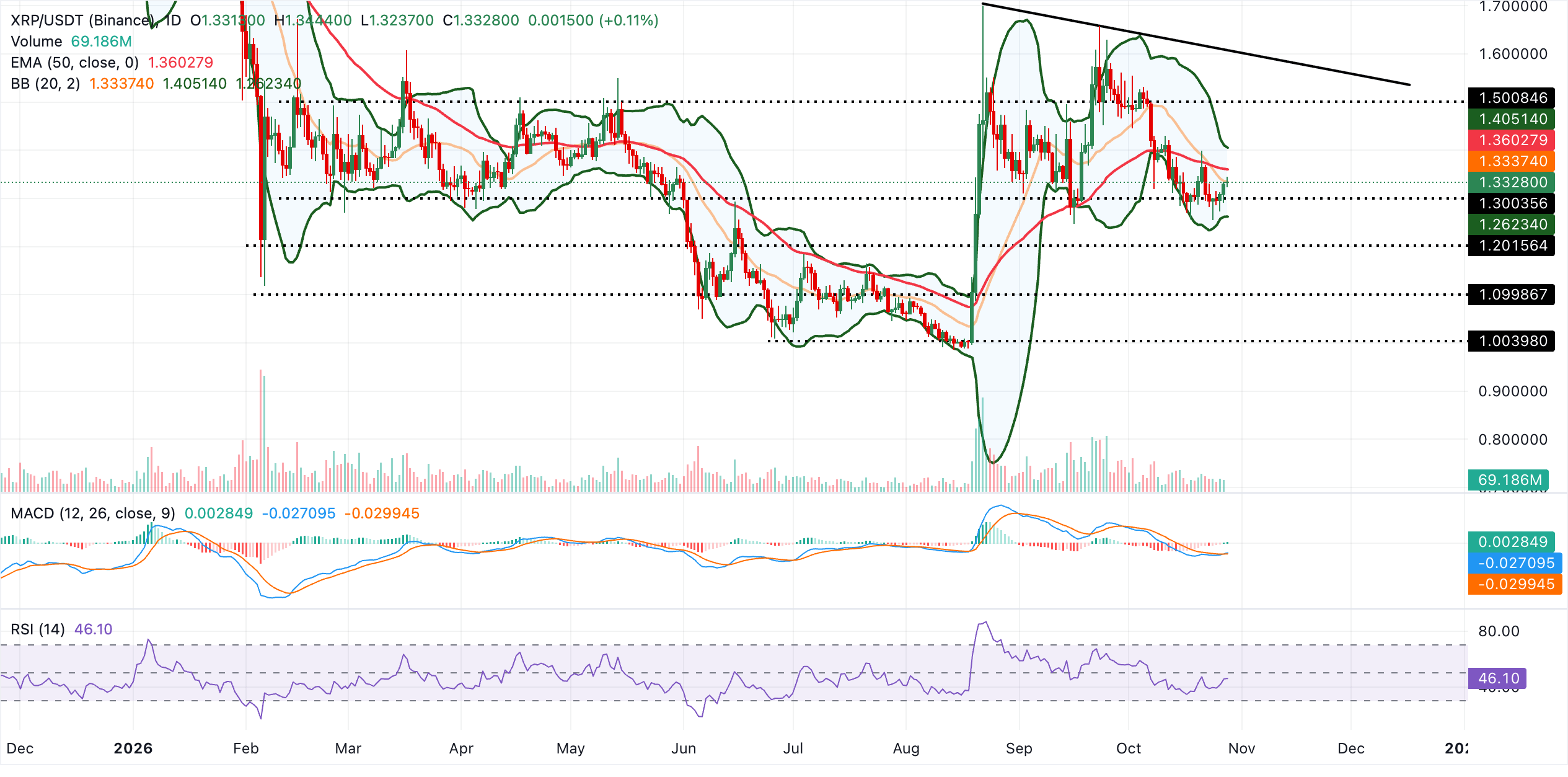
At $1.33, the Bollinger middle band is the first resistance to overcome. A daily close above that pivot would bring the 50-day EMA near $1.36 into view, with the upper Bollinger band around $1.41 the subsequent bullish objective. The lower Bollinger band near $1.26 provides the first significant technical support. Losing that level would likely revive selling pressure and open the way for a deeper retracement within the prevailing downward channel defined by the descending resistance line.
(The technical analysis of this story was written with the help of an AI tool. Know more.)
Designed to function as money, Bitcoin is a virtual currency and the largest cryptocurrency by market capitalisation. No single person, group or entity can control this means of payment, removing the need for third parties to participate in financial transactions.
The term altcoin covers any cryptocurrency other than Bitcoin. Some also exclude Ethereum, however, on the grounds that forks originate from these two cryptocurrencies. On that basis, Litecoin is the first altcoin: it was forked from the Bitcoin protocol and is therefore an “improved” version of it.
By backing their value with a reserve of the asset they represent, stablecoins aim to maintain a stable price. Each stablecoin is pegged to a commodity or financial instrument, such as the US Dollar (USD), while an algorithm or demand regulates its supply. Their primary purpose is to offer a route into and out of cryptocurrencies for investors seeking to trade and invest in them. Given the volatility generally associated with cryptocurrencies, stablecoins also enable investors to store value.
Measured as Bitcoin's market capitalisation divided by the combined market capitalisation of all cryptocurrencies, Bitcoin dominance offers a clear indication of investor interest in Bitcoin. BTC dominance is typically high ahead of and during a bull run, as investors turn to relatively stable cryptocurrencies with large market capitalisations, such as Bitcoin. When BTC dominance falls, it usually signals that investors are shifting capital and/or profits into altcoins in pursuit of higher returns. This generally sparks a surge in altcoin rallies.







Phone: +61 2 8036 8388
Fax: +61 2 8036 8388
Email: support@tmgm.com



The information provided on this website is of a general nature only and does not constitute personal financial advice. Before acting on any information on this website, you should consider the suitability of the information in relation to your objectives, financial situation and needs. Investing in CFDs and FX Margin Contracts carries significant risks and is not suitable for all investors. You may lose more than your initial deposit. You do not own, or have, any interest in the underlying asset. We recommend that you seek independent advice and ensure you fully understand the risks involved before trading. It is important that you read and consider the disclosure document before you acquire any product listed on the website. The information and advertisements offered on this website are not intended for use by any person in any country or jurisdiction where such use would be contrary to local laws and regulations. The Products and Services offered on this website are not intended for residents of the United States, Malaysia and Thailand.
TMGM is authorized and regulated in various jurisdictions.
Trademax Australia Limited, trading as TMGM, is regulated by the Australian Securities and Investments Commission (ASIC), AFSL no. 436416 and is located at Level 28, One International Tower, 100 Barangaroo Avenue, 2000 Sydney, NSW Australia.
Email: support@tmgm.com.au
Trademax Global Limited, trading as TMGM, is authorized and regulated by the Vanuatu Financial Services Commission (VFSC), registration number 40356 and registered at 1276, Kumul Highway, Port Vila, Vanuatu, Republic of Vanuatu.
Email: support@tmgm.com
Trademax Global Markets (SE) Limited, trading as TMGM, is authorized and regulated by the Financial Services Authority (FSA) of Seychelles, with license number SD224. The company is registered at Office No 13, Providence Estate ABIS Centre, Mahe, Seychelles.
Email: support@tmgm.com
Trademax Global Markets (International) Pty Ltd, trading as TMGM, is authorized and regulated by the Financial Services Commission, Mauritius (FSC) with license no. GB22201012, and registered at 33, Edith Cavell Street C/o IQ EQ Fund Services (Mauritius) Ltd Port Louis, 11324 Mauritius.
Email: support@tmgm.com
Copyright © TMGM. All rights reserved

