

Trading
Explore a wide range of markets with competitive pricing, deep liquidity, and advanced trading tools.
Learn More 
Platform
Trade seamlessly with TMGM's powerful platform, built for speed, precision, and a superior trading experience.
Learn More Trading Platform
Academy
Learn the fundamentals of trading with beginner-friendly resources, including guides, webinars, and market insights.
Learn More News & Analysis
Get real-time market updates and expert analysis to stay ahead of trading opportunities
Learn More News & Analysis
About
Learn what sets TMGM apart — our global presence, regulatory strength, and commitment to innovation in trading.
Learn More Why Choose TMGM
Sponsorship
Bitcoin Price Forecast: Why is BTC holding below $80,000 with Middle East tensions and tech earnings in focus?
- Bitcoin remains under pressure below $80,000 on Tuesday after the previous session failed to deliver a close above the 50-day EMA near $80,765.
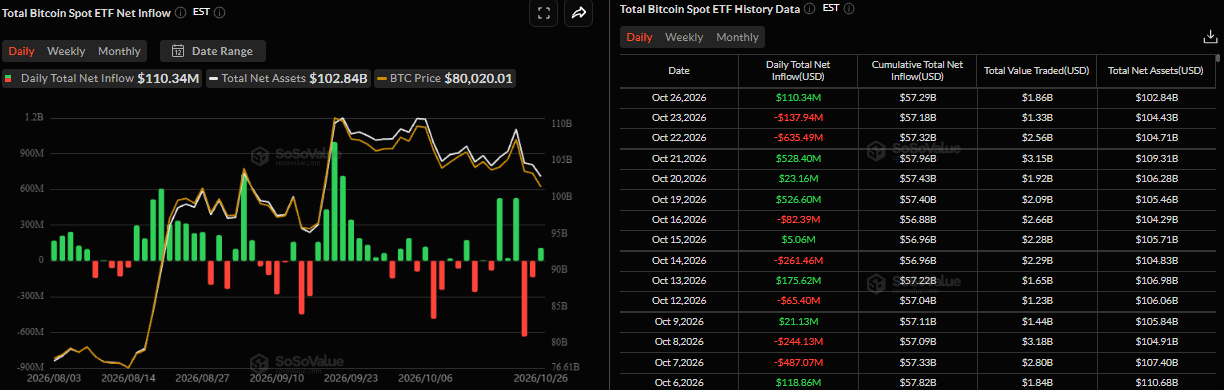
- Institutional buying was mixed: spot BTC ETFs attracted modest inflows of $110.34 million on Monday, while last week saw no BTC purchases by Strategy and an addition of 6,182 BTC by Strive.
- BTC’s next move is likely to be driven by forthcoming hyperscaler earnings and developments in the Middle East, according to QCP Capital.
Bitcoin (BTC) remains below $80,000 at the time of writing on Tuesday, with the previous session’s failure to close above a key resistance zone weighing on price action.
Institutional buying presented a mixed picture. Modest inflows entered US-listed spot Bitcoin Exchange-Traded Funds (ETFs) on Monday; last week, Strategy (MSTR) suspended Bitcoin purchases, whereas Strive (ASST) acquired 6,182 BTC. For the Crypto King’s next directional move, QCP Capital points to forthcoming hyperscaler earnings and developments in the Middle East as likely drivers.
Can modest institutional buying support Bitcoin?
A mildly positive start to the week for institutional demand has yet to translate into a price recovery. According to SoSoValue, spot Bitcoin ETFs attracted $110.34 million on Monday, following net inflows of $301.2 million last week that ended two consecutive weeks of outflows. Monday’s modest inflows were insufficient to lift BTC, although a recovery could follow if inflows persist and gather strength during the week.
In a Monday post on X, Lookonchain reported that Strive purchased 6,182 BTC last week, whereas Strategy bought none. After several weeks of purchases, Strategy’s decision to step back signals a change in institutional accumulation, even as Strive increases its buying. Continued accumulation by Strive could absorb some selling pressure and lend BTC a degree of support.
Which catalysts could determine Bitcoin’s next move?
Forthcoming hyperscaler earnings and developments in the Middle East are likely to matter more for Bitcoin’s next directional move than the Federal Open Market Committee (FOMC) meeting outcome, QCP Capital said in its Monday report. The meeting is scheduled for 27–28 October.
Wednesday brings Q3 earnings from Microsoft and Alphabet, with Amazon following on Thursday. QCP Capital says concerns about hyperscaler valuations could subside if the results support continued heavy spending on Artificial Intelligence (AI). Disappointing earnings, by contrast, could prolong the current AI-driven market sell-off.
The analyst also noted: “Oil is the second driver. The US cut staff at Middle East embassies over the weekend, and US President Donald Trump said a strike on Iran could come as early as Sunday before ruling it out,”
For this week, QCP Capital presented three possible Bitcoin scenarios. Its base case envisages the Federal Reserve (Fed) leaving rates unchanged, with BTC trading within a $78,000 to $86,000 range.
In the bullish scenario, earnings alleviate concerns over AI capital expenditure, while Fed Chair Kevin Warsh softens the December signal and sends yields lower. This would allow BTC to regain the $80,000-$81,500 cost-basis band before advancing towards $86,000 and subsequently $88,000-$90,000.
The bearish scenario combines an escalation in the Middle East with either an unexpected rate increase or a press conference that locks in December. Under these conditions, 10-year US Treasury yields would rise back above 5%, pushing BTC below $78,000.
Bitcoin technical outlook: What do softer momentum indicators signal?
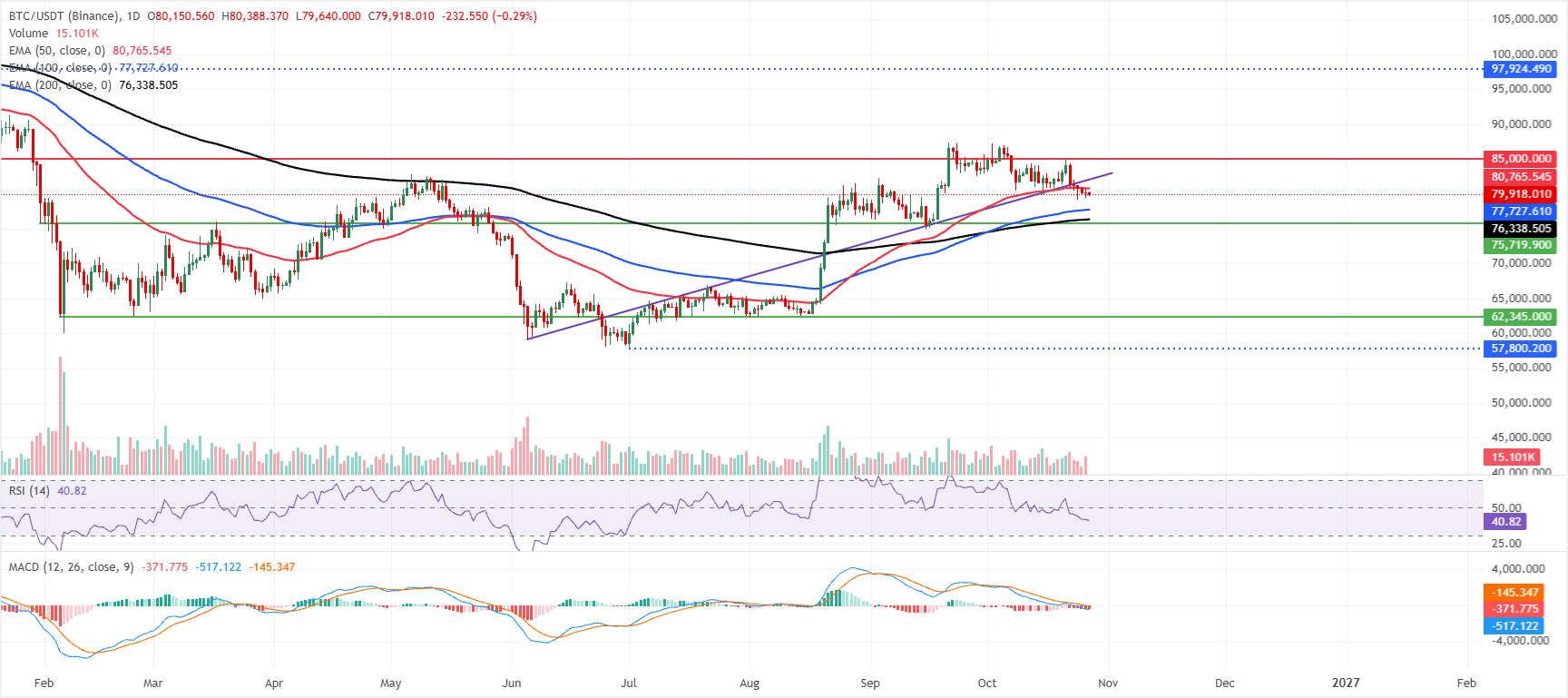
The near-term outlook for Bitcoin remains neutral to slightly bearish as Tuesday’s price of $79,918 consolidates just below the 50-day Exponential Moving Average (EMA) at $80,765, a dynamic resistance level. The medium-term picture remains constructive, however, as BTC holds above the 100-day and 200-day EMAs at $77,727 and $76,338, respectively.
Buyers’ difficulty in extending the earlier advance is reflected in subdued momentum readings. The Relative Strength Index (RSI) is near 41, while the Moving Average Convergence Divergence (MACD) remains below zero, indicating that bullish pressure is fading.
A daily close above immediate resistance at the 50-day EMA near $80,765 would clear the path towards the $85,000 horizontal barrier. Selling interest seen previously is likely to return around that level.
Initial downside support lies at the 100-day EMA of $77,727, ahead of the stronger structural floor around the 200-day EMA at $76,338. Losing the latter level would materially undermine the broader trend, leaving BTC vulnerable to a deeper correction.
(The technical analysis of this story was written with the help of an AI tool. Know more.)
FAQs on Bitcoin, altcoins and stablecoins
As the largest cryptocurrency by market capitalisation, Bitcoin is a virtual currency created to function as money. No single person, group or entity can control this payment method, removing the need for a third party to participate in financial transactions.
The term altcoin covers cryptocurrencies other than Bitcoin. Some also exclude Ethereum, however, because these two cryptocurrencies serve as the origins of forks. Under that interpretation, Litecoin is the first altcoin: it was forked from the Bitcoin protocol and is therefore an “improved” version of it.
Designed to keep their prices stable, stablecoins are cryptocurrencies backed by reserves of the assets they represent. Each stablecoin is pegged to a commodity or financial instrument, such as the US Dollar (USD), while an algorithm or demand regulates its supply. Their primary purpose is to offer investors a route into and out of cryptocurrency trading and investment. They also provide a way to store value, given the volatility generally associated with cryptocurrencies.
By comparing Bitcoin’s market capitalisation with the combined market capitalisation of all cryptocurrencies, Bitcoin dominance offers a clear measure of investor interest in BTC. Dominance is typically high before and during a bull run, when investors favour relatively stable cryptocurrencies with large market capitalisations, such as Bitcoin. Falling BTC dominance generally signals that investors are shifting capital and/or profits into altcoins in pursuit of higher returns, often setting off sharp altcoin rallies.
POPULAR ARTICLES
1Crypto Today: Can Bitcoin, Ethereum and XRP withstand mounting sell-side pressure?2Euro’s losing streak against US Dollar continues: What next for Fed-ECB policy?3US Dollar: How are AI equity risks putting pressure on the Greenback? – TD Securities4Japanese Yen: Could BoJ caution deepen losses against US Dollar? – MUFG5Top Altcoins Price Forecast: Why are Ripple, Cardano and Solana extending losses as selling pressure persists?6Bitcoin Price Forecast: Why is BTC holding below $80,000 with Middle East tensions and tech earnings in focus?7Australian Dollar: Is momentum fading near recent highs against US Dollar? – UOB8Silver price today: FXStreet data shows a decline in silver9Gold: What are the two-way risks near recent lows? – OCBC
LIVE QUOTES

ALL ABOUT TECHNICAL
What Do Reversal Patterns Tell You, and How Can You Trade Them?
How Does a Continuation Pattern Work? Definition, Types and Strategies for Trading
What Is a Breaker Block in Trading, and How Can You Trade It?
Elliott Wave Theory: How Do Traders Apply Its Patterns and Rules?
What Does Smart Money Concept (SMC) Mean, and How Can You Trade It?
What Is an Order Block in Trading and How Can You Trade It?
Average True Range (ATR) Indicator: What Is the Formula, and How Do You Read and Use It?
What Is a Judas Swing? ICT Trading Strategy Explained With Examples
The Real Interest Rate: Are Your Savings Actually Earning Anything?
Get Started!
Sign up and access the Global Markets in less than 3 minutes

Connect With Us









Contacts
Phone: +61 2 8036 8388
Fax: +61 2 8036 8388
Email: support@tmgm.com



The information provided on this website is of a general nature only and does not constitute personal financial advice. Before acting on any information on this website, you should consider the suitability of the information in relation to your objectives, financial situation and needs. Investing in CFDs and FX Margin Contracts carries significant risks and is not suitable for all investors. You may lose more than your initial deposit. You do not own, or have, any interest in the underlying asset. We recommend that you seek independent advice and ensure you fully understand the risks involved before trading. It is important that you read and consider the disclosure document before you acquire any product listed on the website. The information and advertisements offered on this website are not intended for use by any person in any country or jurisdiction where such use would be contrary to local laws and regulations. The Products and Services offered on this website are not intended for residents of the United States, Malaysia and Thailand.
TMGM is authorized and regulated in various jurisdictions.
Trademax Australia Limited, trading as TMGM, is regulated by the Australian Securities and Investments Commission (ASIC), AFSL no. 436416 and is located at Level 28, One International Tower, 100 Barangaroo Avenue, 2000 Sydney, NSW Australia.
Email: support@tmgm.com.au
Trademax Global Limited, trading as TMGM, is authorized and regulated by the Vanuatu Financial Services Commission (VFSC), registration number 40356 and registered at 1276, Kumul Highway, Port Vila, Vanuatu, Republic of Vanuatu.
Email: support@tmgm.com
Trademax Global Markets (SE) Limited, trading as TMGM, is authorized and regulated by the Financial Services Authority (FSA) of Seychelles, with license number SD224. The company is registered at Office No 13, Providence Estate ABIS Centre, Mahe, Seychelles.
Email: support@tmgm.com
Trademax Global Markets (International) Pty Ltd, trading as TMGM, is authorized and regulated by the Financial Services Commission, Mauritius (FSC) with license no. GB22201012, and registered at 33, Edith Cavell Street C/o IQ EQ Fund Services (Mauritius) Ltd Port Louis, 11324 Mauritius.
Email: support@tmgm.com
Copyright © TMGM. All rights reserved